CDR FINLEY E. HALL, USN
Lucky Bag Yearbook
From the 1929 Lucky Bag:
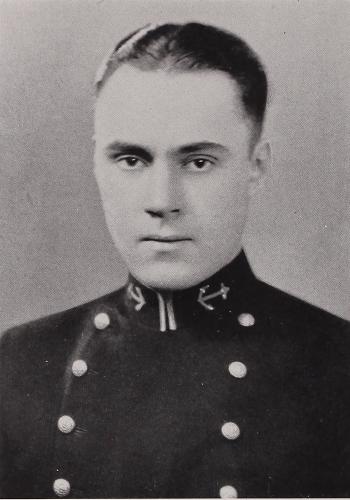
FINLEY ELLIOTT HALL
Baseball 4. Black N**. Hop Committee. Lucky Bag Assistant. Buzzard 2, 1.
AFTER brief sojourns at most of the prep schools in Dixie, “Pete” joined the Navy to settle down, bringing with him the jargon of the Mississippi swamps and a sense of the ludicrous that has helped to make many a tedious hour more bearable for us. He attains his best form in an argument, manipulating his monosyllabic, twenty-six word vocabulary with such convincing logic that he could persuade the devil himself to forsake the fiery regions for a better life, or sell refrigerators to the impoverished Esquimaux of the Bering Straits.
It took Plebe year to convince “FE” he was not ordained to be an athlete, Youngster year to show him the futility of the Radiator Club, and Second Class year for him to blossom out as the politician and committeeman for which fate intended him. Often unforseen circumstances kept him from social functions, but at those which he attended, he could always be found working his persuasive powers on some fair damsel, and usually with victorious results.
In this Southerner the traits of keenness of perception, contagious good humor, and unruffled front are incorporated in such a way that he goes to the fleet fully equipped to lead divisions to the acquisition of excellency trophies or landing forces into the mouths of cannons.
Loss
Finley was lost on November 24, 1943 when USS Liscome Bay (CVE 56) was torpedoed and sunk by a Japanese submarine. He was the ship’s executive officer.
Other Information
From researcher Kathy Franz:
Finley was appointed to the Naval Academy by Congressman John E. Rankin.
He married Jane Topp, also from Tupelo, and they had a daughter Mary and a son William. Both children were born in California. The family lived in Honolulu from 1934 through 1936.
He was promoted to lieutenant commander in November, 1941.
On September 6, 1942, Finley left Pearl Harbor for San Francisco. His address was listed as 737 Tolita Avenue, Coronado, California.
Finley’s brother William was awarded the Navy Cross in 1943 for shooting down a four-engined Japanese flying boat in the Solomon Islands.
Their father Finley was a retail grocery merchant in 1920 Tupelo. In 1910, the family lived in Frederick, Oklahoma, where his father was an agent for an express company.
On December 7, 1941 then-LT Hall was commanding officer of USS Swan (AM 34), which was in drydock in Pearl Harbor.
His wife was listed as next of kin. He has one memory marker in California and another in Mississippi.
Silver Star
From Hall of Valor:
The President of the United States of America takes pride in presenting the Silver Star (Posthumously) to Commander Finley Elliott Hall (NSN: 0-62532), United States Navy, for conspicuous gallantry and intrepidity as Executive Officer of the U.S.S. LISCOME BAY (CVE-56), during action against enemy Japanese forces off Makin Island, Gilbert Islands, on 24 November 1943. When his ship was struck by a hostile torpedo in the early morning darkness and left exploding and blazing, Commander Hall immediately and skillfully supervised the evacuation of personnel from his battle station in the radar plot and, completely disregarding his own safety in the face of continuous ammunition explosions, tremendous structural damage and raging fires, voluntarily remained aboard the rapidly sinking vessel in a gallant effort to search for other wounded and trapped shipmates. His great personal valor and self-sacrificing efforts under extreme perilous conditions were in keeping with the highest traditions of the United States Naval Service.
General Orders: Commander in Chief Pacific: Serial 02267 (June 2, 1944)
Service: Navy
Rank: Commander
Related Articles
Henry Mullinnix ‘16, Irving Wiltsie ‘21, Lester Kern ‘23, Charles Ostrom ‘30, and George Williams ‘40 were also lost in Liscome Bay.
Navy Directories & Officer Registers
The "Register of Commissioned and Warrant Officers of the United States Navy and Marine Corps" was published annually from 1815 through at least the 1970s; it provided rank, command or station, and occasionally billet until the beginning of World War II when command/station was no longer included. Scanned copies were reviewed and data entered from the mid-1840s through 1922, when more-frequent Navy Directories were available.
The Navy Directory was a publication that provided information on the command, billet, and rank of every active and retired naval officer. Single editions have been found online from January 1915 and March 1918, and then from three to six editions per year from 1923 through 1940; the final edition is from April 1941.
The entries in both series of documents are sometimes cryptic and confusing. They are often inconsistent, even within an edition, with the name of commands; this is especially true for aviation squadrons in the 1920s and early 1930s.
Alumni listed at the same command may or may not have had significant interactions; they could have shared a stateroom or workspace, stood many hours of watch together, or, especially at the larger commands, they might not have known each other at all. The information provides the opportunity to draw connections that are otherwise invisible, though, and gives a fuller view of the professional experiences of these alumni in Memorial Hall.
July 1929
October 1929
January 1930
April 1930
October 1930
January 1931
April 1931
July 1931
October 1931
January 1932
April 1932
October 1932
January 1933
April 1933
July 1933
October 1933
April 1934
July 1934
October 1934
January 1935
April 1935
October 1935
January 1936
April 1936
July 1936
January 1937
April 1937
September 1937
July 1938
January 1939
October 1939
June 1940
November 1940
April 1941
Finley is one of 26 members of the Class of 1929 on Virtual Memorial Hall.