CDR ROBERT E. SEIBELS, JR., USN
Lucky Bag Yearbook
From the 1938 Lucky Bag:
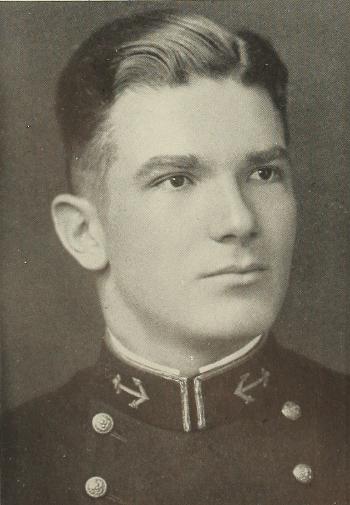
ROBERT EMMET SEIBELS, JR.
Black N**; M.P.O.
Loss
Robert was lost on August 30, 1947 when the F7F Tigercat he was piloting crashed in southern Maryland.
From the Baltimore Sun on August 31, 1947:
Commander Robert E. Seibels, 32, flight test engineer at the Patuxent Naval Air Station, was killed instantly yesterday when his twin-engine fighter plane crashed and burned in a tobacco field near Dares Beach, Calvert County.
On a routine flight, the ship, an F-7-F Tigercat, spun into the field, crashed on its belly and immediately burst into flames, according to air station officers.
The fuselage did not splinter in the crash, but the entire ship was consumed in flames almost instantaneously, naval officials stated. …
Notified of the crash, the air station immediately dispatched a navy surgeon in a helicopter to the scene. The helicopter landed in the tobacco field, which is on Plum Point, 1 mile from the Chesapeake Bay. However, fire already had destroyed the two-engine plane and pilot, naval officers said.
Other Information
From researcher Kathy Franz:
In 1933, Robert graduated from Sidney Lanier High School in Montgomery, Alabama. He was a member of St. John’s Episcopal Church.
He attended Marion Institute for one year before he was appointed to the Naval Academy by Congressman Lister Hill. His father R. E. was a manger of the Montgomery office of the Federal Home Owners Loan Corporation. Robert’s uncle was Admiral George G. Seibels who served under the command of Admiral George Dewey during the historic battle of Manila Bay in the Spanish-American War. Mrs. Margaret Whetstone of Montgomery did a portrait plaque of Robert.
From the Montgomery Advertiser on August 31, 1947:
Robert … “saw two years’ service in the Pacific in World War II, taking part in nine battles. On one occasion his plane was shot down when he encountered a greatly superior Japanese force. He was stationed at Pearl Harbor when the Japanese made the sneak attack that ushered in the war, but was out on maneuvers when the attack came. Most of his Pacific service was aboard the cruiser Portland.
Ordered from Hawaii to Alameda, Calif., he was there six months, and was then ordered to Annapolis for an engineering course of two years. From there he was sent to the Massachusetts Institute of Technology, where he spent a year, and received a master’s degree in aeronautical engineering. His last service was at Patuxent River Naval Station.
Surviving are his parents Mr. and Mrs. Robert Emmett Seibels, of 619 South Perry Street, Montgomery; a brother, William Temple Seibels, Jr.; his wife, the former Jule Sellers; and two children, Robert Emmett Seibels III and Jule Temple Seibels.
He is buried in Alabama; he was survived by his wife, his parents, and his brother. (Found mention of Robert Seibels III.)
Career
From naval aviation historian Richard Leonard via email on February 9, 2018:
- Designated Naval Aviator # 7404, 4/3/1941
- Date of rank LTJG from 1 Jul 1941 USN Register, 6/2/1941
- Date of rank LT from 1 Jul 1942 USN Register, 6/15/1942
- Date of rank LCDR from 1 Jul 1944 USN Register, 3/1/1944
- NAS Patuxent KIFA, 8/30/47
Navy Directories & Officer Registers
The "Register of Commissioned and Warrant Officers of the United States Navy and Marine Corps" was published annually from 1815 through at least the 1970s; it provided rank, command or station, and occasionally billet until the beginning of World War II when command/station was no longer included. Scanned copies were reviewed and data entered from the mid-1840s through 1922, when more-frequent Navy Directories were available.
The Navy Directory was a publication that provided information on the command, billet, and rank of every active and retired naval officer. Single editions have been found online from January 1915 and March 1918, and then from three to six editions per year from 1923 through 1940; the final edition is from April 1941.
The entries in both series of documents are sometimes cryptic and confusing. They are often inconsistent, even within an edition, with the name of commands; this is especially true for aviation squadrons in the 1920s and early 1930s.
Alumni listed at the same command may or may not have had significant interactions; they could have shared a stateroom or workspace, stood many hours of watch together, or, especially at the larger commands, they might not have known each other at all. The information provides the opportunity to draw connections that are otherwise invisible, though, and gives a fuller view of the professional experiences of these alumni in Memorial Hall.
July 1938
November 1940
April 1941
Robert is one of 72 members of the Class of 1938 on Virtual Memorial Hall.