LCDR GILBERT C. CARPENTER, USN
Lucky Bag Yearbook
From the 1930 Lucky Bag:
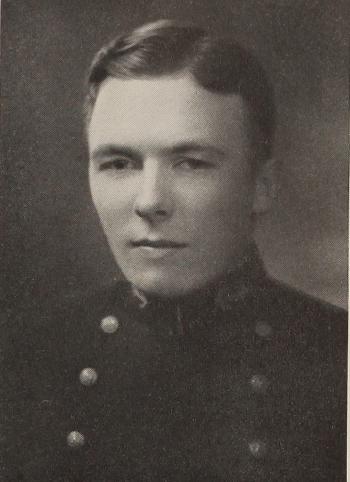
GILBERT CROWELL CARPENTER
Water Polo Manager 4, 2; Gym Squad 3, 1; 2 P.O.
FROM a little village in upper Michigan came a mere boy believing that Iron Mountain was the foundation of the United States. He wasted away a year of Prep at Severn, waiting for the age limit, and had decided to take another year in order to keep up at the Academy. But when it came time for the other fellows to enter, and an appointment floated his way, he jumped the train and arrived late, but not too late, as usual.
Gibbert spent three years at High School, but from what we think and gather, it is probable that his mother taught him faster than his teachers could follow.
He was only expecting to stay here until February, when those unsatisfactory for the first term were let out. But things turned out a little different and since the first marks were posted Gibbert has been called savvy. He justly deserves it as he can cover a lesson better in ten minutes than most of us can in an hour.
He is naturally carefree and pleasure-bent, but when he has a job to do, he tackles it with thoroughness and is always first to finish.
Loss
From The Daily News, Iron Mountain, Dickinson, Michigan on Monday, April 27, 1942:
Iron Mountain’s [Michigan] highest ranking naval officer, Lieutenant Commander Gilbert Crowell Carpenter, U.S. Navy. Aviation branch was stationed at a land air base at San Juan, Puerto Rico, for over 2 years. This is the same island on which his late father & Iron Mountain hero of World War I, Capt. Gilbert V. Carpenter.
Lt. Commander Carpenter’s naval career started upon his graduation from high school, with enrollment in the Annapolis officer’s training academy, graduating in 1930.
He visited his mother in April 1942, a month before his death. It was his 1st visit to Iron Mountain since 1936. His wife, Constance was with him along with their year old son, who was born in Puerto Rico.
Lieutenant Commander Gilbert was killed when the Navy plane he was piloting crashed at Norfolk, Virginia. He is buried at sea with a Memorial Marker at this cemetery.
From the Iron Mountain Press newspaper, Dickinson, Michigan on June 11, 1942:
OFFICER TELLS HOW CARPENTER LOST HIS LIFE
Although he met his death when he was pinned, under water, beneath his ship (plane), the late Lieutenant Commander Gilbert Crowell Carpenter, United States Navy & formerly of this city, “did exactly what any good pilot would have done under the circumstances,” in attempting an emergency landing last May 18 at the Norfolk, Virginia air station.
Death came to the popular Iron Mountain young man shortly after he, with his wife & young son, had visited here with his mother, Mrs. Leonora Carpenter. Robert L. C. Barnard, U.S. aviation radioman 1st class, San Antonio, Texas, who was flying with LCDR Carpenter, was also killed in the crash.
“I will attempt,” the officer wrote, “to describe the situation as simply as possible. LCDR Carpenter was the leading the squadron to land at the field here at Norfolk. He was the be the 1st to land. The plane was down to about 50 feet from the runway & he was almost ready to perform the actual landing.
WIND SHIFTED
“Just at this moment the control tower called him by radio saying that the wind had shifted & requested that he not land on that runway, but continue on across the field & circle, coming in on another runway.
“Carpenter increased the throttle & started to climb, to clear the obstacles on the far side of the field. For some reason, the engine did not respond properly & after a few seconds he realized that he was not getting enough power to clear the obstructions about 600 yards ahead.
“Between where he was at this point & the obstacles ahead, is an area which had recently been filled in by dredging operations & still contains a certain amount of water. The area looks perfectly hard & safe from the air.
“Therefore when LCDR Carpenter saw that he was failing to gain altitude, he nosed over & made an excellent landing.
“However due to the actual condition of the area, the wheels sank in immediately & caused the plane to rollover on its back. This resulted in LCDR Carpenter being pinned under the plane & drowning.
“LCDR Carpenter did exactly what any good pilot would have done under the circumstances. His death was caused by forces definitely beyond his control.”
Other Information
From researcher Kathy Franz:
Gilbert’s middle name Crowell was his mother’s maiden name. His grandfather Joseph was a physician, and Gilbert’s family lived with Joseph’s family after his father died.
Gilbert married Constance Postelthwaite in December 18, 1937, in Colorado Springs, Colorado.
His mother Leonore was a librarian. His sister was also named Leonore. His father Gilbert was a county surveyor in 1910. He was a captain and an engineer who died when the passenger liner S S Carolina was sunk on “Black Sunday” June 2, 1918. All passengers and crew abandoned the ship. Gilbert was in the motor dory that swamped. The liner was one of six vessels sunk that day by the German submarine U-151.
Gilbert’s son died at age 31 after serving as a doctor in Vietnam.
Gilbert has a memorial marker in Michigan.
Career
Gilbert commissioned as an Ensign June 5, 1930 and served on USS Tennessee before attending flight school at Pensacola in 1932. Gilbert was promoted to Lieutenant Junior Grade on June 5, 1933. He served with V.S. Squad 1-B before returning to Pensacola in 1935-1936. On September 1, 1937 he was promoted to Lieutenant. According to the Navy Registries he was connected with or aboard the Enterprise for three years before his assignment to the Puerto Rico Naval Station in 1940.
Navy Directories & Officer Registers
The "Register of Commissioned and Warrant Officers of the United States Navy and Marine Corps" was published annually from 1815 through at least the 1970s; it provided rank, command or station, and occasionally billet until the beginning of World War II when command/station was no longer included. Scanned copies were reviewed and data entered from the mid-1840s through 1922, when more-frequent Navy Directories were available.
The Navy Directory was a publication that provided information on the command, billet, and rank of every active and retired naval officer. Single editions have been found online from January 1915 and March 1918, and then from three to six editions per year from 1923 through 1940; the final edition is from April 1941.
The entries in both series of documents are sometimes cryptic and confusing. They are often inconsistent, even within an edition, with the name of commands; this is especially true for aviation squadrons in the 1920s and early 1930s.
Alumni listed at the same command may or may not have had significant interactions; they could have shared a stateroom or workspace, stood many hours of watch together, or, especially at the larger commands, they might not have known each other at all. The information provides the opportunity to draw connections that are otherwise invisible, though, and gives a fuller view of the professional experiences of these alumni in Memorial Hall.
October 1930
January 1931
April 1931
July 1931
October 1931
January 1932
April 1932
October 1932
January 1933
April 1933
July 1933
October 1933
April 1934
July 1934
October 1934
January 1935
April 1935
October 1935
January 1936
April 1936
July 1936
January 1937
April 1937
September 1937
January 1938
July 1938
January 1939
October 1939
June 1940
November 1940
April 1941
Gilbert is one of 40 members of the Class of 1930 on Virtual Memorial Hall.