LTJG VICTOR M. GADROW, USN
Lucky Bag Yearbook
From the 1935 Lucky Bag:
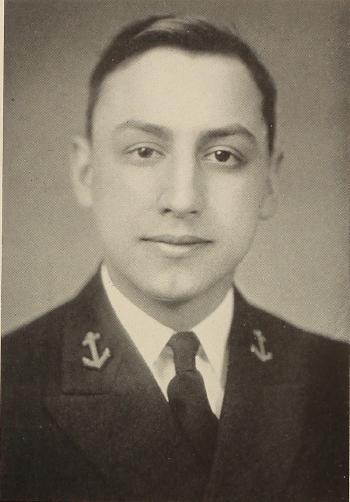
VICTOR MARVIN GADROW
Baseball 4, 3, 2, 1, N*. Class Football 4, 3. 1 Stripe.
Loss
Victor was lost on December 22, 1941 when the F4F Wildcat he was piloting experienced engine problems and crashed in rough seas astern of USS Saratoga (CV 3) in the vicinity of Wake Island.
From Aviation Safety Network:
At 1200 hrs on 16 December 1941 TF 14 left Pearl Harbor to assist Wake Island, two thousand miles to the west. The formation consisted of the aircraft carrier USS Saratoga, with 81 aircraft aboard (the 13 F4F Wildcats, 43 SBD-3 and 11 TBD-1 of the carrier Air Group, plus the 13 F2A-3 Buffaloes of VMF-221), three heavy cruisers, nine destroyers, a seaplane tender crammed with Marines and the fleet oiler Neches, one of the oldest and slowest in the fleet, only able to do 12 knots. On 21 December 1941 Wake Island was attacked by Japanese carrier aircraft and TF 14’s commander, Rear Admiral Frank Jack Fletcher, was warned that he might possibly have to fight a major battle just to get to Wake.
On the morning of 22 December, the ships had closed to about 520 miles northeast of Wake. Rough seas washed over the Saratoga’s plunging bow and greatly hindered the oiler’s efforts to refuel the destroyers. 6 F4Fs of VF-3 flew the early-morning combat air patrol (CAP). At 1021 hrs six other F4Fs took off to relieve them. Taking off into a stiff wind, the division climbed toward patrol altitude, but suddenly Lt.(jg) Victor M Gadrow, the skipper’s wingman, experienced engine trouble. The division leader, Lt Cdr John Thach, turned the lead over to another pilot and, to maintain radio silence, raced back to the Saratoga to give the emergency deferred forced landing signal (wheels up, tail hook down) to warm her that one of his planes needed to land back on board immediately. Gadrow followed in his failing Wildcat but barely got within a mile of the carrier before he stalled and went down. His F4F-3 Buno 3985 sank immediately in the turbulent seas. Racing to the scene, the destroyer Selfridge, acting as plane guard, found nothing.
Gadrow was VF-3’s first wartime loss. Although he graduated from Annapolis in 1935, he was a latecomer to aviation, having earned his wings in the spring of 1941. He had married only a few months before the war broke out.
Other Information
From researcher Kathy Franz:
Victor had just been advanced to engineering officer of VF-3 when he was killed. His brother Robert (‘37) was executive officer of the destroyer O’Brien when she was torpedoed (without personnel casualty) in September 1942. In 1918 in WWI, an older brother Alfred died in a flu epidemic while serving with the Navy at Newport.
Victor married Mary McMullen on August 28, 1941, in Seattle. They lived in Pasadena when he was called back to his ship two weeks later.
He was survived by his mother Hulda. His father was Levi Gadrow, a woolen weaver. They had at least eight children.
His wife was listed as next of kin.
Victor has a memory marker in Rhode Island, and he is also listed at the Courts of the Missing in Hawaii.
Related Articles
Harold Shrider ‘37 was lost the next day while flying from Saratoga.
Navy Directories & Officer Registers
The "Register of Commissioned and Warrant Officers of the United States Navy and Marine Corps" was published annually from 1815 through at least the 1970s; it provided rank, command or station, and occasionally billet until the beginning of World War II when command/station was no longer included. Scanned copies were reviewed and data entered from the mid-1840s through 1922, when more-frequent Navy Directories were available.
The Navy Directory was a publication that provided information on the command, billet, and rank of every active and retired naval officer. Single editions have been found online from January 1915 and March 1918, and then from three to six editions per year from 1923 through 1940; the final edition is from April 1941.
The entries in both series of documents are sometimes cryptic and confusing. They are often inconsistent, even within an edition, with the name of commands; this is especially true for aviation squadrons in the 1920s and early 1930s.
Alumni listed at the same command may or may not have had significant interactions; they could have shared a stateroom or workspace, stood many hours of watch together, or, especially at the larger commands, they might not have known each other at all. The information provides the opportunity to draw connections that are otherwise invisible, though, and gives a fuller view of the professional experiences of these alumni in Memorial Hall.
October 1935
January 1936
April 1936
July 1936
January 1937
April 1937
September 1937
January 1938
July 1938
January 1939
October 1939
June 1940
November 1940
April 1941
Memorial Hall Error?
Victor is not listed on the killed in action panel in the front of Memorial Hall. While not an obvious error, inclusion on the panel for crashes like this (incidental to combat flights) has been inconsistent across WWII, the Korean War, and the Vietnam War.
Victor is one of 56 members of the Class of 1935 on Virtual Memorial Hall.