LT THOMAS ASHWORTH, JR., USN
Lucky Bag Yearbook
From the 1931 Lucky Bag:
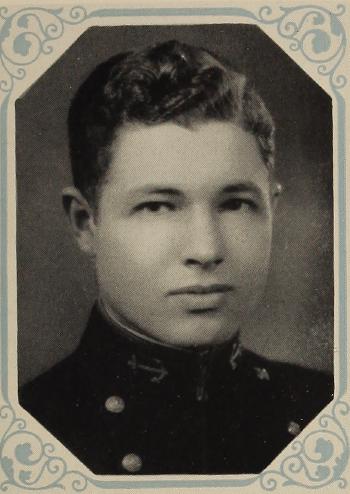
Thomas Ashworth, Jr.
N Club; Baseball 4, 3, 2, 1 Numerals 4; N 3, 2, Captain 1; Hop Committee 2, 1; Ring Dance Committee; Star 2, 1; 1 P. O.
Behold a man with a rare combination of qualities—a man able to work hard and take it easy at the same time. As to the former, well, Tommy never aimed at a mere 2.5 or 3.0, but kept his place in the savvy sections with only a moderate amount of effort. A baseball player par excellence, he stood high in the ranks of the “plumbers,” his “hava-hava” always right there at the crucial moment to inspire that well-known double play and win the game.
As for taking it easy, that is one of the best things he does. Witness innumerable bull-sessions, countless games of cribbage, semi-weekly movies frequent caulking periods. Tommy never cared much about reading. He’d always rather talk with someone, which may be one of the reasons why he has so many friends.
Tommy’s one of those who can get the most of four years like ours here, both in knowledge and in good times. If the rest of his cruise through life continues like the part we’ve seen, it’s certain to be “un buen viaje.”
Loss
Thomas was lost on October 21, 1941 when his SBD-2 Dauntless dive bomber crashed in the Pacific Ocean while attempting to land aboard USS Enterprise (CV 6). He was a member of Bombing Squadron (VB) 6.
Other Information
From researcher Kathy Franz:
Thomas’ father was the Rev. Thomas Ashworth rector of the St John’s Church in Butte. He immigrated in 1906 and in 1910 was running a fruit farm. Two of Thomas’ brothers went to West Point: Edward graduated in 1933 and retired as a Colonel, and Robert retired as a General. A third brother Geoffrey became a minister. Their sister was Elizabeth.
Thomas’ wife was Marjorie Hoyt Ashworth, and their two sons were Thomas, III, and Stephen.
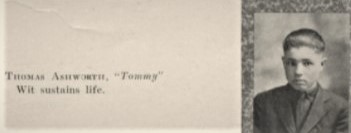
Thomas graduated in 1925 from Payette High School. As a freshman in 1922, Thomas, known as Tommy, was listed as “A preacher’s son, so we haven’t anything on him yet.” He was a member of the Glee Club. His brother Edward was listed as “We wonder who burned down Ashworth’s barn, learning to smoke.” As juniors in 1924, Thomas played left field while his brother Edward played second base on the baseball team. As a senior, Thomas’ nickname was The Gob. Class Prophecy: One of the interesting features of the Pathe News was a side-light on the Great Admiral Thomas Ashworth. The picture showed plainly that he was much admired by all on board, by showing his orderly, brother Edward, shining his shoes, while the Admiral was asleep. Class Will: Thomas leaves with many heart-beats, his address to “Snowflakes.”
Thomas served in the Idaho National Guard from 1925 to 1927 as a private of Battery C, 148th field artillery of Payette.
He later attended St. Alban’s Cathedral school at Washington, D.C. He was appointed to the Naval Academy by Senator Borah in June, 1927.
He married Marjorie Valentine Hoyt of Butte, Montana on July 22, 1933, at the Episcopal church in Yuma, Arizona. She never remarried and remained in Coronado, California. Marjorie and Patricia Ashworth (husband Philip ’31) were not related but were life-long friends. They were co-directors of the David Harrison Preschool in Coronado. Marjorie died July 2, 2001. From the Coronado Eagle and Journal newspaper, August 15, 2001: “At Mrs. Ashworth’s request, there were no services, and her ashes will be scattered in the Pacific where, as she said, her beloved husband had rested alone too long.”
Son Thomas graduated from Coronado High School in 1952, and son Stephen graduated in 1958. Thomas (’56) became a judge of the San Diego County Superior Court, and Stephen became a judge of the San Bernardino County Superior Court, Victorville.
The Naval Air station in San Diego held a memorial service for Thomas on November 5, 1941.
A memorial window at the St. John’s Church in Butte, Montana honors his service and sacrifice.
Photographs
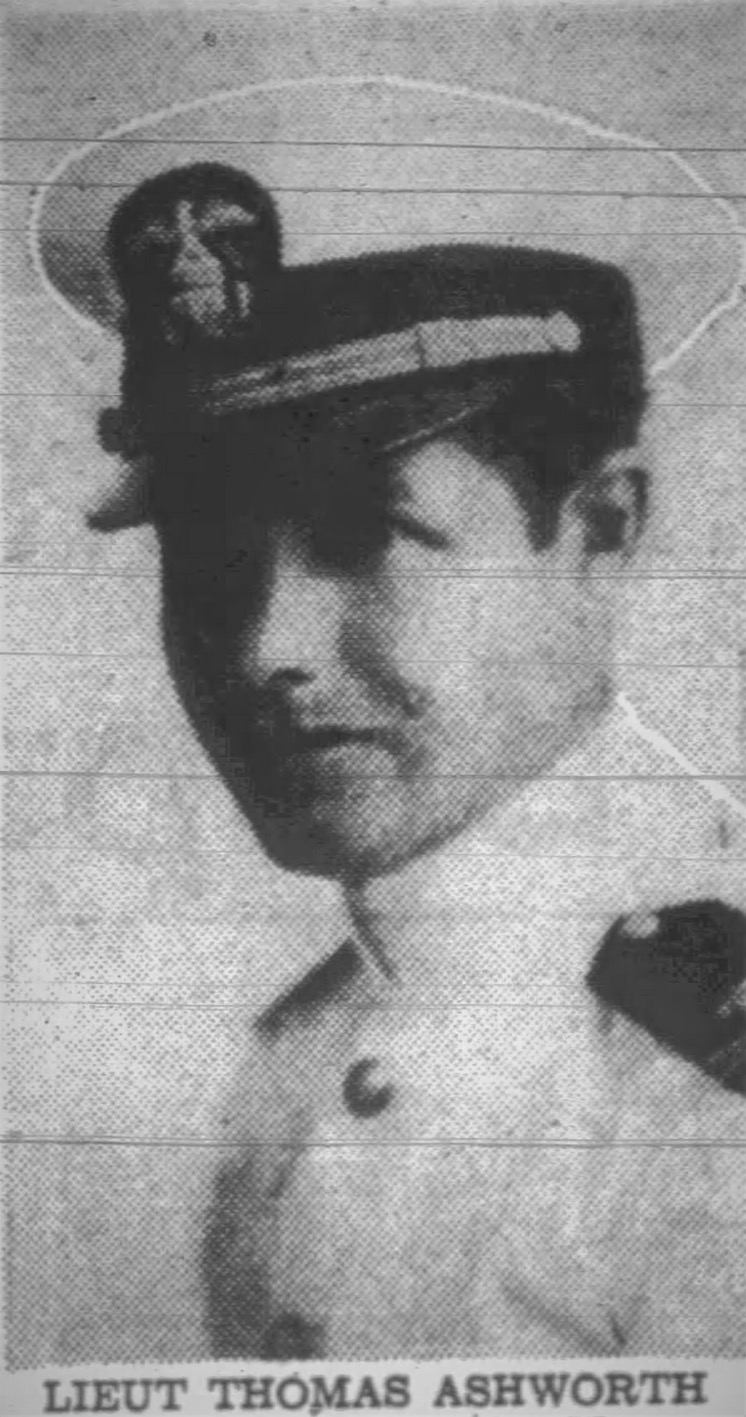
Navy Directories & Officer Registers
The "Register of Commissioned and Warrant Officers of the United States Navy and Marine Corps" was published annually from 1815 through at least the 1970s; it provided rank, command or station, and occasionally billet until the beginning of World War II when command/station was no longer included. Scanned copies were reviewed and data entered from the mid-1840s through 1922, when more-frequent Navy Directories were available.
The Navy Directory was a publication that provided information on the command, billet, and rank of every active and retired naval officer. Single editions have been found online from January 1915 and March 1918, and then from three to six editions per year from 1923 through 1940; the final edition is from April 1941.
The entries in both series of documents are sometimes cryptic and confusing. They are often inconsistent, even within an edition, with the name of commands; this is especially true for aviation squadrons in the 1920s and early 1930s.
Alumni listed at the same command may or may not have had significant interactions; they could have shared a stateroom or workspace, stood many hours of watch together, or, especially at the larger commands, they might not have known each other at all. The information provides the opportunity to draw connections that are otherwise invisible, though, and gives a fuller view of the professional experiences of these alumni in Memorial Hall.
October 1931
January 1932
April 1932
October 1932
January 1933
April 1933
April 1934
July 1934
October 1934
January 1935
April 1935
October 1935
January 1936
April 1936
July 1936
January 1937
April 1937
September 1937
January 1938
July 1938
January 1939
October 1939
June 1940
November 1940
April 1941
Thomas is one of 50 members of the Class of 1931 on Virtual Memorial Hall.