CAPT RICHARD S. MOSS, USN
Lucky Bag Yearbook
From the 1924 Lucky Bag:
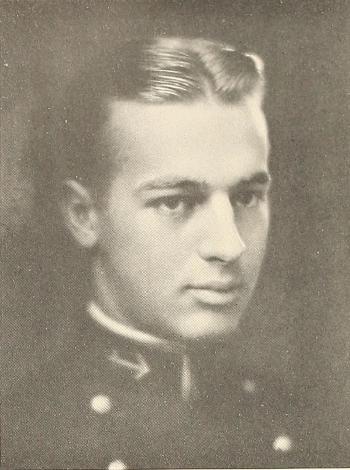
RICHARD STANLEY MOSS
Swimming (4), NA (4); Class Water Polo (4, 3), Numerals (3); Rifle Squad (4, 3, 2, 1); Class Rifle (2), Numerals (2); Class Swimming (4, 3, 2, 1); Class Football (1).
RICHARD STANLEY MOSS came in this place with high ideals and he has never lost sight of his goal. He is fond of dreaming about what he is going to do and often astonishes a person with some exceptional idea. If he could only put them to work!
He likes to swim and could probably have made the A-Squad had he stayed out for it. He possesses latent athletic ability but, as he was continuously associated with the Panamanians, he was exposed to and became affected with that disease which they commonly blame on the hookworm. He is far from lazy, but nevertheless inconsistent in athletics.
“Dick” was booted from the ranks of Red Mikes early in his career by dragging consistently in Crabtown. His favorite saying ever since has been “Man, but I do like her.”
If you want to have an everlasting friend, just say, “Why, Skipper, I believe you are growing.” And should you want to see some fun just tell him you don’t believe a word he’s saying.
Loss
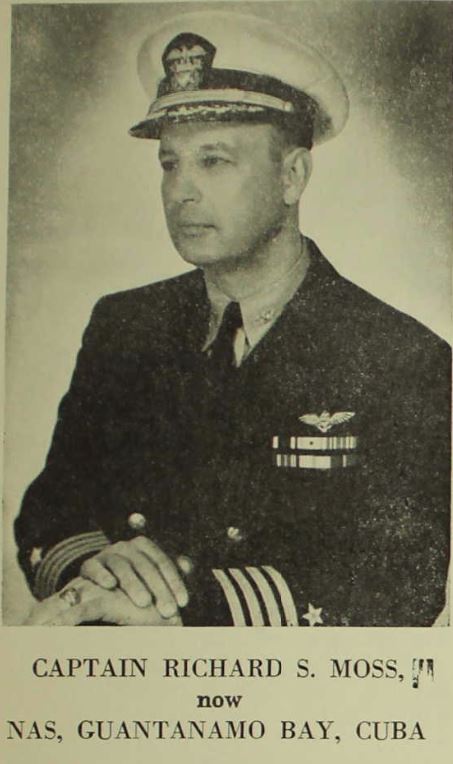
Richard was lost on December 26, 1946 when the plane he was piloting crashed near Naval Station Guantanamo Bay, Cuba. He was the commanding officer of the base.
Other Information
From researcher Kathy Franz:
Richard was born in Maryland. He lived in Panama from November 1914 to December 1917.
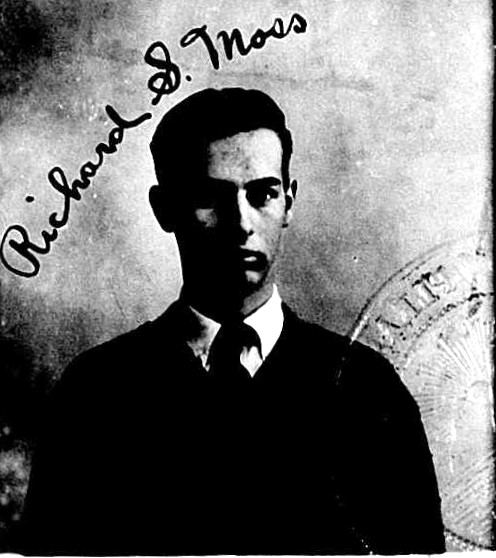
He applied for a passport in June, 1920, when his father was living in London. He planned on traveling aboard an Army Transport out of New York City. He was to visit France, Belgium and England with his father. Richard was 5’11” tall with blue eyes and brown hair.
In 1940 he lived with his wife in San Diego.
His father was James, mother Kate, sister Pauline, and brother Romeyn.
From The Sandusky Register of Sandusky, Ohio, on Saturday, December 28, 1946:
CAPT. RICHARD MOSS. U.S.N. NORWALK, Dec. 28—Word was received here of the tragic death of Captain Richard Moss, 45, of the United States naval air corps, in a plane crash over Guantanamo Bay Cuba, Dec. 26. The body was recovered and will be flown to Washington for burial in Arlington Cemetery. No other details are available as Captain Moss was flying alone at the time. His father, Col. James A. Moss, retired army officer, who with Mrs. Moss has been living in Sarasota, Fla., is flying to Cuba and will return to Washington with the body. In the meantime his mother, Mrs. Moss, formerly Kate Kellogg will go to Fayetteville, N. C. where her other son, Romaine will accompany her to Washington. Captain Moss graduated from Norwalk High school with the class of 1920, and from the Annapolis Naval Academy in 1924. On the day of his graduation, he was united in marriage to Miss Louise Bean, Baltimore, who also survives. There are no children. During World War II, he served on the airplane carrier Block Island and for the past nine months has been commander of the naval base at Guantanamo. A month ago, he was decorated by the Cuban government for saving the town of Guantanamo from destruction by fire.
Richard is buried in Arlington National Cemetery.
Photographs
Wartime Service
Richard was commanding officer of USS Solomons (CVE 67) beginning in January 1945.
Related Articles
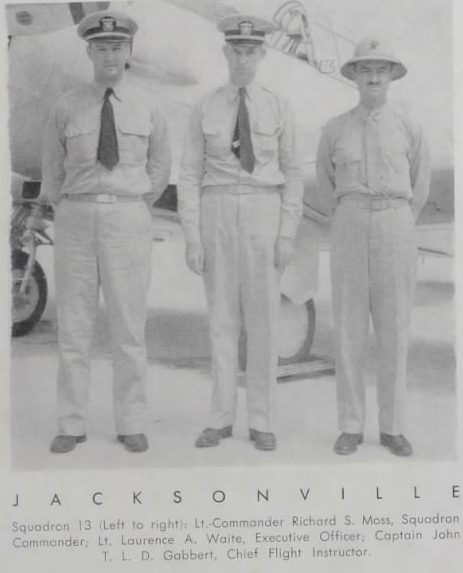
In 1941, and possibly 1940, Richard was stationed with Lance Massey ‘30 and Archibald Greenlee ‘32. All three had their pictures on the same page of a naval aviation training command yearbook from 1941.
Navy Directories & Officer Registers
The "Register of Commissioned and Warrant Officers of the United States Navy and Marine Corps" was published annually from 1815 through at least the 1970s; it provided rank, command or station, and occasionally billet until the beginning of World War II when command/station was no longer included. Scanned copies were reviewed and data entered from the mid-1840s through 1922, when more-frequent Navy Directories were available.
The Navy Directory was a publication that provided information on the command, billet, and rank of every active and retired naval officer. Single editions have been found online from January 1915 and March 1918, and then from three to six editions per year from 1923 through 1940; the final edition is from April 1941.
The entries in both series of documents are sometimes cryptic and confusing. They are often inconsistent, even within an edition, with the name of commands; this is especially true for aviation squadrons in the 1920s and early 1930s.
Alumni listed at the same command may or may not have had significant interactions; they could have shared a stateroom or workspace, stood many hours of watch together, or, especially at the larger commands, they might not have known each other at all. The information provides the opportunity to draw connections that are otherwise invisible, though, and gives a fuller view of the professional experiences of these alumni in Memorial Hall.
July 1924
September 1924
November 1924
January 1925
March 1925
May 1925
July 1925
October 1925
January 1926
October 1926
January 1927
April 1927
October 1927
January 1928
April 1928
July 1928
October 1928
January 1929
April 1929
July 1929
October 1929
January 1930
April 1930
October 1930
January 1931
April 1931
July 1931
October 1931
January 1932
April 1932
October 1932
January 1933
April 1933
July 1933
October 1933
April 1934
July 1934
October 1934
January 1935
April 1935
October 1935
January 1936
April 1936
July 1936
January 1937
April 1937
September 1937
January 1938
July 1938
January 1939
October 1939
June 1940
November 1940
April 1941
Richard is one of 39 members of the Class of 1924 on Virtual Memorial Hall.