LT RALPH D. SMITH, USN
Lucky Bag Yearbook
From the 1926 Lucky Bag:
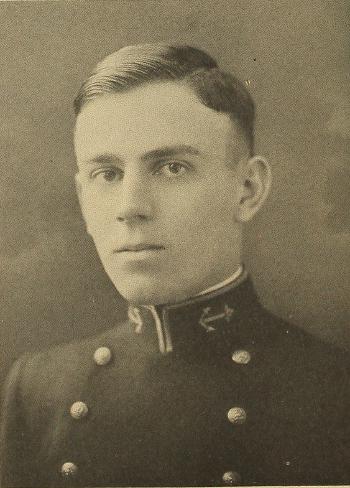
Ralph Dempcy Smith
Lacrosse Squad, Assistant Manager (3, 2); Lucky Bag.
RALPH, the fellow that would drag blind. When another fellow needed a friend for a week-end he knew the place to come and find one. Smitty would never tell whether or not he had been bricked but we found out every once in a while by going over to the hop.
He used to do his share of worrying about marks. Everyday we would hear, “I bet you that I hit the tree this week in Math.” But when the weekly trees were posted his name was seldom found among the chosen few. Then when the monthly averages came up he usually had above a 3.0.
When the call was given for the candidates for Lacrosse manager one of the first to go out was Ralph and he stuck to it and followed the team every day. He lost more weight running back from drill and getting ready for lacrosse than he lost in the fireroom Youngster Cruise.
Just after he returned from Youngster September Leave his favorite Sunday afternoon pastime was to hunt up Plebes and show them his new Elgin watch. Ralph proved himself a shrewd fellow Second Class year. He stayed on the Sub-squad until he could get big odds, and won enough to buy a farm when he finally passed the test.
“I don’t see how any lacrosse team in the country could score on us.”
Loss
Ralph was lost on May 23, 1941 when the Curtiss SBC-3 scout biplane he was piloting crashed near Hawaii. The other man aboard was also killed.
Other Information
From Abilene Reporter-News of Abilene, Texas on May 23, 1941:
WASHINGTON. May 23. The navy reported today the death of Lt. Ralph Dempsey Smith and Chief Radioman Clarence Widner Allen in the crash of a naval plane piloted by Smith. The plane came down in the waters of Pearl Harbor. Hawaii. Both men were attached to the aircraft carrier Enterprise. Allen is survived by his widow, Mrs. Nellie May Allen, San Diego, and his father, C. E. Allen, Mabanks, Tex.
From researcher Kathy Franz:
Ralph graduated from Hagerstown high school in Maryland in 1922. “Smitty” Literary Society 2, 3, 4; Critic 4; Chess Club 2, 3, 4, V. Pres. 4; Athletic Association 2, 3, 4; Senior Basket Ball; Tennis 4; High School Debating Team 3. “He could not debate anything without some commotion even when the argument was not of moment.” Books by Famous Authors: Life in a Lumber Camp by Ralph Smith.
His wife was Marie Strudwick Smith, and their children were Ralph, Jr. and Susanne. The family lived together in April 1940 on the Coco Solo Naval Reservation.
His father Arthur M. was superintendent of a railroad, mother Emma/Winnie, brothers Arthur and Theodore/Thomas, and sister Eleanor (Mrs. Thomas W. Moore, Annapolis.)
Ralph had only been at Hawaii for two weeks, according to another report. He was survived by his wife, Marie, and two children, Ralph Jr. and Susanne; they were in San Diego at the time.
He is buried in Arlington National Cemetery. It’s possible that he was commanding officer of Scouting Squadron (VS) 6, though he is not listed as such in the 1941 Navy Directory. His headstone gives his rank as LCDR, but all other reports and records are that he was a Lieutenant.
Photographs
Navy Directories & Officer Registers
The "Register of Commissioned and Warrant Officers of the United States Navy and Marine Corps" was published annually from 1815 through at least the 1970s; it provided rank, command or station, and occasionally billet until the beginning of World War II when command/station was no longer included. Scanned copies were reviewed and data entered from the mid-1840s through 1922, when more-frequent Navy Directories were available.
The Navy Directory was a publication that provided information on the command, billet, and rank of every active and retired naval officer. Single editions have been found online from January 1915 and March 1918, and then from three to six editions per year from 1923 through 1940; the final edition is from April 1941.
The entries in both series of documents are sometimes cryptic and confusing. They are often inconsistent, even within an edition, with the name of commands; this is especially true for aviation squadrons in the 1920s and early 1930s.
Alumni listed at the same command may or may not have had significant interactions; they could have shared a stateroom or workspace, stood many hours of watch together, or, especially at the larger commands, they might not have known each other at all. The information provides the opportunity to draw connections that are otherwise invisible, though, and gives a fuller view of the professional experiences of these alumni in Memorial Hall.
October 1926
January 1927
April 1927
October 1927
January 1928
April 1928
July 1928
October 1928
January 1929
April 1929
July 1929
October 1929
January 1930
April 1930
October 1930
January 1931
April 1931
July 1931
October 1931
January 1932
April 1932
October 1932
January 1933
April 1933
July 1933
October 1933
April 1934
July 1934
October 1934
January 1935
April 1935
October 1935
January 1936
April 1936
July 1936
January 1937
April 1937
September 1937
January 1938
July 1938
January 1939
October 1939
June 1940
November 1940
April 1941
Ralph is one of 33 members of the Class of 1926 on Virtual Memorial Hall.