CDR JOHN R. YOHO, USN
Lucky Bag Yearbook
From the 1929 Lucky Bag:
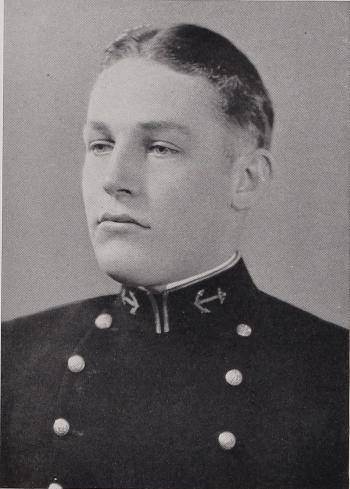
JOHN RICHARD YOHO
Black N**. Class Football 4. Class Swimming 4. Class Water Polo 4. Crew 4. Gymkhana 4, 3. Hop Committee 1. Lucky Bag Staff. Water Polo 4, 3, 2, 1; NA 3, 2. Buzzard.
AT THE tender age of seventeen, honest John, the rambling derelict, cut loose from his Oregon anchorage, and sailed free and unhampered into the Severn, where he dropped the hooks to linger. Tall, blonde, and bland, and possessing that intangible appeal which has invariably caused the tidal waves of emotion to rise in the hearts of the eternal feminine, his romances have bidden fair to take him above the apprentice class. When the bludgeons of fate have fallen all around us, our cousin has always displayed the most unruffled and oblivious tranquility — undisturbed and unfettered by Executives, Academics, and other paltry matters.
His early training on the Columbia River made it inevitable that his athletic tendencies should be along the lines of natatory sports, wherein he achieved marked distinction as a water polo player. And then in other fields, gentlemen — there came a day when the rough and rugged Westerner draped a bear-skin coat about his stalwart physique, set a derby hat over his ears at a rakish angle, swung a lacquered cane under his arm, and sauntered down Broadway amid the plaudits of the multitude — a veritable young Lochinvar.
When the traits of serenity, frankness, and big-heartedness are combined in one man in such abundance, it is only befitting that this man acquire unnumbered friends — and there is no other recourse but to foretell for him an aureate future. “Now take this-here juice problem — it is evident!”
Loss
John was lost on January 6, 1943 when the plane he was piloting crashed near Norfolk, Virginia. The other crewman aboard was also killed. John was commanding officer of Scouting Squadron (VS) 9.
Other Information
From researcher Kathy Franz:
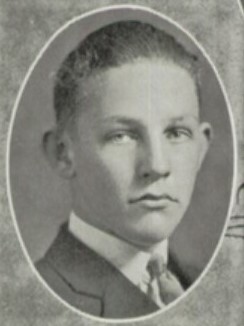
John graduated from Jefferson High School in Portland in 1925. “But he, while his companion slept, was toiling upward in the night.” Class Prophecy, Year 1940: Lieutenant (junior grade) of the U. S. Navy, a graduate of Annapolis. Alias: Johnnie. Favorite Expression: “Haven’t got any.” Deed: Being a math shark.
In April, 1942, John was commanding officer at the Marine Corps stationed at Cherry Point, North Carolina. He wrote the parents of Seaman Louis C. Stephens, Monessen, Pennsylvania, that he died when his patrol plane crashed in the Atlantic Ocean off Cape Hatteras, Virginia.
In 1910, his family lived in Seattle, Washington; and in 1920, his family lived in Akron, Ohio. His father was a building contractor there and a member of the lumber dealers association. That year, he filed for divorce from his wife Elsie who now lived in Portland. She later married Mr. Seubert.
He was survived by his wife, stepson, parents, and younger brother Jud Yoho, Jr. ‘36.
It’s unclear why John’s name appears so late on the Class of 1929 panel.
Photographs
Related Articles
Jud Yoho, Jr. ‘36 was lost a few months later when his submarine was sunk in the Pacific.
The next commanding officer of Scouting Squadron (VS) 9, Robert Donaldson ‘34, was lost barely a month later.
Navy Directories & Officer Registers
The "Register of Commissioned and Warrant Officers of the United States Navy and Marine Corps" was published annually from 1815 through at least the 1970s; it provided rank, command or station, and occasionally billet until the beginning of World War II when command/station was no longer included. Scanned copies were reviewed and data entered from the mid-1840s through 1922, when more-frequent Navy Directories were available.
The Navy Directory was a publication that provided information on the command, billet, and rank of every active and retired naval officer. Single editions have been found online from January 1915 and March 1918, and then from three to six editions per year from 1923 through 1940; the final edition is from April 1941.
The entries in both series of documents are sometimes cryptic and confusing. They are often inconsistent, even within an edition, with the name of commands; this is especially true for aviation squadrons in the 1920s and early 1930s.
Alumni listed at the same command may or may not have had significant interactions; they could have shared a stateroom or workspace, stood many hours of watch together, or, especially at the larger commands, they might not have known each other at all. The information provides the opportunity to draw connections that are otherwise invisible, though, and gives a fuller view of the professional experiences of these alumni in Memorial Hall.
July 1929
October 1929
January 1930
April 1930
October 1930
January 1931
April 1931
July 1931
October 1931
January 1932
April 1932
October 1932
January 1933
April 1933
July 1933
October 1933
April 1934
July 1934
October 1934
January 1935
April 1935
October 1935
January 1936
April 1936
July 1936
January 1937
April 1937
September 1937
January 1938
July 1938
January 1939
October 1939
June 1940
November 1940
April 1941
John is one of 26 members of the Class of 1929 on Virtual Memorial Hall.