CDR ROBERT W. BEDILION, USN
Lucky Bag Yearbook
From the 1922 Lucky Bag:
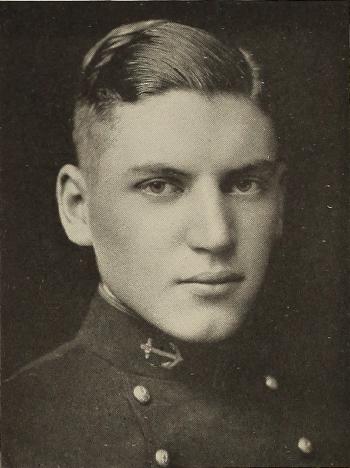
ROBERT WILLIAM BEDILION
Class Soccer (2); Lucky Bag; Gymkhana Sub-Committee.
“YE GODS, end this Academy life
And make two lovers happy,”
might be an appropriate plea for the above specimen of the photographer’s art. “Bob,” although a bear with the ladies, is still essentially a “one woman man.” But, with all his winning ways, he has been a source of keen disappointment to his Academic wife. Despite three years’ constant attempts to instill into him the West Point code of honor, “Bob” remains incorrigible.
Wine, Women, and Song—these three are his greatest weaknesses. His bellowing voice makes him at all times a general nuisance; women alone were the cause of that six hundred dollar bill at Caldwell’s; and if it hadn’t been for the wine, he’d have known why “that damn fool called the fellow a captain when he only had a stripe and a half.”
“Bob” prides himself on being savvy. We often doubt this last, but at least, he can run anything in the machine shops. “Gee, ye broke it, didn’t ye?”
He’s an awfully sweet boy, though, and he usually gets what he’s after, especially if it’s food—in any form.
Loss
Robert died in a plane crash about two miles east of Mantague, VA. He was on temporary assignment to Washington, D.C. for work in the Bureau of Naval Inspection and was being flown to Norfolk when the plane crashed.
Other Information
From researcher Kathy Franz:
Robert graduated from Marietta high school in 1917. He was appointed to the Naval Academy by Representative George White in May, 1918.
He married his high school classmate Martha Stewart (or Stuart) Daker shortly after he graduated from the Academy. They lived on the same street just one block apart in Marietta. Martha was listed as a senior in the Marietta College yearbook of 1923. She was a member of Beta Theta, was in the Glee Club, and played basketball.
From the Marietta high school yearbook of 1936: In 1929, Robert received a Master of Science degree at Columbia University. Inspector on building of U. S. S. Ranger, first ship designed as an airplane carrier, 1932-1934. Now stationed with the Ranger as unit of Pacific fleet. His wife, Martha Daker Bedilion, graduated from Marietta High School in 1918 and from Marietta College in 1922. They live at Coronado, California.
In October, 1940, Martha sailed from Los Angeles to Honolulu.
In August, 1944, the training camp at Port Hueneme, California, was named for Robert. Representative P. W. Griffith placed in the congressional record a resolution of the Marietta Chamber of Commerce thanking the Navy for this. Robert was instrumental in the development of the ACORN program. Under this program, an airfield assembly unit was designed to accomplish the rapid construction and operation of a landplane and seaplane advance base, or in conjunction with amphibious operations, the quick repair and operation of captured enemy airfields.
His father William was a shipping clerk at a glass factory, mother Augusta. In 1910, his grandmother Anna Klostermeyer, born in Germany, lived with them. His mother was honored in May, 1951 on her 80th birthday. The newspaper article recalled her life as a reporter since she started on February 14, 1924.
He is buried in Arlington National Cemetery.
Wartime Service
“He had captained the flagship of a destroyer fleet in the Pacific and was at Pearl Harbor when the base was attacked. He had participated in the Battle of Midway and in the Aleutians.” This account was reported by his aunt in a local publication.
Robert was commanding officer of USS Case (DD 370) from January 6, 1942 to August 19, 1942.
Navy Directories & Officer Registers
The "Register of Commissioned and Warrant Officers of the United States Navy and Marine Corps" was published annually from 1815 through at least the 1970s; it provided rank, command or station, and occasionally billet until the beginning of World War II when command/station was no longer included. Scanned copies were reviewed and data entered from the mid-1840s through 1922, when more-frequent Navy Directories were available.
The Navy Directory was a publication that provided information on the command, billet, and rank of every active and retired naval officer. Single editions have been found online from January 1915 and March 1918, and then from three to six editions per year from 1923 through 1940; the final edition is from April 1941.
The entries in both series of documents are sometimes cryptic and confusing. They are often inconsistent, even within an edition, with the name of commands; this is especially true for aviation squadrons in the 1920s and early 1930s.
Alumni listed at the same command may or may not have had significant interactions; they could have shared a stateroom or workspace, stood many hours of watch together, or, especially at the larger commands, they might not have known each other at all. The information provides the opportunity to draw connections that are otherwise invisible, though, and gives a fuller view of the professional experiences of these alumni in Memorial Hall.
July 1923
September 1923
November 1923
January 1924
March 1924
May 1924
July 1924
September 1924
November 1924
January 1925
March 1925
May 1925
July 1925
October 1925
January 1926
October 1926
January 1927
April 1927
October 1927
January 1928
April 1928
July 1928
October 1928
January 1929
April 1929
July 1929
October 1929
January 1930
April 1930
October 1930
July 1931
October 1931
January 1932
April 1932
October 1932
January 1933
April 1933
July 1933
October 1933
July 1934
October 1934
January 1935
April 1935
October 1935
January 1936
April 1936
July 1936
January 1937
April 1937
September 1937
January 1938
July 1938
January 1939
October 1939
June 1940
November 1940
April 1941
Robert is one of 26 members of the Class of 1922 on Virtual Memorial Hall.