LTJG FORD L. WALLACE, USN
Lucky Bag Yearbook
From the 1931 Lucky Bag:
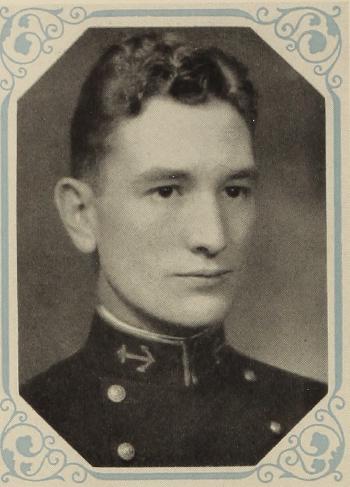
Ford Llewellyn Wallace
Plebe Boxing 31 Varsity Boxing 3, 2, 1 bNt Captain 1 C. P. O.
From the thriving steel center of Youngstown, Ohio, comes this amiable personage with a personality that is infection to all that come within its range; this is the strong forte of Si. Always ready to lend a hand to a disheartened classmate or friend. We find that this is but one of the many salient points of his character that make him so well liked.
His prowess in the ring is well known at the Academy and throughout intercollegiate circles, and the native generosity of his spirit shows itself when in the ring, working on the principle “‘Tis more blessed to give than to receive.”
Si has his serious side of life. He abhors small talk; but when a question of ethics or philosophy is being discussed, Si is in his element. And woe be unto him who fain would argue; he knows his Socrates.
He is the kind of a man that will go a long way in this old world of ours, for nature has strongly fortified him with a brilliant mind, a strong sense of honor combined with good judgment.
Loss
Ford’s was lost on August 23, 1937 when the seaplane he was aboard crashed into San Diego Bay on August 23, 1937.
From The Bakersfield Californian, August 24, 1937 via researcher Kathy Franz:
Disaster – for the first time – struck the navy’s armada giant flying boats, sending the $150,000 plane crashing into San Diego bay, where today rescuers hunted for the bodies of its dead.
The six men, including three officers of a crew of eight, were killed, the others injured, when the plane fell. Hull submerged in shallow water, the wreck was quickly surrounded by navy salvage vessels as searchlights illuminated the bay.
The dead, four of whom were believed still trapped within the plane, were listed as: Lieutenant W. C. Dey, Jr.; Lieutenant, Junior Grade, F. L. Wallace; Lieutenant, Junior Grade, W. M. Freshour; R. Fall, aviation chief machinists’ mate; R. M. Purdy, radio man, second class; and H. K. Bryan, radio man, third class, naval aviation pilot.
Two Rescued
Lifted out of the hull and rushed to Naval Hospital, two survivors were treated for injuries. J. W. Blackman, aviation ordinanceman, second class, was only slightly hurt. T. P. Dougherty, aviation machinist’s mate, third class, suffered severe shock and multiple lacerations.
The ill-starred plane, PBY-1, whose sister flying boats have flown in mass formation to Honolulu and the Canal Zone in the past two years, was undergoing a “routine night practice flight” for a forthcoming hop to Panama.
As it swooped down for a landing after being in the air several hours, the seaplane struck the Narwhal, an abandoned whaling ship once used in filming “Moby Dick.”
Framework Crushed
The 63 ½-foot hull of the flying boat nosed over in the bay mud, crushing its metal framework like paper.
Only the bottom of the fuselage and the two wing pontoons showed above water.
In desperate haste to extricate the victims, three of a crew of 175 many men were imperiled by a sudden fire started when sparks ignited spilled gasoline.
The trio jumped into the bay and were pulled out again after fellow searchers extinguished the flames.
Other Information
He earned his wings as naval aviator #4074 on November 12, 1934.
From researcher Kathy Franz:
His father was George, a city policeman in Youngstown, who died in 1929. His mother Margaret was a practical nurse. His brothers were George, David, and Joseph, and his sister was Thelma.
He is buried in California.
Related Articles
William Freshour ‘31 and Walter Dey ‘34 were also lost in this crash.
Navy Directories & Officer Registers
The "Register of Commissioned and Warrant Officers of the United States Navy and Marine Corps" was published annually from 1815 through at least the 1970s; it provided rank, command or station, and occasionally billet until the beginning of World War II when command/station was no longer included. Scanned copies were reviewed and data entered from the mid-1840s through 1922, when more-frequent Navy Directories were available.
The Navy Directory was a publication that provided information on the command, billet, and rank of every active and retired naval officer. Single editions have been found online from January 1915 and March 1918, and then from three to six editions per year from 1923 through 1940; the final edition is from April 1941.
The entries in both series of documents are sometimes cryptic and confusing. They are often inconsistent, even within an edition, with the name of commands; this is especially true for aviation squadrons in the 1920s and early 1930s.
Alumni listed at the same command may or may not have had significant interactions; they could have shared a stateroom or workspace, stood many hours of watch together, or, especially at the larger commands, they might not have known each other at all. The information provides the opportunity to draw connections that are otherwise invisible, though, and gives a fuller view of the professional experiences of these alumni in Memorial Hall.
July 1931
October 1931
January 1932
April 1932
October 1932
January 1933
April 1933
July 1933
October 1933
April 1934
July 1934
October 1934
January 1935
April 1935
October 1935
January 1936
April 1936
July 1936
January 1937
April 1937
Ford is one of 50 members of the Class of 1931 on Virtual Memorial Hall.