CDR RODERICK S. ROONEY, USN
Lucky Bag Yearbook
From the 1929 Lucky Bag:
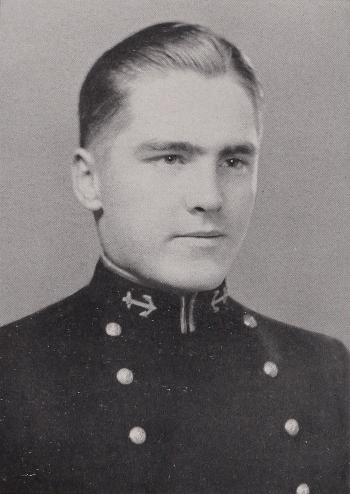
RODERICK SHANAHAN ROONEY
Black N*. Class Football 1. Football B-Squad 2. Class Crew 3, 2. Times Prize 2. Log Staff 2, 1. Plebe Crew Squad. Swimming 4. Water Polo 3, 2, 1; wNAp 3, 2. 2 P.O.
ONE of Pat’s greatest assets is his ability to take misfortune cheerfully. The request, “Name and initials, please,” seldom brings forth peals of laughter from any of us; but from Pat it’s sure to coax a grin, for he’s a son of Erin. Pat has high aspirations. While it has never been his highest ambition to step off the pivot with one full and six-half steps, he has ever kept the demon academics well under control. Nor have his efforts in the line of sports gone unrewarded. Four years of effort in many sports have brought home a sense of leadership and responsibility not easily acquired.
Academically speaking, Pat realizes that there are many Admirals, but there is only one Judge Advocate General. There lies the road. (Let us not in our wanderings imply for a moment that Pat is any sort of a sea-lawyer!) There are people we appreciate more the better we know them, and Pat is of that type. He is earnest and diligent, both in work and in play. With this spirit and his general good nature, we feel perfectly safe in prophesying his future success and advancement in the Service.
Loss
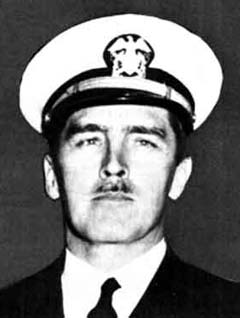
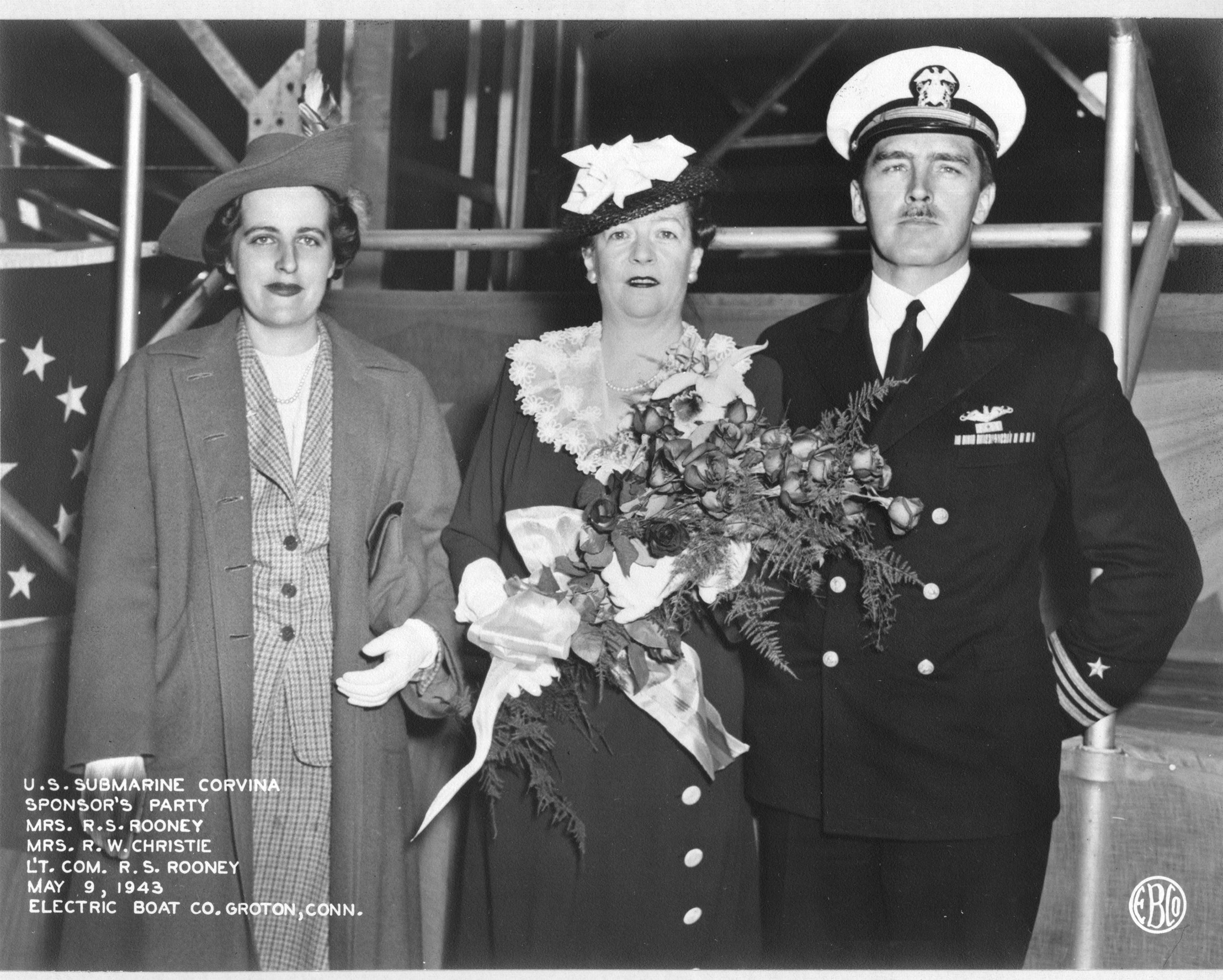
Roderick was lost when USS Corvina (SS 226) was sunk on November 16, 1943 by a Japanese submarine. He was the boat’s commissioning commanding officer.
Other Information
From researcher Kathy Franz:
In 1935, Roderick’s ship was in China. On June 4, 1936, he traveled back to New York City from Southampton, England, on the S. S. Manhattan.
His wife Mary was the daughter of Rear Admiral Ray A. Spear. Roderick and Mary’s son Peter was born in Washington, D. C., in 1939.
Roderick’s father John was a lawyer who became a judge. His mother was Marie, sister Morra and brothers John, Jr., and Collins Dunstar.
Roderick is listed at the Courts of the Missing in Hawaii. His wife was named as next of kin.
Photographs
Career
From the now-broken link http://www.fleetorganization.com/subcommandersclassyear2.html:
- Duty USS Tennessee (BB-430 1 Jan 1939 - 1 Oct 1939
- Flag Lieutenant Commander Battleships Battle Force 1 Jul 1940 - 1 Nov 1940
- Executive Officer USS Nautilus (SS-168) 5 Oct 1942 - 9 Jan 1943
- Student PCO School Submarine Base New London 1943
- Captain USS Corvina (SS-226) 6 Aug 1943 - 16 Nov 1943
- Lieutenant 30 Jun 1937
- Lieutenant Commander (T) 1 Jan 1942
- Lieutenant Commander 30 Jun 1942
- Commander (T) 1 Oct 1942
Silver Star
From Hall of Valor:
SYNOPSIS: Commander Roderick S. Rooney (NSN: 0-62620), United States Navy, was awarded the Silver Star for conspicuous gallantry and intrepidity in connection with military operations against an armed enemy, during World War II. His gallant actions and dedicated devotion to duty, without regard for his own life, were in keeping with the highest traditions of military service and reflect great credit upon himself and the United States Naval Service.
General Orders: American Battle Monuments Commission Service: Navy
Navy Directories & Officer Registers
The "Register of Commissioned and Warrant Officers of the United States Navy and Marine Corps" was published annually from 1815 through at least the 1970s; it provided rank, command or station, and occasionally billet until the beginning of World War II when command/station was no longer included. Scanned copies were reviewed and data entered from the mid-1840s through 1922, when more-frequent Navy Directories were available.
The Navy Directory was a publication that provided information on the command, billet, and rank of every active and retired naval officer. Single editions have been found online from January 1915 and March 1918, and then from three to six editions per year from 1923 through 1940; the final edition is from April 1941.
The entries in both series of documents are sometimes cryptic and confusing. They are often inconsistent, even within an edition, with the name of commands; this is especially true for aviation squadrons in the 1920s and early 1930s.
Alumni listed at the same command may or may not have had significant interactions; they could have shared a stateroom or workspace, stood many hours of watch together, or, especially at the larger commands, they might not have known each other at all. The information provides the opportunity to draw connections that are otherwise invisible, though, and gives a fuller view of the professional experiences of these alumni in Memorial Hall.
July 1929
October 1929
January 1930
April 1930
October 1930
January 1931
April 1931
July 1931
October 1931
January 1932
April 1932
October 1932
January 1933
April 1933
July 1933
October 1933
April 1934
July 1934
October 1934
January 1935
April 1935
October 1935
January 1936
April 1936
July 1936
January 1937
April 1937
September 1937
January 1938
July 1938
January 1939
October 1939
June 1940
November 1940
April 1941
Roderick is one of 26 members of the Class of 1929 on Virtual Memorial Hall.