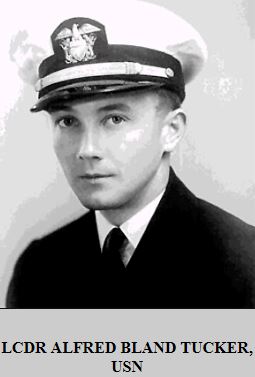
LCDR ALFRED B. TUCKER, III, USN
Lucky Bag Yearbook
From the 1931 Lucky Bag:
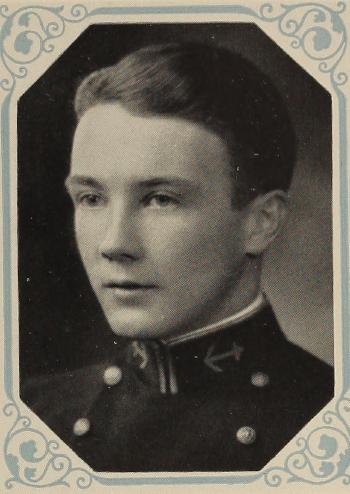
Alfred Bland Tucker, 3rd
N Club Manager; Lacrosse 1 Assistant Manager; Lacrosse 4 3 2; Nm 1; 31; NA; Reception Committee; Gymkhana 4; 1 P. O.
Tuck hails from the aforementioned extremely active hamlet of Winchester. Hailing from the “Old Dominion,” you can always hear Tuck: “Sure, me, Admiral Nulton, and Dick Byrd all come from the same town. " After a year at Severn School, he decided to follow in the footsteps of his predecessors, and come to the Naval Academy.
Abie’s natural personal characteristics placed him high in the esteem of his classmates. A cheerful countenance, and friendships that grew warmer with acquaintance have placed him in the ranks of the selected few. He is a good classmate but to learn his real nature you must look for that happy smile and wrinkled brow. Friends would die for it, and femmes vie for it.
Tuck’s virtues you have heard. His faults are few and far between; first, a constant desire and phenominal ability to sleep at any time, any place, and in any position; and worst, a dying desire to make up his bunk on Saturday mornings. Even with these shortcomings there is not a better wife.
Loss
Alfred was lost on August 19, 1942 when his SDB-3 aircraft crashed at sea near Hawaii.
He was commanding officer of Bombing Squadron (VB) 8 aboard USS Hornet (CV 8); Hornet was in Pearl Harbor until August 17.
Other Information
From researcher Kathy Franz:
Alfred attended Handley High School in Winchester. He worked in a drug store before joining the Navy.
He married Alice McCaw on December 28, 1932, in Norfolk, Virginia.
His father was Dr. Alfred B. Tucker, a practicing physician in New York City who also operated a private hospital at Berryville, Virginia. He died at age 58 in 1915. Alfred’s mother was Martha, and his sisters were Mrs. Thomas S. Ferguson of Sacramento and Mrs. Carroll Campbell of Frederick County, Virginia.
Alred is listed at the Courts of the Missing in Hawaii. His wife was listed as next of kin; he was also survived by a daughter.
Photographs
Navy Cross
From Hall of Valor:
The President of the United States of America takes pride in presenting the Navy Cross (Posthumously) to Lieutenant Commander Alfred Bland Tucker, III (NSN: 0-70101), United States Navy, for extraordinary heroism in operations against the enemy while serving as Pilot of a carrier-based Navy Scout Dive Bomber and Executive Officer of Bombing Squadron EIGHT (VB-8), attached to the U.S.S. HORNET (CV-8), during the “Air Battle of Midway,” against enemy Japanese forces on 6 June 1942. With utter disregard for his own personal safety and in the face of intense anti-aircraft fire, Lieutenant Commander Tucker led his squadron in determined and effective bombing and strafing attacks on fleeing enemy Japanese forces, obtaining a successful hit on one of the enemy ships. His courageous action on this occasion contributed materially to the victory achieved by our forces and was in keeping with the highest traditions of the United States Naval Service.
General Orders: Bureau of Naval Personnel Information Bulletin No. 309 (December 1942)
Action Date: June 6, 1942
Service: Navy
Rank: Lieutenant Commander
Battalion: Bombing Squadron 8 (VB-8)
Division: U.S.S. Hornet (CV-8)
Related Articles
John Waldron ‘24 and William Widhelm ‘32 were also squadron commanders aboard USS Hornet (CV 8) early in the war.
Navy Directories & Officer Registers
The "Register of Commissioned and Warrant Officers of the United States Navy and Marine Corps" was published annually from 1815 through at least the 1970s; it provided rank, command or station, and occasionally billet until the beginning of World War II when command/station was no longer included. Scanned copies were reviewed and data entered from the mid-1840s through 1922, when more-frequent Navy Directories were available.
The Navy Directory was a publication that provided information on the command, billet, and rank of every active and retired naval officer. Single editions have been found online from January 1915 and March 1918, and then from three to six editions per year from 1923 through 1940; the final edition is from April 1941.
The entries in both series of documents are sometimes cryptic and confusing. They are often inconsistent, even within an edition, with the name of commands; this is especially true for aviation squadrons in the 1920s and early 1930s.
Alumni listed at the same command may or may not have had significant interactions; they could have shared a stateroom or workspace, stood many hours of watch together, or, especially at the larger commands, they might not have known each other at all. The information provides the opportunity to draw connections that are otherwise invisible, though, and gives a fuller view of the professional experiences of these alumni in Memorial Hall.
July 1931
October 1931
January 1932
April 1932
October 1932
January 1933
April 1933
July 1933
October 1933
April 1934
July 1934
October 1934
January 1935
April 1935
October 1935
January 1936
April 1936
July 1936
January 1937
April 1937
September 1937
January 1938
July 1938
January 1939
October 1939
June 1940
November 1940
April 1941
Alfred is one of 50 members of the Class of 1931 on Virtual Memorial Hall.