LTCOL PAUL MORET, USMC
Lucky Bag Yearbook
From the 1930 Lucky Bag:
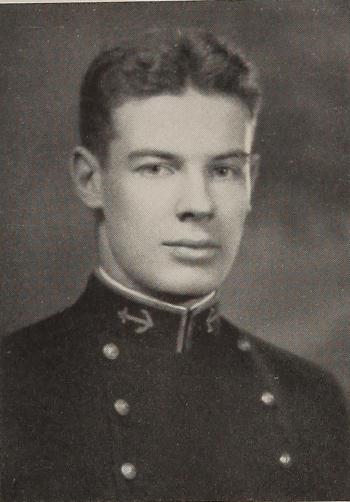
PAUL MORET
Football 4, 3 2, 1, 30 4, N 3, 2, 1; Boxing 4, 3, 2, 1, 30 4, NA 3, bNt 2, Captain 1; Lacrosse 3, 30 2, 1; Four Stripes.
THE nickname of “Trapper” was affixed to Paul after he had related some of his happy adventures with rod and gun in the woods of his native state. He early adapted himself to the routine and discipline of the Naval Academy, however, despite the fact that his time had always been at his disposal before.
Pat has trained himself to be a man in every sense of the word. Personality could be suggested as a middle name, because he is exceedingly popular with both his superiors and his subordinates. That his physique has not been neglected is shown by his athletic achievements. Pat has been an outstanding success in both football and boxing during his years at the Academy. Furthermore, he has managed to stand high academically, seemingly with little or no effort—an enviable achievement.
It is very seldom that one finds a man so quiet and yet so deeply interested in the world’s many and varied amusements. Pat is a literary fiend and spends most of his leisure in reading a good book. He is always occupied with something, and combines a quiet nature with a real and deep-rooted character.
Loss
Paul was lost when the transport aircraft he was aboard crashed near New Caledonia on June 8, 1943. Unable to determine which unit he was stationed with. Earlier in the war he had been commanding officer of Marine Scout-Bomber Squadron (VMSB) 131.
Other Information
From researcher Kathy Franz:
Paul was born in Indiana.
Paul is buried in California. He was married to Dorothy; they had a son Carl Michael, born in Coronado, California. His wife remarried Halle Charles Allen, Jr., Class of 1927.
Remembrances
From Coronado Eagle and Journal, 19 August 1943:
“He was a natural athlete. No matter what sport he engaged in, he was equally adept. Football was his pride and joy.
“The men of his squadron revered him for his gentle understanding and kindness. He won their unqualified respect and devotion …” These were some of the fond recollections yesterday of Mrs. Dorothy Josephine Moret, of Coronado, widow of the Marine hero, Lieutenant Col. Paul Moret, U. S. M. C., who was killed June 8 in a south Pacific plane crash. He was 36.
Mrs. Moret, who resides with her nine-year-old son, Mickey, at 523 Fourth street, has just received the Legion of Merit medal which was awarded to her husband posthumously for outstanding service as Aircraft Operations Officer on Guadalcanal from Nov. 12 to Jan. 20, 1943.
The citation accompanying the award praised Col. Moret for “exceptionally meritorious conduct” in directing operations by Army, Navy and Marine aircraft in bombing, torpedo, reconnaissance, search, antisubmarine and ground support operations, adding:
“Throughout an exceedingly grave period, Lieut. Col. Moret displayed courage, foresight and unusual ability. His skillful employment of aircraft caused severe losses to be inflicted on the enemy in surface vessels, aircraft personnel and vital materials.
“Determined to keep our operational losses at a minimum, he worked tirelessly and with great success toward airdrome control and the training and indoctrination of pilots. “He contributed invaluable service toward the success of our armed forces in the Solomon Islands.”
A native of Jackson, Mich., Col. Moret was graduated from the Naval Academy in 1930, where he starred in football, basketball and boxing and coached football in 1930 and 1935.
During his midshipman days he was an All-Eastern football end and intercollegiate boxing champion, also being captain of his mitt squad. In 1933 he coached and played on the West Coast Marine team in San Diego. He was stationed at North Island from 1933-37.
At the age of 33 the Marine officer became the youngest squadron commander in Marine aviation at that time, having earned his wings in 1932 at the Naval Air Station, Pensacola, Florida.
His last shore assignment before leaving with his squadron for the South Pacific was at North Island, from March to September, 1942. He led his unit only once on a combat mission, encountering no opposition, then was assigned to direct Guadalcanal aerial operations. Mrs. Moret is employed in the bookkeeping department of a bank in Coronado.
From Zamboanga.com; published on January 6, 2001:
I first knew him at Quantico Virginia Marine Barracks when I was assigned to the 1st Marine Air Wing there. Col. Moret, then Capt. Moret, commanded Marine Scout Bombing Squadron 131. This squadron consisted of about 20 SB2U-3 aircraft. The unit moved to San Diego California in December 1941 and sailed shortly thereafter for Hawai. It was based at Ewa Marine Air Station in Hawaii, moved to the southwest pacific area and arrived at Henderson Field, Guadalcanal in the Solomons in November of 1942.
By this time Capt. Moret had been promoted to Major. He was relieved of command on 28 Feb 42 before the movement to the Solomons. He reassumed command for the period 24 March thru 20 November 1942. These switches in command often were caused by a senior officer being transferred in to a unit whereupon the senior did automatically assume command. I mention this so you will understand that Major Moret was not relieved for cause.
When Major Moret left this unit at Guadalcanal is not clear to me. By this time I had returned to the U.S. to begin flight training, actually I left the squadron at Eva prior to its deployment to the Solomons. At some time during this period Major Moret was promoted to Lieut. Colonel and his dive bomber squadron was equipped with new torpedo planes. It was the first USMC torpedo squadron formed during World War II and Col. Moret had the honor to command it.
Colonel Moret was killed in mid 1943 in a transport plane crash at New Caledonia. … James P. Collins, Jr
Legion of Merit
From Hall of Valor:
The President of the United States of America takes pride in presenting the Legion of Merit (Posthumously) to Lieutenant Colonel Paul Moret (MCSN: 0-4528), United States Marine Corps, for exceptionally meritorious conduct in the performance of outstanding services to the Government of the United States during the period from 12 November 1942 through 20 January 1943. As Aircraft Operations Officer on Guadalcanal, Lieutenant Colonel Moret’s courage and unusual ability in the employment of his aircraft caused severe losses to enemy surface vessels, aircraft, and vital materials.
General Orders: Bureau of Naval Personnel Information Bulletin No. 318 (September 1943)
Service: Marine Corps
Rank: Lieutenant Colonel
Moret Field
In March 1945 a Japanese airfield in the Philippines was captured and renamed Moret Field in Paul’s honor.
Naval Academy Superintendent’s Commendation
From the Bureau of Naval Personnel Information Bulletin No. 133 (June 21, 1930):
- The Superintendent has noted with pleasure the exceptional work done by you in promoting athletics at the Naval Academy during the Academic Year 1929-30. He therefore takes this opportunity to commend you for your perseverance, zeal. and example by which you have contributed very much to the promotion of athletics, and the splendid athletic spirit at the Naval Academy.
“2. The Navy Department has been furnished two certified copies of this letter with thé request that one be filed with your record as a midshipman and the other with your record as an officer.”
Navy Directories & Officer Registers
The "Register of Commissioned and Warrant Officers of the United States Navy and Marine Corps" was published annually from 1815 through at least the 1970s; it provided rank, command or station, and occasionally billet until the beginning of World War II when command/station was no longer included. Scanned copies were reviewed and data entered from the mid-1840s through 1922, when more-frequent Navy Directories were available.
The Navy Directory was a publication that provided information on the command, billet, and rank of every active and retired naval officer. Single editions have been found online from January 1915 and March 1918, and then from three to six editions per year from 1923 through 1940; the final edition is from April 1941.
The entries in both series of documents are sometimes cryptic and confusing. They are often inconsistent, even within an edition, with the name of commands; this is especially true for aviation squadrons in the 1920s and early 1930s.
Alumni listed at the same command may or may not have had significant interactions; they could have shared a stateroom or workspace, stood many hours of watch together, or, especially at the larger commands, they might not have known each other at all. The information provides the opportunity to draw connections that are otherwise invisible, though, and gives a fuller view of the professional experiences of these alumni in Memorial Hall.
October 1930
January 1931
April 1931
July 1931
October 1931
January 1932
April 1932
October 1932
January 1933
April 1933
July 1933
October 1933
April 1934
July 1934
October 1934
January 1935
April 1935
October 1935
January 1936
April 1936
July 1936
January 1937
April 1937
September 1937
January 1938
July 1938
January 1939
October 1939
June 1940
November 1940
April 1941
Paul is one of 40 members of the Class of 1930 on Virtual Memorial Hall.