LCDR WELDON L. HAMILTON, USN
Lucky Bag Yearbook
From the 1928 Lucky Bag:
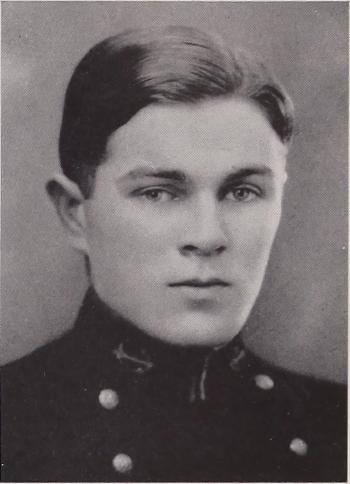
WELDON LEE HAMILTON
Track Squad (4, 3, 2, 1), 1928 (4), 28 (3), NA (2); Captain Track (1); Gymkhana Cast (4).
Loss
Weldon was lost “in an accident near Tontouta Noumea, on 8 June 1943, while a passenger in a transport plane.” He was commander of Air Group 11; also lost were sixteen pilots and aircrew from one of his subordinate squadrons, Torpedo Squadron (VT) 11. They were on their way to a rest and relaxation period in Australia.
Other Information
From researcher Kathy Franz:
Weldon was born in South Carolina. At age 15, he joined the Navy.
He married Inez Esther English on March 28, 1932, in Phoenix, Arizona. In June, 1933, Weldon and Inez traveled from Los Angeles to Honolulu.
His body was repatriated to this country on the funeral ship Honda Knot. Final military services and burial was held at the Golden Gate National Cemetery in November, 1947.
His father was Francis/Frank, an overseer in a cotton mill, and mother Eliza. His sister was Carrie, and his brother was Earl Herbert. In 1910, the family lived in Central, South Carolina; and in 1920, they lived in Central Falls, Rhode Island.
The action for which he was awarded his second Navy Cross is recounted in some detail in The First Team: Pacific Naval Air Combat from Pearl Harbor to Midway. He was commanding officer of Bombing Squadron (VB) 2 at the time. Other actions are also recounted.
On October 10, 1942 he became the first commanding officer of Bombing Squadron (VB) 10; he served as such until he became commanding officer of Air Group 11 sometime before his death. (The page lists September 30, 1943; that is obviously incorrect.) Air Group 11 had been operating from Guadalcanal because of a limited number of aircraft carriers.
From The Edmonton Bulletin (Canada) on February 25, 1943:
Queen of the Flat-Tops
By Stanley Johnston
On May 6, 1942, while the Lexington, as part of a twoo-carrier striking force, was cruising the Coral Sea south of the Louisiade Islands, a scout pilot reported sighting a similar Japanese carrier force far north of the archipelago, heading south. Admiral Frank J. Fletcher, in command of the U.S. force, laid plans to attack the Japanese early the following morning. On the morning of May 7th, U.S. scouts relocated the enemy north of Misima istand, reporting one carrier in the Japanese fleet. How that carrier — later identified as the Ryukaku — was sunk by U.S. planes is vividly described in this installment. This was the beginning of the Coral Sea battle.–EDITOR.
Installment X
= The Sinking of the Ryukaku =
The Lexington’s pilots were all set for take-off at the time the Jap fleet’s location was pinpricked on our charts. A few minutes were required for our navigators to plot the courses our squadrons should fly to intercept the Japanese, and to chalk this and some last minute weather information on the readyroom black board.
Also on the blackboard were instructions to the pilots concerning the course and speed the Lexington would follow for the next three hours. This was information they would require when they started home, and Capt. Sherman always religiously adhered to exactly the speeds and compass headings he had given the pilots before they left. Such matters are vital to men going out to battle.
In all, 76 airplanes were off. They consisted of 24 torpedo planes, and 36 scouts and dive bombers, most of which were carrying a 1,000-pound bomb load. A few of the scouts carried one 500 pounder and two 100 pounders. Finally there was unit of 16 fighter planes to escort the others.
Lieut. Commander Weldon Hamilton, the dive-bomber skipper, told me later: “Our course led us along Island of Tagula for 60 miles. After we had passed Tagula, we went northward to bring us past the eastern tip of Misima. Now we were within 30 miles of where the enemy should be. A few minutes later, we were over the area where we expected to find them, so I began to search the horizon with my powerful binoculars.
“Visibility remarkable, eventually I found, almost 40 miles to the eastward, a number of thin white hairs on the blue sea. A careful look at these showed them to be the wakes of the Japanese fleet seeking. I radioed to the other squadron commanders and we all altered course, to fly toward them. When I was finally able to distinguish the ships, I recognized the carrier from the reflection of the sun on its light colored flight deck.”
= CASCADE OF PLANES =
The arrival of the squadrons over the Japs was also recounted by Lieut. Commander Bob Dixon, who that day was leading his scouts as dive bombers. (These were the planes with single 500 and two 100 pound bombs.)
“We scout bombers came over at 12.000 feet. Enemy fighter patrols were in the air, but they barely reached us as we eased off into our almost vertical dives. To be really effective against dive bombers, fighter planes have to reach them before they get to the turnover point. Ordinarily fighters can’t stay with us in the dive because, with our airbrakes, we keep our speed at about 250 miles an hour. The streamlined fighters go right on past us and pick up speed toward 400 miles an hour.
“But these Japs wouldn’t up. They were Zeros that means they were very clean jobs. The pilots put their flaps down, dropped their landing gear and did everything they could to keep their speed slow. Nevertheless they would go on past us. But that didn’t keep them out either. They would pull up, do a zooming chandelle and come right back in to fire at the next planes diving past. The Zeros stayed with us right down to the water.”
…
= GET A BULLS-EYE =
The first of the heavy dive bombers was piloted by Lieut. Commander Hamilton. “Ham” had been over-carried by the wind in his dive at a Jap cruiser at Salamana and had vowed, before he started his flight this morning of May 7, that he would get a bull’s eye.
“Hamilton did just what he wanted.” Lieut. Commander Paul Ramary, skipper of the Lexington’s fighters, said later. “I watched his dive and saw that he plunked his bomb into the exact-centre of the flight deck just alightly abaft midships. There was a tremendous explosion”
…
His wife was listed as next of kin. He is buried in California.
Photographs
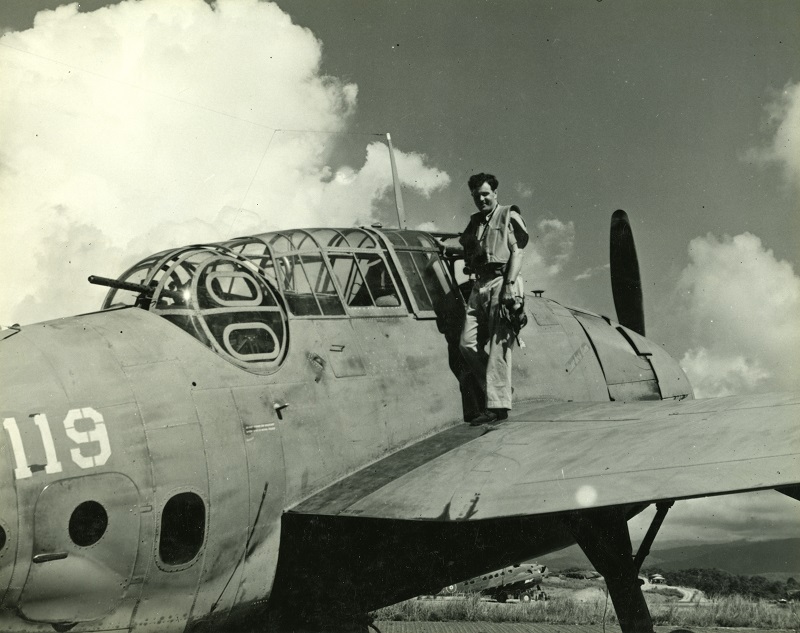
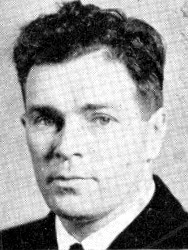
Navy Cross
From Hall of Valor:
The President of the United States of America takes pleasure in presenting the Navy Cross to Lieutenant Commander Weldon Lee Hamilton (NSN: 0-62053), United States Navy, for extraordinary heroism in operations against the enemy while serving as Pilot of a carrier-based Navy Dive Bomber and Commanding Officer of Bombing Squadron TWO (VB-2), attached to the U.S.S. LEXINGTON (CV-2), in action against enemy Japanese forces over enemy-controlled waters near Lae and Salamaua, New Guinea on 10 March 1942. Lieutenant Commander Hamilton led his squadron 125 miles over uncharted mountains and jungles, to press home in the face of heavy anti-aircraft fire, a vigorous and determined dive bombing attack on enemy ships, sinking or crippling three of them. Lieutenant Commander Hamilton’s outstanding courage, daring airmanship and devotion to duty were in keeping with the highest traditions of the United States Naval Service.
General Orders: Commander in Chief Pacific: Serial 6 (April 13, 1942)
Service: Navy
Rank: Lieutenant Commander
From Hall of Valor:
The President of the United States of America takes pleasure in presenting a Gold Star in lieu of a Second Award of the Navy Cross to Lieutenant Commander Weldon Lee Hamilton (NSN: 0-62053), United States Navy, for extraordinary heroism in operations against the enemy while serving as Pilot of a carrier-based Navy Dive Bomber and Commanding Officer of Bombing Squadron TWO (VB-2), attached to the U.S.S. LEXINGTON (CV-2), in action against enemy Japanese forces during the Air Battle of the Coral Sea on 7 May 1942. He led his squadron in a dive bombing attack against an enemy disposition. In this attack, made in the face of heavy anti-aircraft fire and opposed by enemy fighters, he dropped his 1,000 pound bomb on the deck of an enemy carrier. The success of the attack by his squadron attested to the high state of combat efficiency developed under his leadership and inspiring example.
General Orders: Commander in Chief Pacific: Serial 13 (June 16, 1942)
Service: Navy
Rank: Lieutenant Commander
Distinguished Flying Cross
From Hall of Valor:
The President of the United States of America takes pride in presenting the Distinguished Flying Cross (Posthumously) to Lieutenant Commander Weldon Lee Hamilton (NSN: 0-62053), United States Navy, for heroism and extraordinary achievement while participating in aerial flight. Lieutenant Commander Hamilton was killed in an accident near Tontouta Noumea, on 8 June 1943, while a passenger in a transport plane. It is recommended that an award be made to him posthumously for his participation in action described below. As Commanding Officer of Air Group ELEVEN, he displayed to an outstanding degree the qualities of intelligent leadership, personal bravery and the ability to inspire others. While not required to do so, he participated actively in attack missions conducted by squadrons under his command, flying ten missions in a TBF and one in an SBD between 29 April 1943 and 5 June 1943. These missions were all against heavily defended positions and ships. With no thought for his personal safety he repeatedly made bombing attacks against enemy anti-aircraft and searchlight installations that resulted in heavy damage to the enemy and contributed largely to the effectiveness of the missions in which he took part. He participated in a greater number of attacks than any other pilot in this command during this period.
Service: Navy
Rank: Lieutenant Commander
Sundown to Eleven
Weldon’s loss is discussed briefly in the movie Sundown to Eleven:
Navy Directories & Officer Registers
The "Register of Commissioned and Warrant Officers of the United States Navy and Marine Corps" was published annually from 1815 through at least the 1970s; it provided rank, command or station, and occasionally billet until the beginning of World War II when command/station was no longer included. Scanned copies were reviewed and data entered from the mid-1840s through 1922, when more-frequent Navy Directories were available.
The Navy Directory was a publication that provided information on the command, billet, and rank of every active and retired naval officer. Single editions have been found online from January 1915 and March 1918, and then from three to six editions per year from 1923 through 1940; the final edition is from April 1941.
The entries in both series of documents are sometimes cryptic and confusing. They are often inconsistent, even within an edition, with the name of commands; this is especially true for aviation squadrons in the 1920s and early 1930s.
Alumni listed at the same command may or may not have had significant interactions; they could have shared a stateroom or workspace, stood many hours of watch together, or, especially at the larger commands, they might not have known each other at all. The information provides the opportunity to draw connections that are otherwise invisible, though, and gives a fuller view of the professional experiences of these alumni in Memorial Hall.
July 1928
October 1928
January 1929
April 1929
July 1929
April 1930
October 1930
January 1931
April 1931
July 1931
October 1931
January 1932
April 1932
October 1932
January 1933
April 1933
July 1933
October 1933
April 1934
July 1934
October 1934
January 1935
April 1935
October 1935
January 1936
April 1936
July 1936
January 1937
April 1937
September 1937
January 1938
July 1938
January 1939
October 1939
June 1940
November 1940
April 1941
Weldon is one of 15 members of the Class of 1928 on Virtual Memorial Hall.