LCDR CLYDE H. MCCROSKEY, JR., USN
Lucky Bag Yearbook
From the 1935 Lucky Bag:
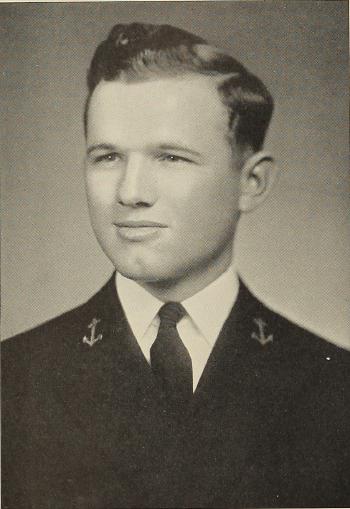
CLYDE HOPKINS McCROSKEY
Gym 4, 3, 2, 1 Numerals. Football 4. Pep Committee 1. Cheer-Leader 1. Musical Show 4, 3, 2, 1. G.P.O.
Loss
Clyde was lost on March 2, 1944 when the aircraft he was piloting crashed during night carrier landing practice at the Norfolk Naval Training Station.
Photographs
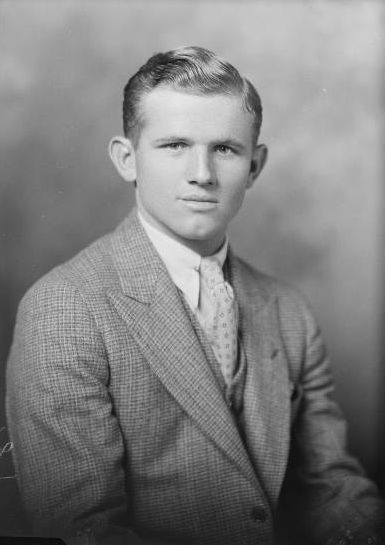
Other Information
From Find A Grave:
Clyde Hopkins McCroskey, Jr. was the son of Clyde Hopkins McCroskey, Sr., and Mary Maulding. He attended the Dermott public school, Hall’s Preperatory School at Columbia, Missouri, the University of Missouri and the United States Naval Academy at Annapolis, Maryland, graduating in 1935.
McCroskey was first assigned to the USS NEW ORLEANS then to the Pensacola Naval Air Station, Florida, for flight training and assignment to the USS LEXINGTON. He served as a flight instructor for one year after graduating from flight school and on the staff of the West Coast Defense Area General Headquarters. In 1943, he was given command of Composite Squadron 58 made up of Wildcat fighters and Avenger torpedo bombers, with the responsibility to equip and train the personnel assigned. The squadron was attached to the USS BLOCK ISLAND (CVE-21) in December 1943 and on its first mission sank a German submarine with a probable sinking of a second.
Commander McCroskey was killed before the second deployment, crash landing at the Norfolk Naval Training Station during night carrier landings on March 2, 1944.
From researcher Kathy Franz: “Per the squadron report: ‘It is believed that his crash occurred as a result of improper switching fuel tanks at low altitude.’ He was in charge of the squadron until his death.”
From the War History of Composite Squadron (VC) 58 (Training):
Composite Squadron VC-58 was fortunate in receiving a long period of training extending from 24 February 1943 to 13 December 1943. During this entire period, the squadron was commanded by Lt. Cdr. C. H. McCroskey. Lt. Cdr. McCroskey was indeed a credit to Naval Aviation. He was gifted with great intelligence and had a thorough knowledge of peace time aviation. His personality was of the best, and he was extremely popular with all personnel under his command. Leadership of the squadron was seldom delegated and the skipper personally led the initial flights of novel or dangerous nature.
It was said of him on numerous occasions that he would never order a pilot to do anything which he would not be willing to do himself with the addition “of course there is no damn thing he won’t do”. Nevertheless, at a time when other VC groups were incurring severe losses in training, VC-58 did not suffer a single casualty. Lt. Cdr. McCroskey was a person of foresight. He early predicted that future warfare would involve a great deal of night flying and as a consequence the squadron not only flew all of the night hours called for in the training syllabi for dive bombing and torpedo plane training but also flew many nights over and beyond such requirements. This training proved valuable in the squadron’s future.
It was the skipper’s idea that the squadron should be well rounded in training and from his store of aviation knowledge he sought to attain this result. At Seattle and Whidbey Island, Washington the squadron received much practice in operation of ASB radar. This training included not only radar search and navigation but also included radar approaches for bombing and torpedoes, including actual release of bombs and torpedoes based on radar ranges. At Whidbey Island the squadron concentrated on dive bombing, torpedo work, high altitude, low level, and glide bombing, overwater navigation carrier technique, and rendezvous, cross country flights and similar training.
He is buried in Arkansas. His wife was the former Betty Dosch; he was also survived by his parents.
Navy Directories & Officer Registers
The "Register of Commissioned and Warrant Officers of the United States Navy and Marine Corps" was published annually from 1815 through at least the 1970s; it provided rank, command or station, and occasionally billet until the beginning of World War II when command/station was no longer included. Scanned copies were reviewed and data entered from the mid-1840s through 1922, when more-frequent Navy Directories were available.
The Navy Directory was a publication that provided information on the command, billet, and rank of every active and retired naval officer. Single editions have been found online from January 1915 and March 1918, and then from three to six editions per year from 1923 through 1940; the final edition is from April 1941.
The entries in both series of documents are sometimes cryptic and confusing. They are often inconsistent, even within an edition, with the name of commands; this is especially true for aviation squadrons in the 1920s and early 1930s.
Alumni listed at the same command may or may not have had significant interactions; they could have shared a stateroom or workspace, stood many hours of watch together, or, especially at the larger commands, they might not have known each other at all. The information provides the opportunity to draw connections that are otherwise invisible, though, and gives a fuller view of the professional experiences of these alumni in Memorial Hall.
July 1936
January 1937
April 1937
September 1937
January 1938
July 1938
January 1939
October 1939
June 1940
November 1940
April 1941
Clyde is one of 56 members of the Class of 1935 on Virtual Memorial Hall.