LCDR THOMAS W. MARSHALL, JR., USN
Lucky Bag Yearbook
From the 1930 Lucky Bag:
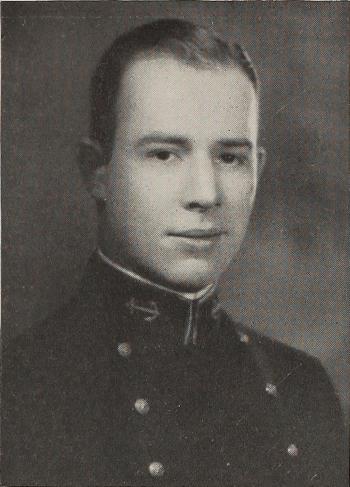
THOMAS WORTH MARSHALL, JR.
Company Representative 3; Ring Committee 3, 2, 1; 1 P.O.
THREE years of architecture; a Sigma Chi; and a man about town was Tacky; then one day he was swallowed up by 500 of us. That day he was tall, dark, and handsome, but he was just a plebe.
A biography is necessarily brief. But a few words must be said for Tom: here is a man who has found what he wants to do and has done it, who is at his best on a cruise and admits it, who can go below for ten minutes and come up with a detailed sketch of the engineering installation, turn his youngsters to and have his division looking like a Dutch housewife’s kitchen for Skipper’s inspection, or shoot Arcturus, Vega, and Spica and intersect them in a pinpoint on his chart.
Has he faults? Well, naturally. Some of them: a passion for “nickel magazines,” a greater passion for sleep, an inherent dislike of a razor, and—if it can be classed as a fault—a past in which iced coffee has been his strongest stimulant.
Despite these unalterable facts, and sundry others which space does not permit of mention, those of his classmates who know would say “Tacky Marshall, yeah—a water man———”
Loss
Thomas was lost when USS Jacob Jones (DD 130) was torpedoed on the morning of February 28, 1942 by U-578 off the coast of Delaware.
From the March 3, 1942 Naval communique reprinted in the April, 1942 issue of Shipmates:
The USS JACOB JONES, a World War destroyer, was sunk by an enemy submarine off Cape May, New Jersey, just before dawn on February 28, 1942.
There were only eleven survivors consisting of nine engine room ratings and two apprentice seamen. Factual information in regard to the circumstances that led to the sinking is sparse because of the lack of deck ratings among the survivors. It has been established, however, that prior to receiving the first torpedo hit, the enemy submarine was not sighted nor was the torpedo.
The first torpedo blew up the bow and apparently killed all the personnel on the bridge as well as the men sleeping in the forward living compartments. The second torpedo, which was fired after the submarine circled ahead of the JACOB JONES, blew up the stern and all the depth charges.
The only survivors, except one man from the after engine room, were in the amidship section when the stern was blown up.
Other Information
From Destroyer History:
Lt. Comdr. Thomas W. Marshall, Jr., born 22 December 1906 in the District of Columbia, graduated from the U.S. Naval Academy and was commissioned ensign 5 June 1930. Prior to 1939 he served in Nevada, Marblehead, Houston, John D. Ford and S-42.
On 15 June 1939 he joined Jacob Jones as executive officer. Lt. Comdr. Marshall was killed when Jacob Jones was sunk by enemy torpedo off Cape May, N.J., 28 February 1942.
From researcher Kathy Franz:
His father Thomas was a civil engineer and building contractor. His mother Kathleen died in 1915. His brothers were Donald born 1899, Henry born 1904, Whitfield born 1909 and James Philip born 1913, a Navy commander. His sisters were Mary and Jane (Mrs. Baird). His stepmother was Grace (nee Mead.)
His father was listed as next of kin. He was also survived by a brother, who retired from the Navy as a Commander.
Photographs
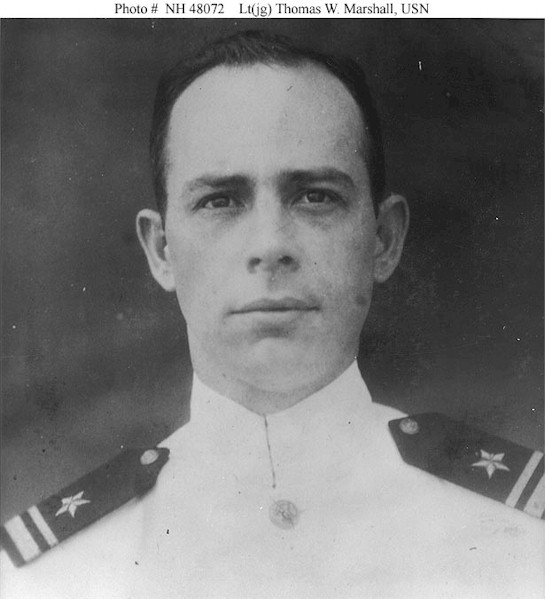
Namesake
USS Marshall (DD 676) was named for Thomas.
Related Articles
Hugh D. Black ‘26, Burton R. Hanson ‘40, and Norman C. Smith ‘42 were also lost when Jacob Jones was torpedoed.
Navy Directories & Officer Registers
The "Register of Commissioned and Warrant Officers of the United States Navy and Marine Corps" was published annually from 1815 through at least the 1970s; it provided rank, command or station, and occasionally billet until the beginning of World War II when command/station was no longer included. Scanned copies were reviewed and data entered from the mid-1840s through 1922, when more-frequent Navy Directories were available.
The Navy Directory was a publication that provided information on the command, billet, and rank of every active and retired naval officer. Single editions have been found online from January 1915 and March 1918, and then from three to six editions per year from 1923 through 1940; the final edition is from April 1941.
The entries in both series of documents are sometimes cryptic and confusing. They are often inconsistent, even within an edition, with the name of commands; this is especially true for aviation squadrons in the 1920s and early 1930s.
Alumni listed at the same command may or may not have had significant interactions; they could have shared a stateroom or workspace, stood many hours of watch together, or, especially at the larger commands, they might not have known each other at all. The information provides the opportunity to draw connections that are otherwise invisible, though, and gives a fuller view of the professional experiences of these alumni in Memorial Hall.
October 1930
January 1931
April 1931
July 1931
October 1931
January 1932
April 1932
January 1933
April 1933
July 1933
October 1933
April 1934
July 1934
October 1934
January 1935
April 1935
October 1935
January 1936
April 1936
July 1936
January 1937
April 1937
September 1937
January 1938
July 1938
January 1939
October 1939
June 1940
November 1940
April 1941
Thomas is one of 40 members of the Class of 1930 on Virtual Memorial Hall.