LT JAMES F. MCDONOUGH, USN
Lucky Bag Yearbook
From the 1924 Lucky Bag:
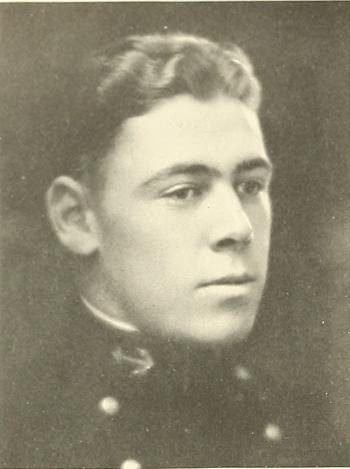
JAMES FRANCIS McDONOUGH
Class Lacrosse (3, 2); Numerals (2).
“HEY, ‘Mac’! Ya sat?”
“Hell, no!”
Our hero fails to wear the stellar decoration which is so popular with the boys from the savvy state, but don’t get the idea that it is because of his inability. Far be it from that! As he puts it, the Academic Department merely can’t agree with his answers on the exams.
“Caulking” and “Workouts” are his delights. “Got to work out tonight,” is his only comment after a hard drill.
Try to find him studying when there is a review lesson the next period.
“What have we got? Review? Fruit! Wake me up in time for the formation, will ya?”
He even goes to church before breakfast on Sundays, so that he can sleep all morning while the rest of us go to chapel.
“Mac” brandishes a potent lacrosse stick for ‘24. Even the workouts are given up when lacrosse season is on.
Although not absolutely a Red Mike, “Mac” seldom drags the femmes. However, he quite frequently drags a Springfield on pleasant afternoons.
It you want to see him smile, ask him about Youngster cruise and Christiania.
Loss
James was lost when his torpedo bomber crashed on July 25, 1938, near Norfolk, Virginia. He was a member of Torpedo Squadron (VT) 5, operating from USS Yorktown (CV 5). Two other members of the squadron, William Drumtra ‘34 and Aviation Cadet John R. Patch, were also killed.
(Information via Press and Sun Bulletin on Monday, July 25, 1938; scan emailed on February 10, 2018 by a researcher providing information on Bill Drumtra ‘34.)
Other Information
From researcher Kathy Franz:
Attached to the YT-5 USS Yorktown, James’ plane was en route to Squantum, Massachusetts when a rain squall trapped the plane and it plunged nose downward to earth. It dug a crater eight feet deep on the Carpenter farm in Woodbridge.
The plane had lost its way to the extent that it was seen over Seymour, 10 miles north of its course, and turned south and circled Woodbridge several times before crashing. The plane’s propeller was found in high indicating James in a final effort was to switch the propeller into low in an effort to reorient the plane’s direction.
About three months earlier, on May 7, 1938, James, his wife Hazel, and daughters Lida and Catherine sailed from Honolulu to Los Angeles. They had been in Honolulu since September 3, 1936, when Catherine was 6 months old.
James and Hazel Sullivan were married on December 31, 1931, at St. Margaret’s church in Dorchester, Massachusetts. Lida was born in 1933, in Florida, and Catherine was born in February, 1936, in California.
James’ father Lt. Col. John J. McDonough was born in Ireland in 1880, and he died in 1965. His mother Catherine A. was born in Massachusetts in 1882, and she died in February, 1923. Both parents were buried in St. Joseph’s Cemetery, West Roxbury. James’ sisters were Winifred and Rose, and their brother was John.
James was buried with a full military funeral on July 26, 1938, in St. Joseph’s cemetery. He was disinterred in March 1961, and removed to New Calvary Cemetery. He was reburied in Section 7, grave 1409B with his wife Hazel. Their daughter, now Lida Hawk, owned the plot. Additionally at this cemetery, his aunt Nora erected a monument to his mother Catherine and their brother Patrick. His other aunt was Mrs. Ethel Renehan.
He was survived by his wife and daughter in addition to his father, who was the Works Progress Administration head for Massachusetts.
James is buried in Massachusetts with his wife.
Related Articles
William Drumtra ‘34 was also lost in this crash.
Navy Directories & Officer Registers
The "Register of Commissioned and Warrant Officers of the United States Navy and Marine Corps" was published annually from 1815 through at least the 1970s; it provided rank, command or station, and occasionally billet until the beginning of World War II when command/station was no longer included. Scanned copies were reviewed and data entered from the mid-1840s through 1922, when more-frequent Navy Directories were available.
The Navy Directory was a publication that provided information on the command, billet, and rank of every active and retired naval officer. Single editions have been found online from January 1915 and March 1918, and then from three to six editions per year from 1923 through 1940; the final edition is from April 1941.
The entries in both series of documents are sometimes cryptic and confusing. They are often inconsistent, even within an edition, with the name of commands; this is especially true for aviation squadrons in the 1920s and early 1930s.
Alumni listed at the same command may or may not have had significant interactions; they could have shared a stateroom or workspace, stood many hours of watch together, or, especially at the larger commands, they might not have known each other at all. The information provides the opportunity to draw connections that are otherwise invisible, though, and gives a fuller view of the professional experiences of these alumni in Memorial Hall.
July 1924
September 1924
November 1924
January 1925
March 1925
May 1925
July 1925
October 1925
January 1926
October 1926
January 1927
April 1927
October 1927
January 1928
April 1928
July 1928
October 1928
January 1929
April 1929
July 1929
October 1929
January 1930
April 1930
October 1930
January 1931
April 1931
July 1931
October 1931
January 1932
April 1932
October 1932
January 1933
April 1933
July 1933
October 1933
April 1934
July 1934
October 1934
January 1935
April 1935
October 1935
January 1936
April 1936
July 1936
January 1937
April 1937
September 1937
January 1938
July 1938
James is one of 39 members of the Class of 1924 on Virtual Memorial Hall.