LT ROBERT T. SYMES, USN
Lucky Bag Yearbook
From the 1927 Lucky Bag:
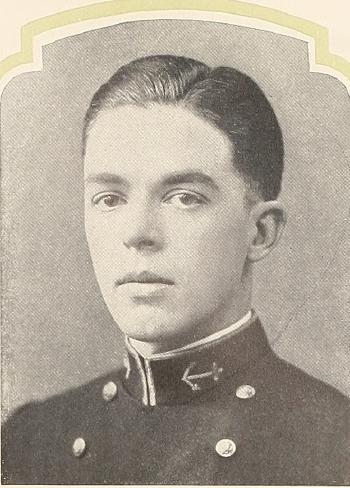
Robert Thomas Symes
Baseball: Class (5, 3); Crew: Manager (1) Block N (1); Basketball: Plebe Team.
AT last the Math Department is due for some commendation. Through its bilging efforts Bob came into our midst during Plebe year. With his winning ways and true comradeship he immediately proceeded to carve for himself a niche in our hearts which only grows deeper and more permanent as time rolls by.
Bob has evinced only a spasmodic interest in athletics, although we believe he possesses latent powers. Was he not on the basketball squad Plebe year? The apparent reason for this lack of interest in athletics lies in his consistent boning of the Cosmo and associated. Any other type of boning is absolutely taboo, which perchance explains why we are now graced with his presence.
The thought that the gentler sex has resisted his charms is not to be harbored, for one only has to gaze on his raven black hair and ruddy cheek to realize that there must be many broken hearts throughout his scattered ports of call.
Gifted with an overflowing well of cheery good humor and the rare knack of being able to express himself, Bob has enlivened many gatherings with the narration of the anecdotes of his prep school days in Washington and his eventful cruises.
A parting hint—if you are to escape this man’s personality, steer clear of his course, for once exposed you are infected forever.
Loss
Robert was lost on November 30, 1936 when the airplane he was piloting crashed near La Jolla, California. His crewman was also killed; they were members of Fighting Plane Squadron (VF) 1B.
Other Information
From researcher Kathy Franz:
Robert was born in Gainesville, New York. He attended Medina and Lockport schools.
In July 1920, Robert and his brother Harold took a 5,600-mile auto trip to Texas for ten weeks. They rigged up their Ford car with a complete kitchen outfit and other camping necessities.
In September 1920, Robert was manager of the Lockport football team. In February 1921, Robert was on the Lockport basketball team which played the Hutchinson-Central high school in Buffalo. The team members were assured their valuables would be safe in the locker room. However, the boys lost cuff links, a tie-pin and the team captain’s gold watch.
In November and December 1928, Robert attended the Chemical Warfare School at the Edgewood Arsenal, Maryland.
Robert was commended by Secretary of Navy Charles Francis Adams in October 1932 for the highest horizontal bombing score during the 1931-32 competition.
His wife was Jessie Drank Symes, born in Washington, D.C. in 1911. Their two children were Ann and Robert, Jr. Robert, Jessie and Ann returned from Cristobal, Canal Zone, in June, 1934.
Robert’s father John was president of the Niagara County National Bank and Trust Company and a past governor of the 27th district of Rotary International. His mother was Jane, his brothers were Harold and John, Jr., and their sister was Florence (Mrs. Robert C. Bishop of Lockport.)
He earned his wings as naval aviator #3661 on July 1, 1930.
Robert is buried in New York; he was survived by his father, and a son Robert Jr.
Navy Directories & Officer Registers
The "Register of Commissioned and Warrant Officers of the United States Navy and Marine Corps" was published annually from 1815 through at least the 1970s; it provided rank, command or station, and occasionally billet until the beginning of World War II when command/station was no longer included. Scanned copies were reviewed and data entered from the mid-1840s through 1922, when more-frequent Navy Directories were available.
The Navy Directory was a publication that provided information on the command, billet, and rank of every active and retired naval officer. Single editions have been found online from January 1915 and March 1918, and then from three to six editions per year from 1923 through 1940; the final edition is from April 1941.
The entries in both series of documents are sometimes cryptic and confusing. They are often inconsistent, even within an edition, with the name of commands; this is especially true for aviation squadrons in the 1920s and early 1930s.
Alumni listed at the same command may or may not have had significant interactions; they could have shared a stateroom or workspace, stood many hours of watch together, or, especially at the larger commands, they might not have known each other at all. The information provides the opportunity to draw connections that are otherwise invisible, though, and gives a fuller view of the professional experiences of these alumni in Memorial Hall.
April 1928
July 1928
October 1928
January 1929
April 1929
July 1929
October 1929
January 1930
April 1930
October 1930
January 1931
April 1931
July 1931
October 1931
January 1932
April 1932
October 1932
January 1933
April 1933
July 1933
October 1933
April 1934
July 1934
October 1934
January 1935
April 1935
October 1935
January 1936
April 1936
July 1936
Robert is one of 41 members of the Class of 1927 on Virtual Memorial Hall.