LCDR RENWICK S. CALDERHEAD, USN
Lucky Bag Yearbook
From the 1927 Lucky Bag:
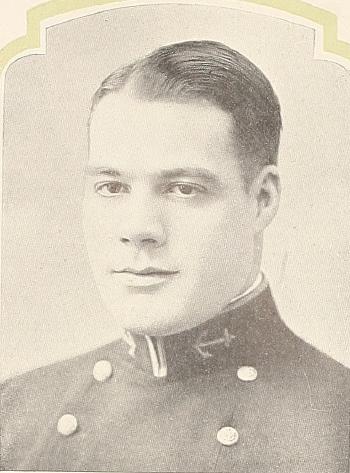
Renwick Silas Calderhead
Wrestling: A Squad (3, 2, 1) Plebe (4) Navy Numerals (4, 2); Gym Class Numerals (3).
POLAR made a roaring good start on his Naval career, and you can take that literally. His talent in impersonating Tarzan was discovered early Plebe year, and the Mess Hall hasn’t been the same since. His main pastimes Plebe year were scaring people, driving imaginary dog teams around the tables in the Mess Hall, and shaking the roof with his howls.
Youngster year was survived by dint of some hard boning, and another defeat for the Academic Department was chalked up. Polar’s spare moments were spent in the wrestling loft, breaking bones (other peoples’), and his ability on the mat soon won him a regular berth on the squad.
But 158 pounders aren’t the only things that Polar can throw. His fame as a Mexican athlete has spread far and wide, and many a bull contest has seen him emerge top-side. His tales of the North Country have chilled the blood of many gatherings, and oft has he told the quaint story of “What They Do in Alaska in the Winter.”
In spite of his rare yarns. Polar really means well. He is a man that we are very glad to have as a classmate, and we hope that we’ll have him as a shipmate some day.
Loss
Renwick was lost on August 20, 1942 when the PBY-5 Catalina he was piloting crashed at Manzanilla Bay, Panama.
Three others were also killed; four were injured. He was commanding officer of Patrol Squadron (VP) 34 from the squadron’s establishment on April 16, 1942 until his death.
Other Information
From researcher Kathy Franz:
Renwick was known as Rennie or “Si,” In June 1913, Renwick was one of the escorts for the queen in the Festival of the Midnight Sun parade.
Per the Fairbanks Daily Times, June 22, 1913:
He was born in Dawson on July 29, 1903. He moved with his parents from one camp to another in the interior of Alaska.
When but a few months old, he became a resident of Circle, on the upper Yukon, and later lived on Mastodon creek, some distance from the river port. Until the spring of 1905, the Calderheads were on Mastodon, stampeding to the Kantishna that fall when other fortune-seekers rushed into that remote section, in the foothills of the Alaskan range. While there “Si” was playing on a sandbar on the river one day, when a big bull moose ran down from the woods. “Si” was taken completely by surprise and took to the water. His cries attracted the attention of his father and others, who frightened the moose back into the wilderness whence he had come.
In 1906, when Mr. and Mrs. Calderhead moved to Hot Springs, in the lower Tanana district, “Si” was privileged to see his first cow and first chickens. In 1910, Fairbanks attracted the Calderheads, and since that time “Si” has numbered among his friends the healthy, lusty-lunged youth of the interior Alaska’s biggest mining camp.
He is in the fifth grade at school, likes to play ball and is a lover of the outdoor. He has never been outside and has never seen a street car.
In October, 1913, Renwick had a case of typhoid fever. In May, 1914, he played right field for the Rip Van Curlers baseball team in the junior baseball championship in Fairbanks.
Renwick wrestled his classmate at the Fraternal Order of Eagles luncheon and program in October, 1915. “They went three rounds of five minutes each and worked hard to secure a fall, but neither was successful. Both showed great knowledge of the finer points of the game.”
In November, 1941, he was promoted, and in April, 1942, his family sailed from Honolulu to San Francisco. His wife was Pauline.
In 1910 Hot Springs, Alaska, his father Renwick Wallace was a freighter, his mother was Josephine, and his brother was Wallace.
Renwick was survived by his wife and two sons, Dickie and Renwick Jr., as well as a brother, Wallace.
Navy Directories & Officer Registers
The "Register of Commissioned and Warrant Officers of the United States Navy and Marine Corps" was published annually from 1815 through at least the 1970s; it provided rank, command or station, and occasionally billet until the beginning of World War II when command/station was no longer included. Scanned copies were reviewed and data entered from the mid-1840s through 1922, when more-frequent Navy Directories were available.
The Navy Directory was a publication that provided information on the command, billet, and rank of every active and retired naval officer. Single editions have been found online from January 1915 and March 1918, and then from three to six editions per year from 1923 through 1940; the final edition is from April 1941.
The entries in both series of documents are sometimes cryptic and confusing. They are often inconsistent, even within an edition, with the name of commands; this is especially true for aviation squadrons in the 1920s and early 1930s.
Alumni listed at the same command may or may not have had significant interactions; they could have shared a stateroom or workspace, stood many hours of watch together, or, especially at the larger commands, they might not have known each other at all. The information provides the opportunity to draw connections that are otherwise invisible, though, and gives a fuller view of the professional experiences of these alumni in Memorial Hall.
January 1928
April 1928
July 1928
October 1928
January 1929
April 1929
July 1929
October 1929
January 1930
April 1930
October 1930
January 1931
April 1931
July 1931
October 1931
January 1932
April 1932
October 1932
January 1933
April 1933
July 1933
October 1933
April 1934
July 1934
October 1934
January 1935
April 1935
October 1935
January 1936
April 1936
July 1936
January 1937
April 1937
September 1937
January 1938
July 1938
January 1939
October 1939
November 1940
Renwick is one of 41 members of the Class of 1927 on Virtual Memorial Hall.