LTJG JOHN J. DAUB, JR., USN
Lucky Bag Yearbook
From the 1936 Lucky Bag:
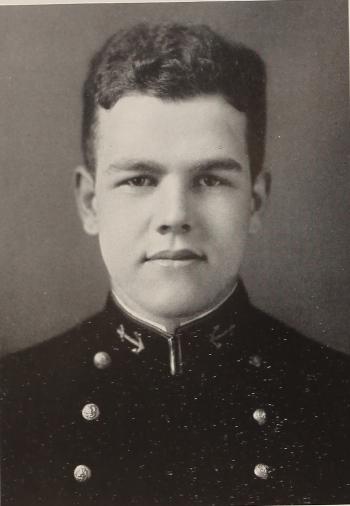
John Justus Daub, Jr.
Class Football 4; Class Lacrosse 4; Water Polo 4, 3, 2, 1; One Stripe
Loss
John was lost when USS Reuben James (DD 245) was sunk by a torpedo attack from German submarine U-552 near Iceland on October 31, 1941.
Other Information
From the Class of 1936’s “Golden Lucky Bag,” published in 1986 (via Marianne Bradley, daughter of LCDR John Ellis ‘36, USN (Ret.)):
Jack had hoped to go into aviation and aeronautics after graduation but unfortunately his eyes did not make the grade for Pensacola and as close as he could get to flying without being in it was to put three years in the carrier Ranger, and a fair part of that in anti-aircraft control. In April 1939, he reported for duty on the staff of Aircraft, Battle Force where he served a year as a Communications Watch Officer. He then moved on to destroyers with a tour in Bainbridge in the Atlantic Fleet which lasted until September 1941 when he was transferred to Reuben James, an old four-piper on convoy escort duty in which Jack’s USNR classmate, Jim Belden, had been serving since the previous year.
On 31 October 1941, Reuben James was one of five U.S. escorts in a convoy 600 miles west of Ireland. At dawn, as Reuben James changed course to investigate unknown radio transmissions, the ship was hit by a torpedo on the port side near number 1 stack. A tremendous explosion blew the forward part of the ship to bits, evidence that the torpedo hit the forward magazine. Five minutes later the stern half of the ship also sank. Of the ship’s company of 160, 115 were lost including Jack and all his fellow officers. Forty-five men were picked up by the destroyers Niblack and Hilary P. Jones.
Jack was a competent, good natured officer, somewhat laconic, with a well dimpled smile. It is unfortunate that his eyes kept him from aviation and that, in 1941, the need for seagoing officers for the North Atlantic convoys was greater than the requirement for candidates for postgraduate work in Aeronautical Engineering. Jack, with his shipmate, Jim Belden, were the first of the class to give up their lives in combat with the enemy.
There was no next of kin listed, but he was survived by his parents, grandmother, a sister, and a brother. His brother, 2nd Lt Arthur Craig Daub, US Army Air Corps, was lost in a plane crash in May 1942.
From the Pittsburgh Sun Telegraph on November 2, 1941:
Daubs Hopeful For Son Aboard Reuben James
Saltsburg, Pa., Nov 1—Night is shading the elm-studdeed, winding lanes of the Kiski Prep School campus. Rain lashes the campus buildings in miniature waves remindful of the dark Atlantic which swallowed the Destroyer Reuben James.
On the outer rim of the campus is an ivy-covered, Dutch Colonial home—the headmaster’s house—the residence of John J. Daub, Sr. the “Mr. Chips” of Salsburg.
The lights are dim, smoke from a heart-warming fire place creeps lazily up the chimney.
A Hope and a Prayer
In the small, book-lined library, twisting a radio dial with the hope and prayer for information on the fate of his son, sits 47-year-old, sandy-haired, bespectacled Headmaster Daub.
His elder son, Gunnery Officer, Lieut. John J. Daub, Jr., a true son of Kiski, was aboard the sunken Reuben James — transferred there three weeks ago.
He tells you: “It’s a tough break for him.”
You inquire about the health of the boy’s mother—how the shock of the news affected her. There are tears in his eyes, but his voice is firm, resolute: “His mother is fine and she will be fine, for that’s just the kind of a person she is. We’ve got to take things as they come. We’ve got to expect things like this in war.”
Across the hall—from the music room—come strains of “Reverie,” a few bars of “Taps,” and the soothing echoes of a waltz, from the piano-playing fingers of Marcia Daub.
Perhaps she remembers Brother Jack’s postcard of a few days ago, from Iceland—a card showing long sheets of ice and snow, barren except for two barracks, and on which Jack, 26, had written: “It isn’t as inhospitable as it looks.”
Upstairs, in a rear bedroom, sits Mrs. Daub—caring for her 76-year-old mother, Mrs. A W. Wilson, widow of the founder of Kiski, critically ill from a stroke.
Planned Yule Visit
In the library, between puffs on his pipe, Daub recalls his son’s voice from Boston two weeks ago, in which young Daub expressed the hope he could get home for Christmas.
In his last letter—received the day the ship sank—young Daub had been in high spirits.
Young Daub had wanted to fly for the Army, but defective eyesight prevented him and he went to the Navy.
Headmaster Daub tells you we will be more actively in the war—can’t help it—but hopes we are prepared for it when the time comes. He believes President Roosevelt is biding his time because America isn’t ready.
Related Articles
Samuel Hunter, Jr. ‘38 was John’s cousin.
Navy Directories & Officer Registers
The "Register of Commissioned and Warrant Officers of the United States Navy and Marine Corps" was published annually from 1815 through at least the 1970s; it provided rank, command or station, and occasionally billet until the beginning of World War II when command/station was no longer included. Scanned copies were reviewed and data entered from the mid-1840s through 1922, when more-frequent Navy Directories were available.
The Navy Directory was a publication that provided information on the command, billet, and rank of every active and retired naval officer. Single editions have been found online from January 1915 and March 1918, and then from three to six editions per year from 1923 through 1940; the final edition is from April 1941.
The entries in both series of documents are sometimes cryptic and confusing. They are often inconsistent, even within an edition, with the name of commands; this is especially true for aviation squadrons in the 1920s and early 1930s.
Alumni listed at the same command may or may not have had significant interactions; they could have shared a stateroom or workspace, stood many hours of watch together, or, especially at the larger commands, they might not have known each other at all. The information provides the opportunity to draw connections that are otherwise invisible, though, and gives a fuller view of the professional experiences of these alumni in Memorial Hall.
July 1936
January 1937
April 1937
September 1937
January 1938
July 1938
January 1939
October 1939
June 1940
John is one of 39 members of the Class of 1936 on Virtual Memorial Hall.