CDR MARK ESLICK, JR., USN
Lucky Bag Yearbook
From the 1935 Lucky Bag:
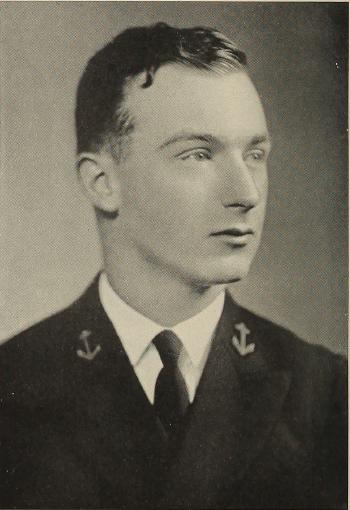
MARK ESLICK
Class Football 3. B Squad Football 2. Glee Club 4, 3, 2. Choir 4, 3, 2, 1. 1 Stripe.
Loss
Mark was lost when his Curtiss SB2C-3 Helldiver was shot down over Kiirun Harbor, Formosa on October 12, 1944. He was commanding officer of Bombing Squadron (VB) 18, flying from USS Intrepid (CV 11).
From The Honolulu Advertiser on December 3, 1944:
Lt. Cmdr. George D. Ghesquiere … who graduated from the Naval Academy in 1939 …Only recently he was given command of his squadron when the former skipper, Cmdr. Mark Eslick, Jr., of Pulaski, Tenn., was shot down while leading a mission over Formosa on Oct. 12. Ghesquiere feels the loss keenly as he had been executive under Eslick. The latter was a graduate of Annapolis in ’35 and was highly regarded by the officers and men under him. On the day he was lost visibility was down to almost zero and the flight had to climb high over the Formosan mountains to reach its target. They found it and Mark was the first to dive, but he had to make it from 5,500 feet which is bad altitude for a dive-bomber. However, he scored a hit but the AA was very heavy. No one actually saw him go in but no one saw him after the dive as there was also considerable fighter opposition and the other planes were busy escaping into the clouds.
Other Information
From researcher Kathy Franz:
Mark was a member of the Naval Academy Glee Club which sang at an evensong service at the Washington cathedral on Sunday, April 28, 1935.
His father was Mark, a banker, mother Hallie, and sisters Helen and Martha.
From VB-18 War Diary: The week of October 18-25, Ghesquiere led the Helldivers in attacks which destroyed 25,000 tons of enemy shipping, sank a medium carrier, damaged another medium carrier and two battleships, including one of the largest, most modern class.
As reported in the Class News section of the July 1946 issue of Shipmate, Mark had taken over command of Harlan’s VB-18 squadron in February 1944. As commanding officer he “…flew 12 bombing and strafing missions against Palau, the Philippines, Nansli Shoto, and Formosa; led a 700-mile attack which destroyed 55,000 tons of merchant shipping; led 6 unescorted bombers in a devastating attack on harbor installations in the principal port of Northern Formosa.”
Mark’s Naval Academy ring is in the collection of the US Naval Academy Museum.
His wife was listed as next of kin; they had two children together. His wife, Jane, later remarried a classmate of Mark’s. Mark was also survived by his parents and sister.
Silver Star
From Hall of Valor:
(Citation Needed) - SYNOPSIS: Commander Mark Eslick, Jr. (NSN: 0-74816), United States Navy, was awarded the Silver Star (Posthumously) for extraordinary gallantry in action as Commanding Officer of a dive bombing squadron embarked in U.S.S. INTREPID (CV-11), on 12 October 1944. His gallant actions and dedicated devotion to duty, without regard for his own life, were in keeping with the highest traditions of military service and reflect great credit upon himself and the United States Naval Service.
General Orders: Bureau of Naval Personnel Information Bulletin No. 348 (March 1946)
Action Date: October 12, 1944
Service: Navy
Division: U.S.S. Intrepid (CV-11)
Distinguished Flying Cross
From Hall of Valor:
(Citation Needed) - SYNOPSIS: Commander Mark Eslick, Jr. (NSN: 0-74816), United States Navy, was awarded the Distinguished Flying Cross for extraordinary achievement while participating in aerial flight during World War II.
General Orders: American Battle Monuments Commission
Action Date: World War II
Service: Navy
Rank: Commander
Navy Directories & Officer Registers
The "Register of Commissioned and Warrant Officers of the United States Navy and Marine Corps" was published annually from 1815 through at least the 1970s; it provided rank, command or station, and occasionally billet until the beginning of World War II when command/station was no longer included. Scanned copies were reviewed and data entered from the mid-1840s through 1922, when more-frequent Navy Directories were available.
The Navy Directory was a publication that provided information on the command, billet, and rank of every active and retired naval officer. Single editions have been found online from January 1915 and March 1918, and then from three to six editions per year from 1923 through 1940; the final edition is from April 1941.
The entries in both series of documents are sometimes cryptic and confusing. They are often inconsistent, even within an edition, with the name of commands; this is especially true for aviation squadrons in the 1920s and early 1930s.
Alumni listed at the same command may or may not have had significant interactions; they could have shared a stateroom or workspace, stood many hours of watch together, or, especially at the larger commands, they might not have known each other at all. The information provides the opportunity to draw connections that are otherwise invisible, though, and gives a fuller view of the professional experiences of these alumni in Memorial Hall.
October 1935
January 1936
April 1936
July 1936
January 1937
April 1937
September 1937
January 1938
July 1938
January 1939
October 1939
June 1940
November 1940
April 1941
Mark is one of 56 members of the Class of 1935 on Virtual Memorial Hall.