LCDR SEYMOUR A. JOHNSON, USN
Lucky Bag Yearbook
From the 1927 Lucky Bag:
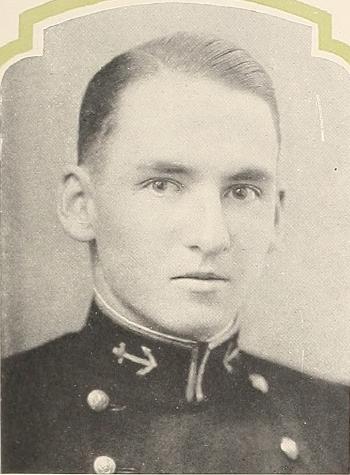
Seymour Anderson Johnson
Wrestling A Squad (3, 2, 1); Plebe Varsity (4).
ANDY seems to have quite a hobby in going to school. Before casting his lot with the Navy he completed three years at the University of North Carolina, where he was a popular man in campus life. However, he decided that the Navy was the place for him, and he says Uncle Sam has a good officer, if the unexpected doesn’t happen.
You should have seen him when he first entered the Academy. He certainly was bewildered, that freckle-faced lad. Just mention freckles to him now and all he says is, “Just wait and see; I’ve got them under control now.” Passing by his room, one often hears, “Shut up or I’ll throw you out the window.” These hard words carry all over the deck and the gang comes on the run to his room, to save his roommate. It pleases him to talk loudly and harshly, but really, he’s harmless. Sam is always willing to help you in anything and this, combined with his congenial ways, makes him a host of friends. He is slow-and-easy going, never hurrying. The only thing he ever gets excited over is a letter from his girl, and when one comes you can hear him for miles around. Andy never misses giving the girls a treat at the hops, but there is only one real girl in his life and he passes all others up for her. He fits in well in the Service and is glad to be a part of it and the Navy has done Andy a world of good.
Biography
From Seymour Johnson AFB:
Seymour Johnson Air Force Base, N.C., is named in honor of Navy Lt. Seymour A. Johnson, a Goldsboro native who died in an airplane crash near Norbeck, Md., on March 5, 1941.
Lieutenant Johnson was born in Goldsboro on Feb. 15, 1904, and was the son of Dr. John N. and Lilly Johnson of Goldsboro. He graduated from Goldsboro High School in 1920 and attended the University of North Carolina at Chapel Hill for three years before entering the United States Naval Academy at Annapolis, Md.
After graduating from the academy, Lieutenant Johnson was commissioned as an ensign and entered flight training at Pensacola, Fla. He received his pilot wings in 1929. After completing flight training, he served as a pilot aboard battleships and aircraft carriers.
In 1937 he volunteered for duty as a test pilot, an assignment usually lasting two years. He was assigned to Anacostia Naval Air Station beginning in 1938 and served as a test pilot until his final mission on March 5, 1941. Lieutenant Johnson reported that he was at 43,000 feet and was getting low on oxygen. His Grumman F4F-3 fighter plane crashed near Norbeck, Md., and his death was attributed to a lack of oxygen at high altitude. He was buried in Arlington National Cemetery in Washington, D.C.
The lieutenant had more than 4,000 hours in a variety of Naval and Grumman Aircraft Corporation aircraft. He had been selected for promotion to commander in June 1941.
In August 1940 the War Department designated the airport near Goldsboro as essential to national defense. In December 1940, $168,811 was authorized for the construction of a U.S. Army Air Corps Technical Training School. Local officials began working to have the field named in honor of Lieutenant Johnson.
The name became official on Oct. 30, 1942, when Congressman Graham H. Barden informed the Goldsboro News-Argus that “the Army Air Forces Technical Training School in Goldsboro had been named Seymour Johnson Field.”
Note: Seymour Johnson is the only Air Force base named in honor of a naval officer.
Other Information
From researcher Kathy Franz:
In February, 1919, Seymour played George Washington in the celebration at Goldsboro High School. In February, 1920, Seymour was elected President of the O. Henry II Literary Society. At graduation, Seymour read his award-winning essay on “The Boy Scout Movement as a Means of Teaching Citizenship.”
In 1929, Seymour married Alice Kelly of Washington, D. C., in Cristobal, Panama Canal Zone. Their two-month-old daughter Joan died on February 27, 1931.
In December, 1933, Seymour flew from Norfolk to Goldsboro to visit his father. The local newspaper wrote: “Hundreds of Goldsboro people were astonished and interested to see a big plane go through a series of daring loops and dives over the city. No one knew who was in the plane until Lieutenant Johnson landed at the airport.”
Seymour and his wife and daughter Suzanne attended the wedding of his sister, Mrs. Florence Johnson Henry, to Allen Barbrey McMillan in November, 1939.
In July, 1940, Seymour was testing a seaplane when it developed engine trouble, crashed into a tree, and fell into the Potomac River. He was flying at a height of 150 feet when the engine began running too fast and “froze.” The plane bounced twice in the water, and the motor was torn out of the plane. Seymour and his passenger Donald Ross, a scientist from the Bureau of Standards, were rescued by men in a small boat. Seymour sustained a back injury, but Ross was uninjured.
Seymour was a member of the Episcopal church. His father J. N. was a dentist and vice president of the State Board of Health. His mother Lilly Belle died in 1916. Seymour was survived by his step mother and four sisters: Virginia (Mrs. Sam Britt,) Elizabeth (Mrs. Redmond Dortch,) Florence (Mrs. Allen McMillan) and Chase.
He was survived by his father; he is buried in Arlington National Cemetery with his infant daughter.
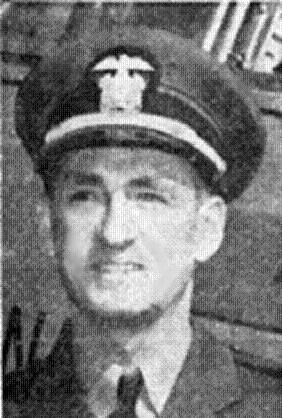
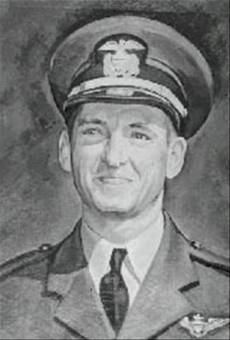
Photographs
Navy Directories & Officer Registers
The "Register of Commissioned and Warrant Officers of the United States Navy and Marine Corps" was published annually from 1815 through at least the 1970s; it provided rank, command or station, and occasionally billet until the beginning of World War II when command/station was no longer included. Scanned copies were reviewed and data entered from the mid-1840s through 1922, when more-frequent Navy Directories were available.
The Navy Directory was a publication that provided information on the command, billet, and rank of every active and retired naval officer. Single editions have been found online from January 1915 and March 1918, and then from three to six editions per year from 1923 through 1940; the final edition is from April 1941.
The entries in both series of documents are sometimes cryptic and confusing. They are often inconsistent, even within an edition, with the name of commands; this is especially true for aviation squadrons in the 1920s and early 1930s.
Alumni listed at the same command may or may not have had significant interactions; they could have shared a stateroom or workspace, stood many hours of watch together, or, especially at the larger commands, they might not have known each other at all. The information provides the opportunity to draw connections that are otherwise invisible, though, and gives a fuller view of the professional experiences of these alumni in Memorial Hall.
April 1928
July 1928
October 1928
January 1929
April 1929
July 1929
October 1929
January 1930
April 1930
October 1930
January 1931
April 1931
July 1931
October 1931
January 1932
April 1932
October 1932
January 1933
April 1933
July 1933
October 1933
April 1934
July 1934
October 1934
January 1935
April 1935
October 1935
January 1936
April 1936
July 1936
January 1937
April 1937
September 1937
January 1938
July 1938
January 1939
October 1939
June 1940
November 1940
April 1941
Seymour is one of 41 members of the Class of 1927 on Virtual Memorial Hall.