LTJG WEBSTER C. JOHNSON, USN
Lucky Bag Yearbook
From the 1936 Lucky Bag:
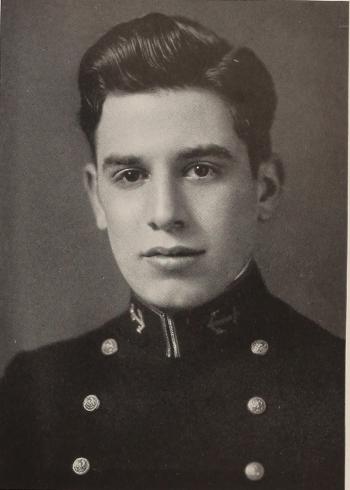
Webster Cochran Johnson
Company soccer: 4, 3, 2, 1; Choir 4, 3, 2, 1; Glee Club 4, 3, 2, 1 President; Musical Clubs 4, 3, 2, 1; Masqueraders 2; One Stripe.
Loss
Webster was lost on December 19, 1940 when his F4F-3 crashed shortly after takeoff in the Norfolk, Virginia area. He was a member of Fighting Squadron (VF) 72 at NAS Norfolk, Virginia. (Aircraft and squadron details from an email from naval aviation historian Richard Leonard on December 29, 2017.)
Other Information
From the Richmond Times Dispatch on December 21, 1940:
Navy Flyer Succumbs To Injuries
ANNAPOLIS, MD., AP—Lieutenant Webster C. Johnson, naval airman who died Thursday night of injuries suffered in an airplane crash Monday at Norfolk, will receive a military burial at the Naval Academy Saturday.
The body is being shipped here from Norfolk.
Captain Theodore W. Johnson, U. S. N. (retired), and Mrs. Johnson, the lieutenant’s parents, and their son and daughter, Woolsey Johnson, Nashville, Tenn., and Mrs. Henry Larom, Scarsdale, N. Y., are accompanying the body.
Chaplain William N. Thomas will conduct the funeral services at 10:30 A. M. at the academy chapel. Burial will be in the academy cemetery.
An escort commander, a platoon of Marines and bluejackets, a color guard, bugler and the academy band will form the funeral cortege.
Lieutenant Johnson’s skull was fractured when his fighter plane crashed on Virginian Railway property just outside the Naval Operating Base. He was attached to Fighting Squadron VF-72 of the aircraft carrier Wasp, naval officials said.
Besides his parents and brother and sister, Lieutenant Johnson is survived by his wife, the former Miss Carrie Shand. Lieutenant Johnson’s father and grandfather both were professors of mathematics at the academy.
From the Class of 1936’s “Golden Lucky Bag,” published in 1986 (via Marianne Bradley, daughter of LCDR John Ellis ‘36, USN (Ret.)):
After graduation, Webby served a year in Lexington and then was ordered to Yorktown, fitting out in Newport News, Virginia. A year later he went to Enterprise which was then completing at the same shipyard. Finally detached from shipboard duty in February 1939, he reported to Pensacola for flight instruction. After winning his wings he was assigned to Patrol Wing 5 at Norfolk in January 1940 with additional duty in Fighting Squadron 72 attached to Wasp. This latter became his primary assignment a few months later. In September 1940, Webby was married at Norfolk to Carey Shands, attractive young sister of Lieutenant (later Rear Admiral) Courtney Shands (USNA ‘27).
Webby was flying the then experimental version of the F4F aircraft from the Naval Air Station, Norfolk, in December 1940 when his plane crashed in the rail yards adjacent to the station shortly after takeoff, injuring him so severely that he died a few days later. His widow, Carey, later married his Academy classmate, Hollis Cooley.
Webby’s accident is believed to have been the result of a design defect in an experimental plane which was corrected as a result of the crash. The plane, thus improved, became one of the Navy’s great combat designs. It is tragic that Webby did not survive to complete his career in aviation.
He is buried in the Naval Academy Cemetery.
Navy Directories & Officer Registers
The "Register of Commissioned and Warrant Officers of the United States Navy and Marine Corps" was published annually from 1815 through at least the 1970s; it provided rank, command or station, and occasionally billet until the beginning of World War II when command/station was no longer included. Scanned copies were reviewed and data entered from the mid-1840s through 1922, when more-frequent Navy Directories were available.
The Navy Directory was a publication that provided information on the command, billet, and rank of every active and retired naval officer. Single editions have been found online from January 1915 and March 1918, and then from three to six editions per year from 1923 through 1940; the final edition is from April 1941.
The entries in both series of documents are sometimes cryptic and confusing. They are often inconsistent, even within an edition, with the name of commands; this is especially true for aviation squadrons in the 1920s and early 1930s.
Alumni listed at the same command may or may not have had significant interactions; they could have shared a stateroom or workspace, stood many hours of watch together, or, especially at the larger commands, they might not have known each other at all. The information provides the opportunity to draw connections that are otherwise invisible, though, and gives a fuller view of the professional experiences of these alumni in Memorial Hall.
July 1936
January 1937
April 1937
September 1937
January 1938
July 1938
January 1939
October 1939
June 1940
November 1940
April 1941
Webster is one of 39 members of the Class of 1936 on Virtual Memorial Hall.