LT JOHN A. THOMAS, USN
Lucky Bag Yearbook
From the 1937 Lucky Bag:
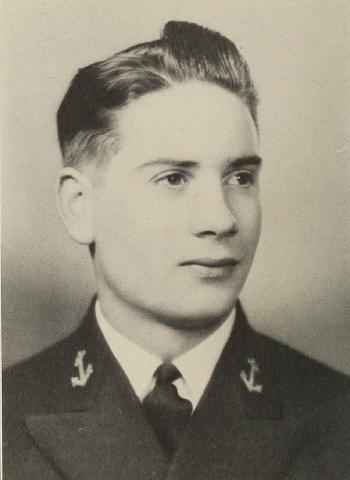
JOHN ANDREW THOMAS
Swimming 4, 3. Reception Committee. Two Stripes.
Loss
John died on November 15, 1942 of wounds suffered when USS San Francisco (CA 38) was severely damaged during the Naval Battle of Guadalcanal on November 13, 1942.
Other Information
From researcher Kathy Franz:
As a junior at Knoxville High School, he was one of the class’ directors and a member of the Rifle team. At the University of Tennessee, he was a member of Alpha Tau Omega.
John married Lillian Morey on November 10, 1939, in the St. Clements Episcopal Church in Honolulu. She was the daughter of the late Commander Franklin L. Morey and his wife. Lillian returned to California at the end of February 1940. Their son John Anthony Thomas was born June 21, 1940.
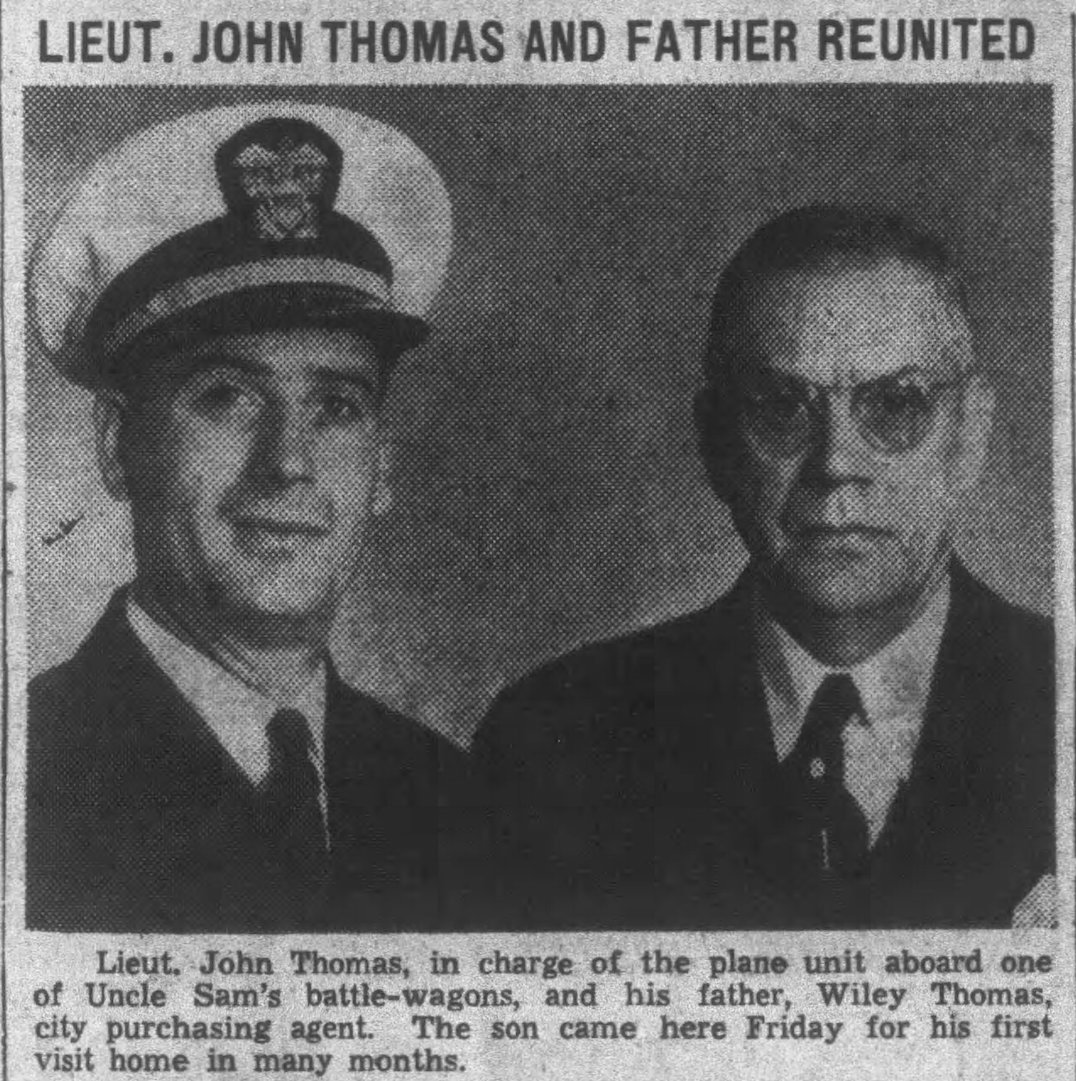
John’s father was Wiley, purchasing agent for the City of Knoxville, mother Ann, and brother Wiley Jr. His brother became assistant to the dean of engineering at the University of Tennessee and was in charge of a Civil Defense plan. John’s grandparents Thomas and Mary came from South Wales. In 1900 his grandfather was a watchman on the railroad, and his uncle David was a railroad engineer and uncle George was a railroad machinist.
His son, John Anthony, was listed as next of kin. Thomas has a memory marker in Tennessee.
Career
John was promoted to LTJG on June 3, 1940; on January 2, 1941 he was designated naval aviator #7003. He was promoted to LT on January 2, 1942, and reported to Cruiser Scouting Squadron (VCS) 6 on March 10, 1942. (Information from Richard Leonard, naval aviation historian.)
Battle of Cape Esperance
John was the pilot of USS San Francisco (CA 38)’s OS2U Kingfisher scout plane and was the first to report the presence of a Japanese task force on the night of 11-12 October in what became the Battle of Cape Esperance. He later landed the aircraft at the island of Tulagi.
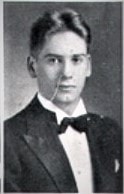
Photographs
Navy Directories & Officer Registers
The "Register of Commissioned and Warrant Officers of the United States Navy and Marine Corps" was published annually from 1815 through at least the 1970s; it provided rank, command or station, and occasionally billet until the beginning of World War II when command/station was no longer included. Scanned copies were reviewed and data entered from the mid-1840s through 1922, when more-frequent Navy Directories were available.
The Navy Directory was a publication that provided information on the command, billet, and rank of every active and retired naval officer. Single editions have been found online from January 1915 and March 1918, and then from three to six editions per year from 1923 through 1940; the final edition is from April 1941.
The entries in both series of documents are sometimes cryptic and confusing. They are often inconsistent, even within an edition, with the name of commands; this is especially true for aviation squadrons in the 1920s and early 1930s.
Alumni listed at the same command may or may not have had significant interactions; they could have shared a stateroom or workspace, stood many hours of watch together, or, especially at the larger commands, they might not have known each other at all. The information provides the opportunity to draw connections that are otherwise invisible, though, and gives a fuller view of the professional experiences of these alumni in Memorial Hall.
September 1937
January 1938
January 1939
June 1940
November 1940
April 1941
Unit and Navy Cross
The next-of-kin listing indicates he was a member of Cruiser Scouting Squadron 6, stationed aboard USS San Francisco (CA 38); he was certainly stationed aboard that ship a month prior. A Navy Cross citation, however, lists him as a member of Bombing Squadron (VS) 10 aboard USS Enterprise.
It seems unlikely he would shift units and aircraft types so quickly when his original command was still engaged in combat, and he is not listed as a member of VS-10 [formerly at http://www.cv6.org/company/muster/display_ag.asp?page=VS-10] or here. He is not listed among Air Group 10 casualties in Enterprise’s after-action report1.
(Note “Bombing Squadron (VS) 10” had changed names but not yet designations, and continued to operate as a separate unit from “Bombing Squadron (VB) 10”, which was also operating from USS Enterprise (CV 6).)
An after-action report on the damage suffered by San Francisco says that prior to the battle her “planes had been sent to Tulagi.”
The source cited for the Navy Cross award below is incorrect; it does not list an award for John Andrew Thomas. It does, however, list “Lt. James Alfred Thomas” — also of Knoxville, Tennessee. James Thomas’ Navy Cross was for action at the same time, as commanding officer of Bombing Squadron (VB) 10. The Hall of Valor page says he retired as a Rear Admiral… but the All Hands Bulletin says it was a posthumous award.
Hall of Valor lists awards to both John Alfred Thomas2 and James Andrew Thomas for the same action, but with different units (VB-10 and VS-10) aboard Enterprise. The Department of Defense lists James Thomas as a recipient. Both entries list the same birthdate and hometown. None name John Andrew Thomas as a recipient of the Navy Cross.
Conclusion: John was never a member of Bombing Squadron (VS or VB) 10 and was not awarded the Navy Cross. He was serving aboard USS San Francisco (CA 38) and was one of the 77 men killed in the engagement. This is confirmed by Richard Leonard, naval aviation historian.
References
-
Previously accessible at http://www.cv6.org/ship/logs/action19421113.htm#personnel ↩︎
-
Previously accessible at https://homeofheroes.com/distinguished-service-cross/world-war-ii/navy-cross/navy-t-u/ ↩︎
John is one of 47 members of the Class of 1937 on Virtual Memorial Hall.