CDR LLOYD K. GREENAMYER, USN
Lucky Bag Yearbook
From the 1929 Lucky Bag:
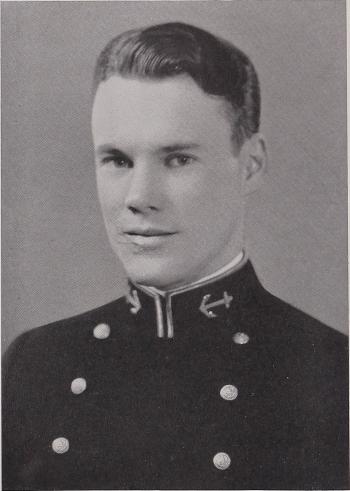
LLOYD KEYES GREENAMYER
Choir 4, 3, 2, 1. Football 4, 3. Gymkhana 4. Masqueraders 2, 1. Musical Clubs 4, 3, 2, 1. 1 P.O.
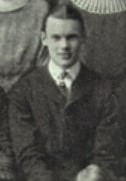
EVERYONE has heard of Michigan, and even Lansing, but since we have been associated with Bud we have heard too much! Yes, Bud is from Lansing, Michigan, and we are proud to say he thinks the world of his home town. He has never told us any good reason for leaving home to come to the Naval Academy, but we attribute it to the “call of the sea,” and his natural desire to see what it is all about. He came to Annapolis from Michigan State; and, after spending one easy year of college studying, he has never really studied seriously enough to be among our “brilliant stock.” That, however, is not saying a word about affairs other than Academic!
Never much of an athlete, our Bud has had to distinguish himself in other ways. Oh! yes, we can remember the old Plebe year days on the company gym team! He still keeps up his work in the gym, but that’s not where Bud shines! “Snake”—did you say? Well, not exactly, but we must admit he has a way with the ladies. Just ask him about Youngster and Second Class Cruise,—and the Chicago and New York trips!! We shall always remember Bud for his smiling face and happy good-natured friendship, and hope that he will always be with us in later life.
Loss
Lloyd was lost on May 14, 1943 when his aircraft failed to return from a strike on Japanese-held Attu, Alaska. He was commanding officer of Composite Squadron (VC) 21, operating from USS Nassau (CVE 16).
Other Information
From Find A Grave:
Lloyd Greenamyer graduated from the U.S. Naval Academy at Annapolis, Class of 1929. After flight Training at Pensacola he was designated Naval Aviator and was assigned to Fighter Squadron 1, VF-1 Top Hats, attached to USS Saratoga CV-3.
Per The Cincinnati Enquirer, Ohio, July 11, 1943, from researcher Kathy Franz:
Washington, July 10 – (AP) – A “baby flat-top” was a vital factor in driving the Japanese from Attu in the Aleutians.
This was disclosed tonight by the Navy in telling of the tiny auxiliary aircraft carrier’s campaign which, on occasions when fog had closed in, “single-handedly provided our aerial offensive against the Japs.”
The story of [Escort] Carrier “A,” the Navy added, proved the value of the little auxiliary carriers being built by the scores to carry fighting planes into battle against the Axis.
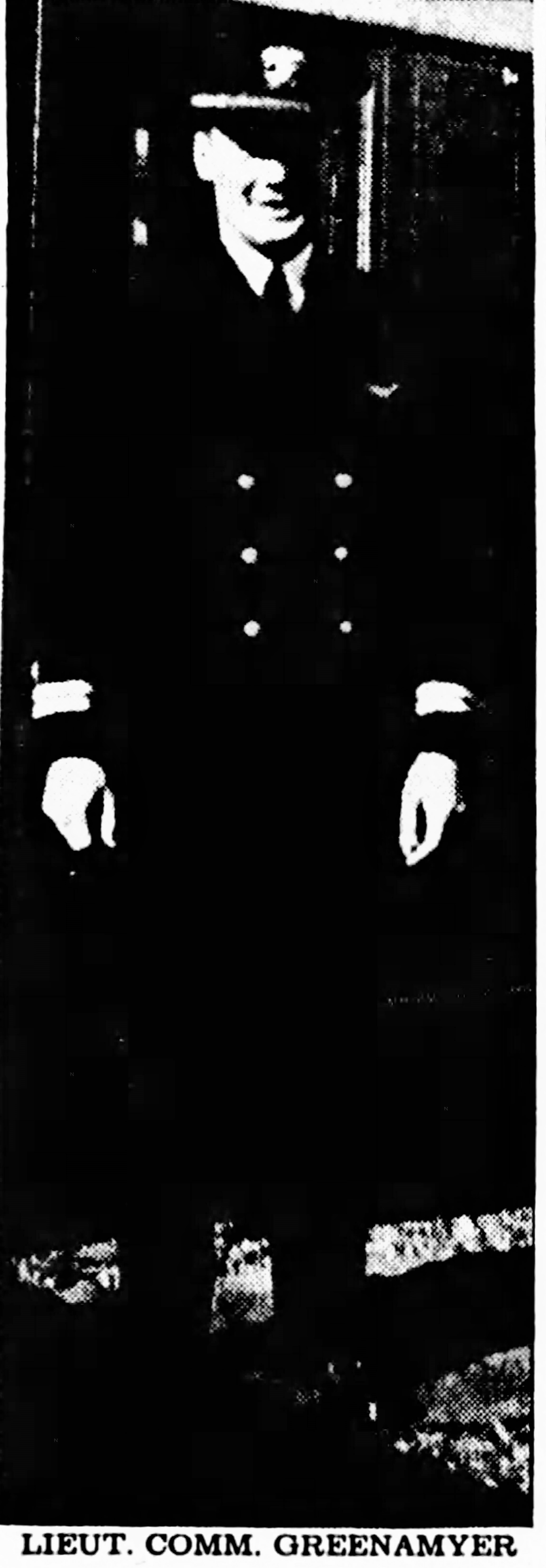
Time after time the fliers, led by Lieutenant Commander Lloyd K. Greenamyer, Corpus Christi, Texas, now listed as missing, answered calls of ground troops for strafing and bombing the Japanese in their dugouts and cave dwellings.
“The weather was always bad,” the Navy related, “ceilings were low, yet the response of the carrier’s Wildcats (fighter planes) to requests for air support from beach control parties and combat units ashore was so prompt as to be startling.
“Her Wildcats would take off, pull up into the low fog, spot enemy positions through holes, dive out of the overcast, strafe and bomb Jap dugouts, foxholes and machine-gun nest and then swoop back into the fog, often before the Japs had time to return their fire. In the clouds, the planes would fly out to sea a short distance then turn and come back for another attack, repeating this maneuver until they were low on gas.”
On one occasion, Japanese barges, protected by the fog, landed in the rear of American forces on the west arm of Holtz Bay, placing ground troops between two fires and threatening American supplies. The “baby’s” planes were summoned. Their .50 caliber machine guns sank the barges and mowed down enemy soldiers, driving them from behind sheltering rocks.
Eight of the carrier’s planes crashed, forced down at sea, in collisions with mountains, or shot down by Japanese antiaircraft fire.
From researcher Kathy Franz:
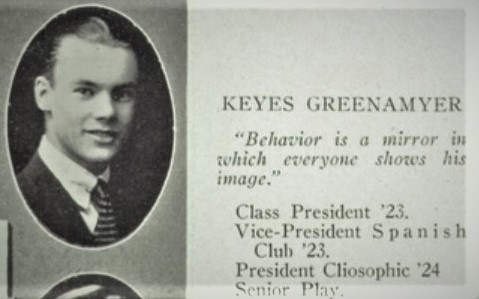
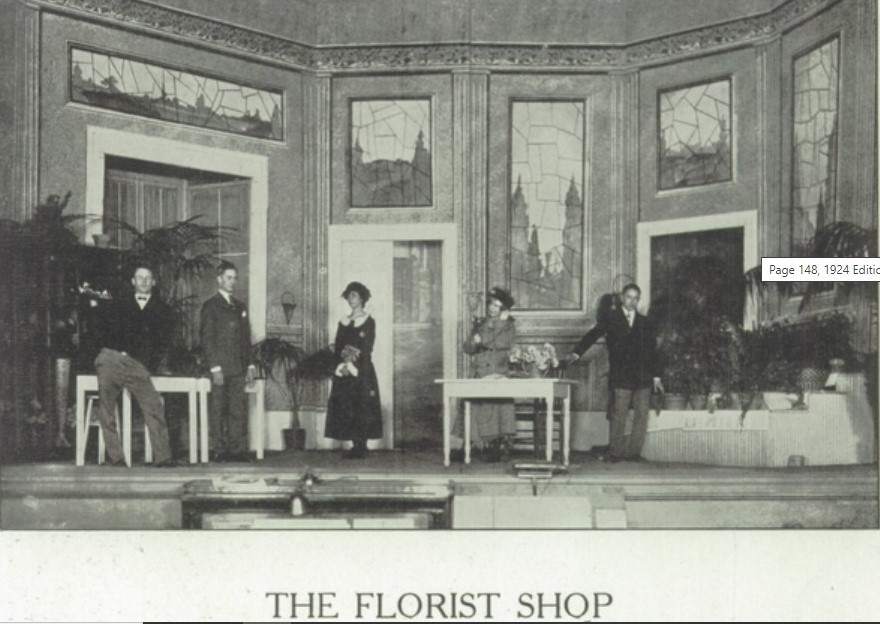
Lloyd, who went by his middle name Keyes, graduated from Lansing high school in 1924. He played “an ordinary tough office boy” in the senior performance of “The Florist Shop.” In the section “Alumni 1950:” Lloyd is manager of Western Reo Branch, Riverside, California. At Michigan State University, he was a member of the Hermian (fraternity,) and he played snare drums in the M. S. C. Military Band.
On April 15, 1931, the Evening Star, Washington, D. C., reported Lloyd was sent to Aircraft, Battle Force.
He was stationed on the Saratoga airplane carrier in August, 1932. According to the Lansing State Journal, he along with 400 army and navy planes took part in the opening ceremony of the Olympic games in Los Angeles: “ … the planes of the aviation corps, showing a split dive attack and surface attack with machine guns.”
For the two years that he was stationed in Honolulu, May 1934 to May 1936, he was maintenance officer of the aerial squadron.
His transfer from scouting squadron to torpedo squadron on the USS Yorktown was reported in late August, 1938.
On his 35th birthday, November 6, 1941, he received his promotion to lieutenant commander.
He married Helen Elizabeth Olwell on May 17, 1930, at his parents’ home. They had two daughters: Anne, born September 15, 1931, in California, and Gretchen, born February 11, 1936, in Hawaii.
His father Lloyd was manager of the Reo Motor Car Company’s service unit. His mother was Hattie, and his sister was Harriet (Mrs. Roseberry.)
From the Lansing State Journal, Michigan, January 25, 1932 via researcher Kathy Franz:
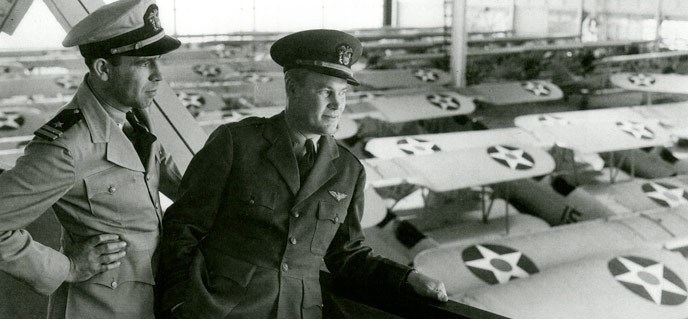
Ensign L. Keyes Greenamyer Pilots Planes Used in Filming of ‘Hell Divers’
Local interest in “Hell Divers,” sensational romance of United States naval aviation which opened at the Strand theater Sunday, is heightened by the fact that three of the roaring airplanes used in the filming of the production were piloted by Ensign L. Keyes Greenamyer, son of Mr. and Mrs. Lloyd C. Greenamyer, 410 South Butler boulevard.
Ensign Greenamyer or “Bud” Greenamyer, as he is known to Lansing acquaintances, was honored by being one of the naval pilots chosen to pilot planes used in the film production. In the picture he is one of the members of the “High Hat Squadron” and during the making of the picture he piloted three planes, Nos. 2, 8, and 9. . . .
He received his “wings” in April, 1931, and was assigned to the “High Hat Squadron” of the U. S. S. Saratoga with headquarters at San Diego, Calif.
Since the completion of “Hell Divers” Ensign Greenamyer has returned to San Diego from Seattle, Wash., with a new Boeing plane which he will pilot in maneuvers off the coast of Hawaii during the next three months.
[“Hell Divers” starred Wallace Beery and Clark Gable. The planes were Curtiss F8C-4 Helldivers. USS Saratoga was featured in the film.]
His wife was listed as next of kin. He was also survived by his mother and at least one daughter.
Photographs
](/honorees/cdr-lloyd-k-greenamyer-usn/1929_Greenamyer_8.jpg)
](/honorees/cdr-lloyd-k-greenamyer-usn/1929_Greenamyer_3.jpg)
](/honorees/cdr-lloyd-k-greenamyer-usn/1929_Greenamyer_2.jpg)
Navy Cross
From Hall of Valor:
The President of the United States of America takes pride in presenting the Navy Cross (Posthumously) to Lieutenant Commander Lloyd Keys Greenamyer (NSN: 0-62608), United States Navy, for extraordinary heroism in operations against the enemy while serving as Pilot of a carrier-based Navy Fighter Plane and Commanding Officer of Composite Squadron TWENTY-ONE (VC-21), attached to the U.S.S. NASSAU (CVE-16), during the seizure and occupation of Attu Island, Territory of Alaska, in May 1943. At a time when launching and recovery operations were rendered extremely dangerous by poor visibility, Lieutenant Commander Greenamyer repeatedly led his squadron through heavy anti-aircraft fire in a succession of vigorous bombing and strafing raids against hostile installations on the island. These hazardous missions, executed with grim determination and superb flying skill, furnished invaluable support for our ground forces on critical occasions which otherwise might have resulted in more extensive damage to equipment and greater loss of life. His inspiring leadership and relentless fighting spirit, maintained with complete disregard of personal safety, were in keeping with the highest traditions of the United States Naval Service.
General Orders: Commander In Chief Pacific: Serial 0185 (January 14, 1944)
Service: Navy
Rank: Lieutenant Commander
Related Articles
Dick Downer ‘27 was also a pilot in “Hell Divers.”
Navy Directories & Officer Registers
The "Register of Commissioned and Warrant Officers of the United States Navy and Marine Corps" was published annually from 1815 through at least the 1970s; it provided rank, command or station, and occasionally billet until the beginning of World War II when command/station was no longer included. Scanned copies were reviewed and data entered from the mid-1840s through 1922, when more-frequent Navy Directories were available.
The Navy Directory was a publication that provided information on the command, billet, and rank of every active and retired naval officer. Single editions have been found online from January 1915 and March 1918, and then from three to six editions per year from 1923 through 1940; the final edition is from April 1941.
The entries in both series of documents are sometimes cryptic and confusing. They are often inconsistent, even within an edition, with the name of commands; this is especially true for aviation squadrons in the 1920s and early 1930s.
Alumni listed at the same command may or may not have had significant interactions; they could have shared a stateroom or workspace, stood many hours of watch together, or, especially at the larger commands, they might not have known each other at all. The information provides the opportunity to draw connections that are otherwise invisible, though, and gives a fuller view of the professional experiences of these alumni in Memorial Hall.
July 1929
October 1929
January 1930
April 1930
October 1930
January 1931
April 1931
July 1931
October 1931
January 1932
April 1932
October 1932
January 1933
April 1933
July 1933
October 1933
April 1934
July 1934
October 1934
January 1935
April 1935
October 1935
January 1936
April 1936
July 1936
January 1937
April 1937
September 1937
January 1938
July 1938
January 1939
October 1939
June 1940
November 1940
April 1941
Lloyd is one of 26 members of the Class of 1929 on Virtual Memorial Hall.