LT ROBERT W. LARSON, USN
Lucky Bag Yearbook
From the 1924 Lucky Bag:
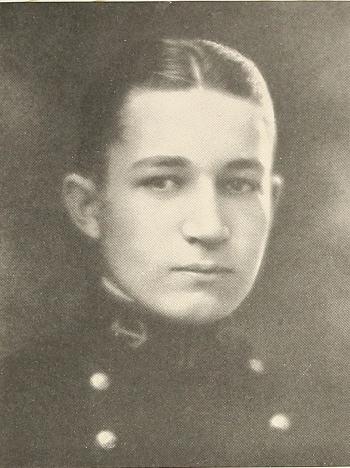
ROBERT WARREN LARSON
Class Lacrosse (3).
LOOKING at his rosy cheeks and robust J build, you just know he spent his early days on the plains of his native state. Swede is not at all the story-book cow-puncher; quite the opposite, in fact. He is quiet in the extreme and has never been known to give the famous “Hook ’em, cowboy” yell.
Our hero’s pet diversion is playing solitaire, and he spends most of his leisure hours trying to prove that it is a good game.
High on the tree; dragging blind, a philosophy that would make Socrates turn over in his grave—that’s Swede. He has his own ideas about life and nothing will change them, except, possibly, a girl.
Bob tries never to force his opinions on anyone and is one of the rarest specimens of mankind,—a good listener.
“I’m going to the Asiatics for the first twenty years, ‘cause they’re the hardest.”
Loss
Robert was lost on June 11, 1936 when the SOC-1 he was piloting crashed near Guantanamo Bay, Cuba.
From Naval History and Heritage Command:
During dive bombing practice, SOC-1 from Memphis (CL-13) crashed into the sea near Guantanamo Bay, Cuba. Lt. Robert W. Larson and Aviation Machinist’s Mate Sidney L. Harris both killed. 11 June 1936.
They were members of Scouting Plane Squadron (VS) 5B.
Other Information
Robert earned his wings as naval aviator #3402 on April 7, 1928.
From researcher Kathy Franz:
Robert was born in Nebraska.
After graduating from the Naval Academy, Robert spent time with his parents in Omaha, his friends in Cheyenne, and his brother Arnold in Casper. He then joined his ship, the Rochester, in the Canal zone, Panama.
In 1910, Robert’s family lived in Denver. His father John, who was born in Sweden, was a railroad clerk, and his mother Margaret was a merchant at a novelty store. His brother was Arnold, and his sister was Margaret.
Unable to find a memorial marker.
Navy Directories & Officer Registers
The "Register of Commissioned and Warrant Officers of the United States Navy and Marine Corps" was published annually from 1815 through at least the 1970s; it provided rank, command or station, and occasionally billet until the beginning of World War II when command/station was no longer included. Scanned copies were reviewed and data entered from the mid-1840s through 1922, when more-frequent Navy Directories were available.
The Navy Directory was a publication that provided information on the command, billet, and rank of every active and retired naval officer. Single editions have been found online from January 1915 and March 1918, and then from three to six editions per year from 1923 through 1940; the final edition is from April 1941.
The entries in both series of documents are sometimes cryptic and confusing. They are often inconsistent, even within an edition, with the name of commands; this is especially true for aviation squadrons in the 1920s and early 1930s.
Alumni listed at the same command may or may not have had significant interactions; they could have shared a stateroom or workspace, stood many hours of watch together, or, especially at the larger commands, they might not have known each other at all. The information provides the opportunity to draw connections that are otherwise invisible, though, and gives a fuller view of the professional experiences of these alumni in Memorial Hall.
January 1926
October 1927
January 1928
April 1928
July 1928
October 1928
January 1929
April 1929
July 1929
October 1929
January 1930
April 1930
October 1930
January 1931
April 1931
July 1931
October 1931
January 1932
April 1932
October 1932
January 1933
April 1933
July 1933
October 1933
April 1934
July 1934
October 1934
January 1935
April 1935
October 1935
January 1936
April 1936
Robert is one of 39 members of the Class of 1924 on Virtual Memorial Hall.