LTJG WILLIAM S. ARTHUR, USN
Lucky Bag Yearbook
From the 1929 Lucky Bag:
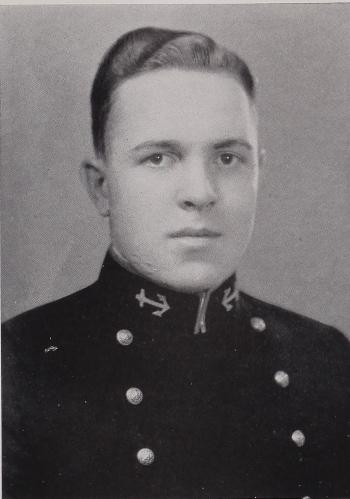
WILLIAM SAMUEL ARTHUR
Football NA 2. Lacrosse N 2. Two Stripes.
AFTER a year at North Dakota University, Bill labored under the impression that he was still in college for most of the first term of Plebe year. This illusion resulted in a Dago re-exam, but since passing this he has always held a fair lead over the Academics. These early struggles cut short his athletic career, but for a time only. In the fall of Second Class year, he broke forth with an A-Squad suit and a bad elbow, which later prevented further advancement in football. But the next spring he came into his own in lacrosse. He had had no experience, but developed so rapidly that George played him against “Light Horse Harry” Wilson for some sixty minutes in the Army game.
Amusement in many forms has attracted him, from room wrecking to “big” liberties, from varsity athletics to “bull” sessions. His tales of Christmas leaves in Baltimore have rung throughout the batt. He has even temporarily convinced us that North Dakota is not just a barren waste. Arthur can justly claim to be of that exclusive and select few, the stripers, whom their classmates like and admire. “——————, Where would Kansas City be?”
Loss
William was lost on December 12, 1933 when the aircraft he was piloting crashed near La Jolla, California.
Other Information
From Naval History and Heritage Command:
F11C-2 from VF-1B on board USS Saratoga (CV-3) crashed three miles west of La Jolla, Calif., killing Lt. (jg) William S. Arthur. 12 December 1933.
From researcher Kathy Franz:
William was engaged in gunnery exercises and had made several of the 2,000-foot power dives successfully, straightening out his plane and firing at the target just above the water level. On the last attempt, his plane suddenly dived, striking the water after a drop of 2,000 feet. The plane sank in 300 feet of water.
Born in York, North Dakota, William graduated from Mandan high school in June, 1924. He won state-wide prominence as a football and basketball player. In the fall of 1924, he played end on the University of North Dakota football team.
William was appointed to the Naval Academy by Representative J. H. Sinclair.
Per The Bismarck Tribune, North Dakota, June 14, 1928: William was on the Navy lacrosse team and played in the Navy-Army game. “He was stationed opposite Harry Wilson, the great army football, basketball, baseball and what-have-you-in-athletics hero. Neither Lighthorse Harry nor Mandan Billy scored.”
Arthur was a member of the Mandan lodge, A. F. and A. M., and had taken the third degree at a special session of the Mandan lodge, acting under a special dispensation from the Grand Lodge. His father was master of the lodge and conferred the degree.
A memorial service for William was held at the North Island naval air station in San Diego. His brother Donald and J. M. Hanley of Mandan attended the service.
His father Samuel was city auditor, mother Alice, brother Donald and sisters Ruth (Mrs. Earl Owens) and Janet.
He was survived by his parents and has a memory marker in North Dakota.
Navy Directories & Officer Registers
The "Register of Commissioned and Warrant Officers of the United States Navy and Marine Corps" was published annually from 1815 through at least the 1970s; it provided rank, command or station, and occasionally billet until the beginning of World War II when command/station was no longer included. Scanned copies were reviewed and data entered from the mid-1840s through 1922, when more-frequent Navy Directories were available.
The Navy Directory was a publication that provided information on the command, billet, and rank of every active and retired naval officer. Single editions have been found online from January 1915 and March 1918, and then from three to six editions per year from 1923 through 1940; the final edition is from April 1941.
The entries in both series of documents are sometimes cryptic and confusing. They are often inconsistent, even within an edition, with the name of commands; this is especially true for aviation squadrons in the 1920s and early 1930s.
Alumni listed at the same command may or may not have had significant interactions; they could have shared a stateroom or workspace, stood many hours of watch together, or, especially at the larger commands, they might not have known each other at all. The information provides the opportunity to draw connections that are otherwise invisible, though, and gives a fuller view of the professional experiences of these alumni in Memorial Hall.
April 1930
October 1930
January 1931
April 1931
July 1931
October 1931
January 1932
April 1932
October 1932
January 1933
April 1933
July 1933
October 1933
William is one of 26 members of the Class of 1929 on Virtual Memorial Hall.