LT PAUL B. THOMPSON, USN
Lucky Bag Yearbook
From the 1919 Lucky Bag:
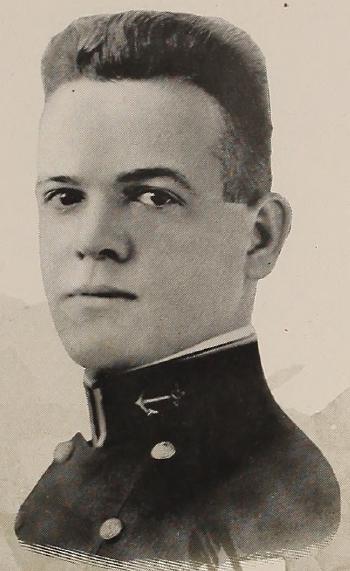
Paul Bristol Thompson
Honors: Buzzard; Basketball Squad 4, 3; Lacrosse Numerals 4, 3.
“TOMMY, the handsomest man in the Naval Academy”—so said the Daily Outburst from his home town, heralding their hero’s return, First-Class leave. Having gotten into the habit of not committing ourselves, the decision is up to you, girls.
It is true that Tommy is there when it comes to the subject of ladies, but that is not the only way that he’s there. Now Tommy apparently has nothing of evil in his make-up, and hence may seem a queer specimen for a lacrosse sandbagger, but such he is. Our private explanation is that he spills all his meanness on Riff and on the field, clipping gnomonic charts on the superstructures of other cutthroats, leaving naught but sweetness. Anyhow, he has worked like an erg X 10^n, and while we hope we’ll not be here for another season, Tommy sure rates a fair crack at an lNt.
He loves a rough-house, and Youngster year it was nothing uncommon for his neighbors to have their study hours shattered by such faint sounds as made by falling lockers, upturned beds, and busted sloboons coming from his room, which upon investigation proved to be Tommy and Riffel trying to take the first-classmen across the corridor into camp.
The weed has another victim in Tommy, for he has smoked most consistently ever since he landed here, but has always had a horseshoe and has gotten away with it without once getting ragged. Youngster year he came rather uncomfortably close on a certain day when he, Abie, and Riffel were staging a triangular meet on one skag, but as the D. O. appeared on the scene just as it was Riffel’s turn, Riff was the only one who was forced to pay the penalty.
“Hey, Tommy, how does it feel to be a man?”
“Oh, that’s the seagoing way to spell it—d-e-a-p s-e-a.”
Loss
Paul was lost on February 19, 1931 when the training plane he was aboard (as an instructor) crashed near Pensacola, Florida. The student pilot was also killed.
Other Information
From researcher Kathy Franz:
In April, 1914, the annual debating, reading and musical contest for three local high schools was held. Paul and a classmate took the affirmative side for Hot Springs high school in the debate “Resolved, That All Cities of 10,000 or More Inhabitants Should Adopt the Commission Form of Government Similar to the Des Moines Plan.”
In April, 1919, Paul was one of three navy men from Arkansas appointed by Governor Brough to represent their home state at the presentation of the silver service to the battleship Arkansas in New York City.
Paul married Sophie Stites on October, 23, 1920, at the Episcopal Church of the Holy Rood in New York City. Their children were Lucile and Suzan. In April, 1930, they were living in New York City with Sophie’s parents.
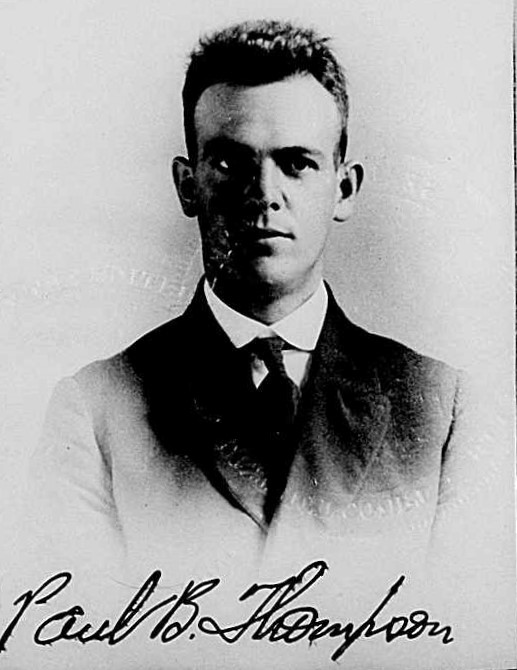
In 1921, Paul applied for a U. S. passport for duty on the USS Utah which would take him to many countries in Europe and Africa. He was 5’ 11” tall with brown eyes and black hair.
Paul played on Lieut. J. F. McDonough’s golf team in Pensacola the week of January 18, 1931.
His father Markus G. was a physician, mother Lena, sister Ruth (Mrs. Arthur Lockwood,) and brothers Murray and Lieutenant William Thompson, U. S. army in China.
He is buried in Arlington National Cemetery.
Photographs
Navy Directories & Officer Registers
The "Register of Commissioned and Warrant Officers of the United States Navy and Marine Corps" was published annually from 1815 through at least the 1970s; it provided rank, command or station, and occasionally billet until the beginning of World War II when command/station was no longer included. Scanned copies were reviewed and data entered from the mid-1840s through 1922, when more-frequent Navy Directories were available.
The Navy Directory was a publication that provided information on the command, billet, and rank of every active and retired naval officer. Single editions have been found online from January 1915 and March 1918, and then from three to six editions per year from 1923 through 1940; the final edition is from April 1941.
The entries in both series of documents are sometimes cryptic and confusing. They are often inconsistent, even within an edition, with the name of commands; this is especially true for aviation squadrons in the 1920s and early 1930s.
Alumni listed at the same command may or may not have had significant interactions; they could have shared a stateroom or workspace, stood many hours of watch together, or, especially at the larger commands, they might not have known each other at all. The information provides the opportunity to draw connections that are otherwise invisible, though, and gives a fuller view of the professional experiences of these alumni in Memorial Hall.
January 1920
January 1922
May 1923
July 1923
September 1923
November 1923
January 1924
March 1924
May 1924
July 1924
September 1924
November 1924
January 1925
March 1925
May 1925
July 1925
October 1925
January 1926
October 1926
January 1927
April 1927
October 1927
January 1928
April 1928
July 1928
October 1928
January 1929
April 1929
July 1929
October 1929
January 1930
April 1930
October 1930
January 1931
Paul is one of 10 members of the Class of 1919 on Virtual Memorial Hall.