LCDR ROBERT L. STRICKLER, USN
Lucky Bag Yearbook
From the 1932 Lucky Bag:
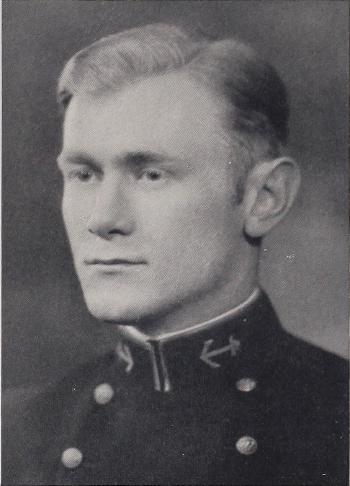
ROBERT LAWRENCE STRICKLER
2 P.O.
Strick came to us from ‘31. Their loss was our gain, and a real gain it is. Strick hails from Enid, Oklahoma, and if Enid feels the same way about him that we do they must have been sorry to see him leave his native heath. They should be perpetually proud of a product like Strick, and no doubt they are.
Strick is one of our staunchest supporters of baseball. Every game, be the weather foul or fair, will find him in the stands lending his moral support to the team and ready with plenty of expert (?) advice. Though baseball is his first love he supports all athletics to the best of his ability.
Strick has graced the afternoon swimming squad since Plebe year and his manful efforts find plenty of appreciation in the large audience that never fails to gather when he makes his appearance in the pool.
Strick is a man of strong character and generous impulses, a true friend and a delightful companion.
Here’s luck to you, Strick, and may we all be shipmates with you in the future.
Loss
Bob was lost on October 9, 1942, when, while returning from combat air patrol to the “Turtle Bay fighter strip at Espiritu Santo” his “F4F suddenly dropped into the jungle, and he died instantly.”
Other Information
From researcher Kathy Franz:
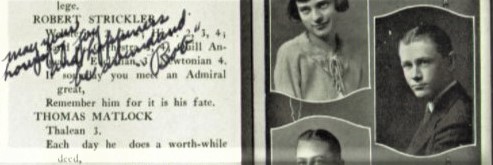
Robert graduated from Enid high school in 1926. He was on the yearbook staff covering athletics. Websterian Literary Society 2, 3, 4; Hi-Y 2, 3, 4; Band, Orchestra 3, 4; Quill Annual 4; Euclidian 3; Newtonian 4. “If someday you meet an Admiral great, Remember him for it is his fate.” He wrote in someone’s yearbook over his name: May your hours of joy and happiness be abundant” Class Prophecy (as happening on an ocean liner): “Bobby” was captain of the liner.
He married his classmate Genevieve Conway in early 1940. At that time, Robert was stationed in Pensacola.
He was a pallbearer for Lt. (jg) Harold Von Weller (’33) who died in an airplane crash near Old Corry Field in Pensacola in July, 1940.
Per The Daily Oklahoman, June 12, 1943: Robert’s wife received a naval citation stating, in part: “for bravery and devotion to duty under adverse conditions . . . He was outstanding in detecting and identifying enemy craft often at great personal danger from enemy sniper fire. His skill and intelligence contributed greatly to the defeat and repulse of the Japanese.”
She remarried and died in 2000. https://www.oklahoman.com/article/2714803/genevieve-conway-strickler-rapp
Robert’s father was Henry, aka “Bert,” a manager of a dry goods store, mother Maude, brother Marvin, and sister Katherine. The Stricklers were a pioneer family of Enid.
His wife was listed as next of kin. He is buried in Arlington National Cemetery.
Photographs
Wartime Service
Bob is mentioned repeatedly in First Team and the Guadalcanal Campaign: Naval Fighter Combat by John Lundstrom. One passage:
He graduated from Pensacola in 1936 and spent two years with VF-4B on the Ranger, followed by a year in VO-3 with the battleship New Mexico (BB 40). From June 1939 to August 1941, he instructed at Pensacola, then became XO of VF-71. Much alike in personality and style, Shands [the CO] and Strickler were quiet, capable, conservative, and dedicated naval aviators, who enjoyed the respect and loyalty of the squadron.
Bob was airborne when USS Wasp (CV 7) was torpedoed and sunk on September 15, 1942. This is the reason he and the remnants of his squadron (eight F4F-4s) were operating with the “Cactus Air Force” from land bases on and near Guadalcanal at the time of his loss. (His squadron lost 10 officers and men, and several aircraft, when Wasp was sunk.) He became the squadron’s commanding officer during this time.
Navy Directories & Officer Registers
The "Register of Commissioned and Warrant Officers of the United States Navy and Marine Corps" was published annually from 1815 through at least the 1970s; it provided rank, command or station, and occasionally billet until the beginning of World War II when command/station was no longer included. Scanned copies were reviewed and data entered from the mid-1840s through 1922, when more-frequent Navy Directories were available.
The Navy Directory was a publication that provided information on the command, billet, and rank of every active and retired naval officer. Single editions have been found online from January 1915 and March 1918, and then from three to six editions per year from 1923 through 1940; the final edition is from April 1941.
The entries in both series of documents are sometimes cryptic and confusing. They are often inconsistent, even within an edition, with the name of commands; this is especially true for aviation squadrons in the 1920s and early 1930s.
Alumni listed at the same command may or may not have had significant interactions; they could have shared a stateroom or workspace, stood many hours of watch together, or, especially at the larger commands, they might not have known each other at all. The information provides the opportunity to draw connections that are otherwise invisible, though, and gives a fuller view of the professional experiences of these alumni in Memorial Hall.
October 1932
January 1933
April 1933
July 1933
October 1933
April 1934
July 1934
October 1934
January 1935
April 1935
October 1935
January 1936
April 1936
July 1936
January 1937
April 1937
September 1937
January 1938
July 1938
January 1939
October 1939
June 1940
November 1940
April 1941
Robert is one of 52 members of the Class of 1932 on Virtual Memorial Hall.