LCDR JOHN C. WALDRON, USN
Lucky Bag Yearbook
From the 1924 Lucky Bag:
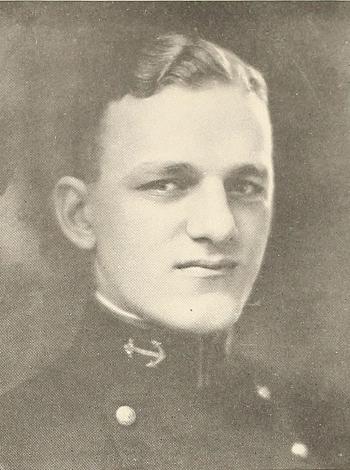
JOHN CHARLES WALDRON
Class Wrestling (2); Class Boxing (3).
STRANGER, pause! Look at this strange specimen. Reading from the outboard halliard, we make out the ambitious student, the aspiring athoolete, the snake par excellence and, last but not least, the sea-going cowpuncher. Here is a man who is lord of fluttering hearts, scattered from hither to yon, wherever he has travelled. And yet, he wouldn’t let Helen herself in his room after study call has busted. The “Busy Day” sign is always in evidence on " Jawn’s" door during boning hours.
Lady Luck has given him a cold shoulder as far as athletics are concerned. “Jawn” comes across with the desire and the ability, but the aforementioned damsel steps in with the sand and rocks. Having taken a shot at everything, he has at last decided to choose the sport which will keep him in the hospital the shortest time, sort of a cross between boxing and wrestling. His ambition is laudable, since the doctors need a rest.
Loss
John was lost on June 4, 1942 when his torpedo bomber was shot down during the Battle of Midway. He was the commanding officer of Torpedo Squadron (VT) 8, flying from USS Hornet (CV 8).
Other Information
From Find A Grave:
US Navy WW II Aviator. He was born at Fort Pierre, South Dakota, graduated from the U.S. Naval Academy in 1924 and became a Naval Aviator in 1927. In 1941 he was Lieutenant Commander and became Commanding Officer of Torpedo Squadron Eight (VT-8) to serve on the new aircraft carrier USS Hornet (CV-8). At the Battle of Midway on June 4, 1942, he led his squadron to be the first to locate and attack the Japanese Imperial Fleet. In overwhelming enemy fighter opposition while making an unsupported attack on Japanese aircraft carriers, he with all fifteen of his planes and 28 crew were lost. Their sacrifice made possible the success of American dive bombers that arrived later, to devastate the Japanese carriers Akagi, Kaga, and Soryu, bringing victory at Midway. Lieutenant Commander Waldron was posthumously awarded the Navy Cross.
From Wikipedia:
Waldron was born on August 24, 1900 at Fort Pierre, South Dakota, son of rancher Charles Westbrook Waldron and Jane Van Metre grandson of lawyer and probate Judge George Prentiss Waldron, and a sixth great nephew of Richard Waldron. He was of colonial New Hampshire families on his father’s side, and of Oglala Lakota on his mother’s side. His family immigrated to Canada when he was a child and homesteaded near Lashburn, Saskatchewan where he spent his youth before returning to the USA. In the midst of his armed forces career he married Adelaide Wentworth and had two daughters. He studied law and was admitted to the bar, but never practiced.…
He received an appointment as midshipman from his home state on June 16, 1920 and graduated with the United States Naval Academy Class of 1924. Following his initial sea duty in Seattle (CA-11), Waldron went to Naval Air Station Pensacola, Florida, where he received his wings in the summer of 1927. Over the ensuing months, Waldron flew with torpedo squadrons (VT-1S and VT-9S and received his promotion to lieutenant, junior grade, on February 16, 1928. He served at the Naval Academy from May 24 to September 13, 1929, where he instructed midshipmen in the field of aviation. Then, after duty as an instructor at the NAS Pensacola, between October 1929 and June 1931, Waldron went to sea again, this time with Scouting Squadron 3B (VS-3B), based on board Lexington (CV-2), reporting for duty on July 1, 1931.
Waldron flew observation aircraft off Colorado (BB-45), before he joined Patrol Squadron 1B (VP-1B), Battle Force, for a brief period in late 1936. Subsequently flying from Saratoga (CV-3) with Fighter Squadron 3 (VF-3) until the early summer of 1939, he reported back to NAS Pensacola, for further instructor’s duty on June 27, 1939. Waldron then served three successive tours of shore duty, all involving flying, at the Naval Proving Ground, Dahlgren, Va.; the Bureau of Ordnance, Washington, D.C.; and finally in the 3rd Naval District, where he was appointed naval inspector of ordnance at the plant of Carl L. Norden, Inc., in New York City—makers of the famed Norden bombsight. Detached from that duty in the summer of 1941, Lieutenant Commmander Waldron took command of the newly formed Torpedo Squadron 8 (VT-8), part of the embryonic air group being assembled for the new fleet carrier Hornet (CV-8) at Newport News, Virginia. The Pearl Harbor attack, though, meant that his training of his men had to be intensive.
There is also a biography of John on the Military Hall of Honor.
From researcher Kathy Franz:
John married Mary Adelaide Wentworth on May 21, 1927, at her parents’ home in Pensacola. Their daughters were Nancy and Ann.
John’s father Charles was a horse dealer, and his mother Jane sold real estate. His brothers were Arthur, George and Allen, and sister was Isle (Mrs. George Philip.)
His wife was listed as next of kin; he was also survived by two daughters. He has one memory marker in Arlington National Cemetery and another in Florida. His sister’s son, George Philip, Jr. ‘35, was also a posthumous recipient of the Navy Cross.
Video
The series “Heroes of the Naval Academy” profiled John in this video:
Photographs
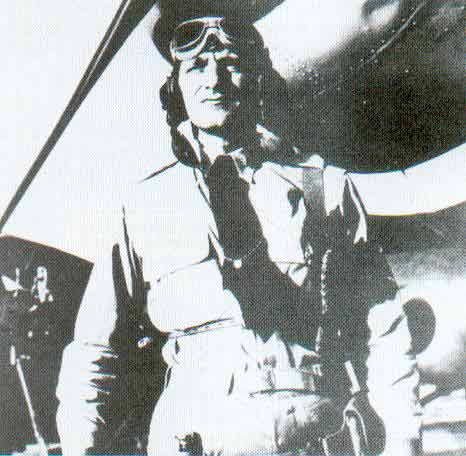
Navy Cross
From Hall of Valor:
The President of the United States of America takes pride in presenting the Navy Cross (Posthumously) to Lieutenant Commander John Charles Waldron (NSN: 0-58825), United States Navy, for extraordinary heroism in operations against the enemy while serving as Pilot of a carrier-based Navy Torpedo Plane and Commanding Officer of Torpedo Squadron EIGHT (VT-8), attached to the U.S.S. HORNET (CV-8), during the “Air Battle of Midway,” against enemy Japanese forces on 4 June 1942. Grimly aware of the hazardous consequences of flying without fighter protection, and with insufficient fuel to return to his carrier, Lieutenant Commander Waldron resolutely, and with no thought of his own life, led his squadron in an effective torpedo attack against violent assaults of enemy Japanese aircraft fire. His courageous action, carried out with a gallant spirit of self-sacrifice and a conscientious devotion to the fulfillment of his mission, was a determining factor in the defeat of the enemy forces and was in keeping with the highest traditions of the United States Naval Service. He gallantly gave his life for his country.
General Orders: Bureau of Naval Personnel Information Bulletin No. 317 (August 1943)
Service: Navy
Division: U.S.S. Hornet (CV-8)
Battalion: Torpedo Squadron 8 (VT-8)
Namesakes
USS Waldron (DD 699) was named for John; the ship was sponsored by his daughter, Nancy.
From Wikipedia:
Naval Auxiliary Air Station Waldron Field, part of the NAS Corpus Christi, Texas complex, was named in his honor. Closed in the 1950s, NAAS Waldron Field was later reactivated in the early 1960s as an outlying field renamed OLF Waldron Field in support of Student Naval Aviator primary flight training operations at NAS Corpus Christi, a role it continues to have today.
Camp Waldron of the Farragut Naval Training Station on Lake Pend Oreille in northern Idaho was named in honor of LtCdr Waldron. The camp, designed to house and train 5,000 naval recruits at a time, opened on 8 November 1942.
John C. Waldron Bridge (renamed in his honor in 2002) across the Missouri River between Pierre and Fort Pierre, SD.
Related Articles
Alfred Tucker, III ‘31 and William Widhelm ‘32 were also squadron commanders aboard USS Hornet (CV 8) early in the war.
Navy Directories & Officer Registers
The "Register of Commissioned and Warrant Officers of the United States Navy and Marine Corps" was published annually from 1815 through at least the 1970s; it provided rank, command or station, and occasionally billet until the beginning of World War II when command/station was no longer included. Scanned copies were reviewed and data entered from the mid-1840s through 1922, when more-frequent Navy Directories were available.
The Navy Directory was a publication that provided information on the command, billet, and rank of every active and retired naval officer. Single editions have been found online from January 1915 and March 1918, and then from three to six editions per year from 1923 through 1940; the final edition is from April 1941.
The entries in both series of documents are sometimes cryptic and confusing. They are often inconsistent, even within an edition, with the name of commands; this is especially true for aviation squadrons in the 1920s and early 1930s.
Alumni listed at the same command may or may not have had significant interactions; they could have shared a stateroom or workspace, stood many hours of watch together, or, especially at the larger commands, they might not have known each other at all. The information provides the opportunity to draw connections that are otherwise invisible, though, and gives a fuller view of the professional experiences of these alumni in Memorial Hall.
September 1924
November 1924
January 1925
March 1925
May 1925
July 1925
October 1926
January 1927
April 1927
October 1927
January 1928
April 1928
July 1928
October 1928
January 1929
April 1929
July 1929
October 1929
January 1930
April 1930
October 1930
January 1931
April 1931
July 1931
October 1931
January 1932
April 1932
October 1932
January 1933
April 1933
July 1933
October 1933
April 1934
July 1934
October 1934
January 1935
April 1935
October 1935
January 1936
April 1936
July 1936
January 1937
April 1937
September 1937
January 1938
July 1938
January 1939
October 1939
June 1940
November 1940
April 1941
John is one of 39 members of the Class of 1924 on Virtual Memorial Hall.