MAJ DOUGLAS E. KEELER, USMC
Lucky Bag Yearbook
From the 1938 Lucky Bag:
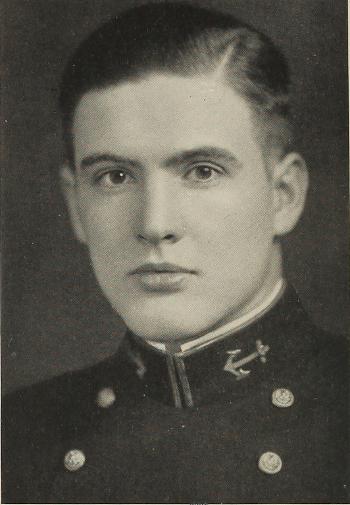
DOUGLAS EDGAR KEELER
Star 4; Wrestling 4, 3; Lucky Bag; Lieutenant.
Loss
Douglas was lost when his PBJ-1 Mitchell patrol bomber was shot down on April 20, 1944 near Kavieng, Papua New Guinea. He was a member of Marine Bombing Squadron (VMB) 413 operating from Sterling Island.
Other Information
From researcher Kathy Franz:
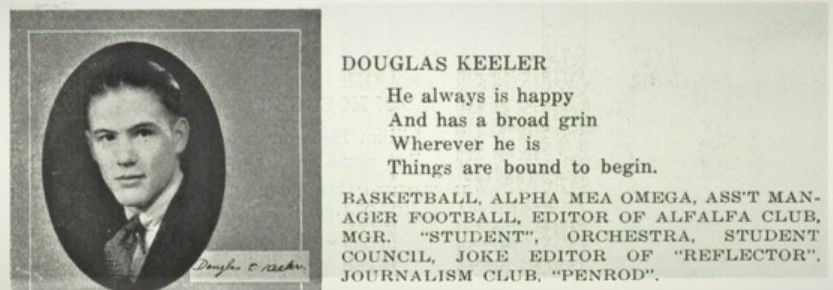
Douglas graduated from Sidney High School in 1932. “He always is happy, And has a broad grin, Wherever he is, Things are bound to begin.” Basketball, Alpha Mea Omega, Ass’t Manager Football, Editor of Alfalfa Club, Mgr., “Student”, Orchestra (cornet), Student Council, Joke Editor of the yearbook “Reflector”, Journalism Club, “Penrod.” In the play “Penrod,” he was Mr. Jones, Marjorie’s father. Noted For: freedom of speech. Private Weakness: Metz. Will be: butcher and egg man.
He studied at Lincoln Preparatory school in Philadelphia. He was appointed to the Naval Academy by Congressional Representative Marian W. Clarke.
His nickname “Ruby” probably came from the popular actress, dancer, and singer Ruby Keeler.
In 1930, his father Harold ran a meat market. Mother Frances, sister Gertrude, and brother Kenneth.
From the Press and Sun-Bulletin, Binghamton, New York, May 9, 1944:
Major Keeler Was No. 1 Heckler of Japs
(The following story was written by Technical Sergeant Harry S. Bolser, Louisville, Ky., a Marine Corps Combat Correspondent.)
Somewhere in the Solomons (Delayed) To other members of squadron Marine Maj. Douglas E. Keeler, Sidney, N. Y., was the No. 1 heckler of Japs at Rabaul.
On a recent night bombing mission over the big enemy base on New Britain Island, the marine major dropped 14 100-pound bombs on Rabaul town from different altitudes at 10-minute intervals.
He so baffled enemy searchlight operators that they never were able to spot his plane. Not a shot was fired by Jap anti-aircraft batteries.
Then, to add insult to injury after spending his bombs, Major Keeler dived his twin-engined Mitchell bomber down to 1,500 feet and raked the bomb-battered town with machine gun fire. On the strafing run Major Keeler was guided by light from fires his bombs had set in the city.
Major Keeler, playing hide-and-seek with Jap searchlights made seven bombing sweeps over Rabaul. Each time he would drop two bombs, retire to sea, and return 10 minutes later, giving the Japs just time enough to crawl into their bunks and roll out again.
“I don’t suppose the Japs got much sleep,” remarked Major Keeler after the fight. “I figure we kept them up most of that night.”
Major Keeler, 29, executive officer of his outfit, the first Marine Mitchell medium bombing squadron (“The Flying Nightmares”) had been piloting bombers less than two months.
He spent 13 months in the South Pacific as a pilot of the South Pacific Combat Transport Command, known as SCAT. He turned down a chance to return home for a rest to become a bomber pilot.
His wife was listed as next of kin. He is buried in New York.
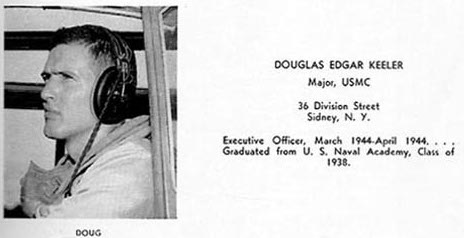
Photographs
Navy Directories & Officer Registers
The "Register of Commissioned and Warrant Officers of the United States Navy and Marine Corps" was published annually from 1815 through at least the 1970s; it provided rank, command or station, and occasionally billet until the beginning of World War II when command/station was no longer included. Scanned copies were reviewed and data entered from the mid-1840s through 1922, when more-frequent Navy Directories were available.
The Navy Directory was a publication that provided information on the command, billet, and rank of every active and retired naval officer. Single editions have been found online from January 1915 and March 1918, and then from three to six editions per year from 1923 through 1940; the final edition is from April 1941.
The entries in both series of documents are sometimes cryptic and confusing. They are often inconsistent, even within an edition, with the name of commands; this is especially true for aviation squadrons in the 1920s and early 1930s.
Alumni listed at the same command may or may not have had significant interactions; they could have shared a stateroom or workspace, stood many hours of watch together, or, especially at the larger commands, they might not have known each other at all. The information provides the opportunity to draw connections that are otherwise invisible, though, and gives a fuller view of the professional experiences of these alumni in Memorial Hall.
July 1938
January 1939
October 1939
June 1940
November 1940
April 1941
Douglas is one of 72 members of the Class of 1938 on Virtual Memorial Hall.