LT ELMER G. COOPER, USN
Lucky Bag Yearbook
From the 1927 Lucky Bag:
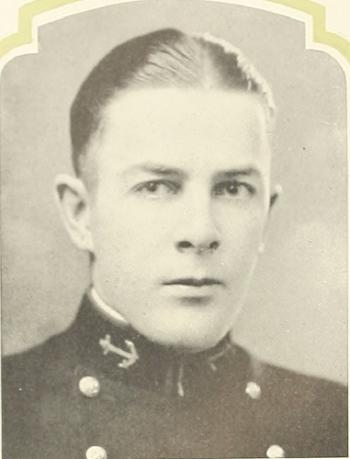
Elmer Glenn Cooper
Gymkhana: Cast (4).
THE door bangs open and in it we see Cooper, demanding, in a loud voice, as to the whereabouts of his mail. “This was her day to write, where did you hide it?” And then he proceeds to inform the world at large that he will get it next mail, that he has bilged cold and doesn’t care whether school keeps or not. But in spite of his tales of bilging he is still with us.
Cooper’s virtues, too numerous to be listed, are offset by his terrible failing for woman. Singular, if you please, for he never wants more than one to enjoy the privilege of his affections. But we will forgive him for that, even if he does gum up the mails on account of her. When you are on the West Coast, look him up in his cottage built for two.
Zulu is a confirmed radiator hound, self-appointed caretaker of his wife, and a radio fan. If he was not too lazy to put his theories to trial, great would be the innovations in radio. But you can’t get along without him for he always remembers the pennies in the light bowl for the movies and chow. And he sticks by in the worst. Sometime in the far future Coop will he helping some poor devil on a life raft and giving him the “big half” of his “iron ration.”
“Hill’s bells,—there goes taps. Why don’t you ever pull down the ports. Get us something on the radio.” And he turns in to wait for tomorrow and for June Week.
Loss
Elmer was lost on February 2, 1938 when the patrol bomber he was piloting collided with another and crashed off the coast of Southern California.
From researcher Kathy Franz:
Per the Hope Star, Arkansas, February 3, 1938:
SAN PEDRO, Calif. – (AP) – Two Navy patrol bombers, flying through a rain squall, collided within sight of a maneuvering United States fleet off the Southern California coast Thursday, killing at least seven of 14 crewmen. . . . one bomber, a 11-P3, fell in flames. The other bomber, a 11-P4, cracked up when it struck the sea.
Elmer was commanding officer of the 11-P3. Lt. Carlton Hutchins (’26) was also killed in this crash. Some surmised it might have been a sudden downdraft that caused the planes to collide.
Other Information
From researcher Kathy Franz:
In June, 1935, Elmer, his wife Frances and son Glenn sailed from Balboa, Canal Zone, to Los Angeles.
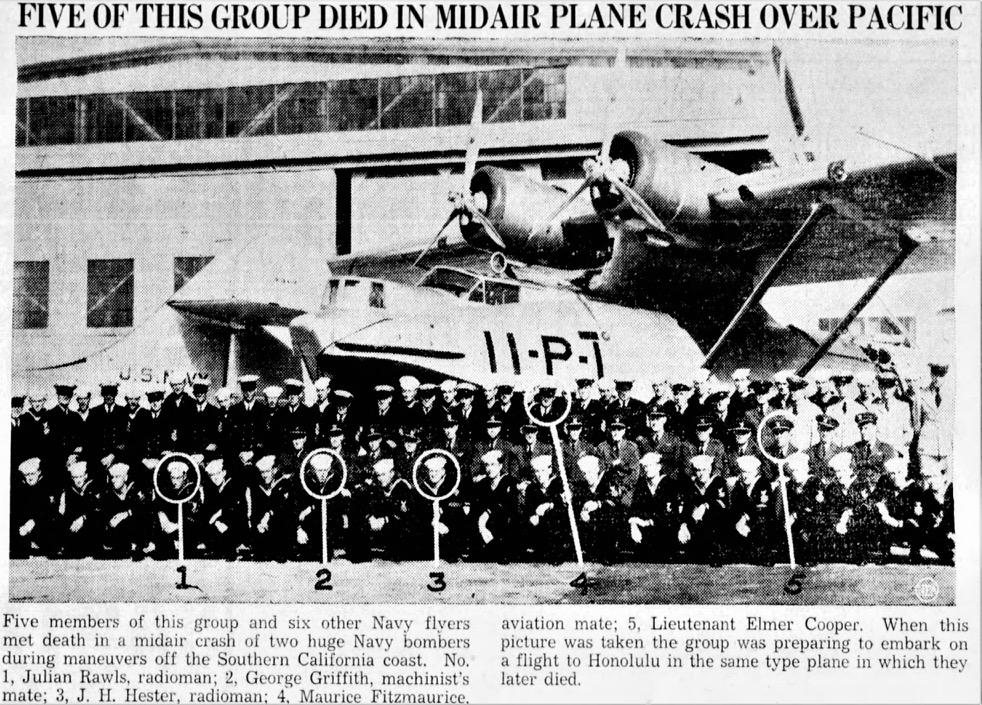
In April, 1937, Elmer was one of the pilots in the VP-11 Squadron which delivered 12 bombers to Pearl Harbor in a non-stop mass flight. He is pictured in the photo below – circle #5.
His father James was a farmer, mother Anne, brother James, Jr., and sister Clara.
From Find A Grave:
Elmer Glenn Cooper (9 May 1905 – 2 February 1938) was an officer in the United States Navy.
Born in Monticello, Arkansas, Cooper graduated from the Naval Academy 2 June 1927. A naval aviator, he served on board several carriers. He died 2 February 1938 as the result of a seaplane crash off the coast of southern California.
He earned his wings as naval aviator #3714 on October 2, 1930.
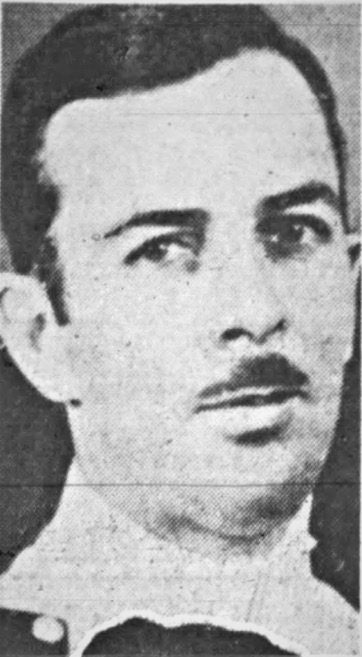
Photographs
Namesake
USS Cooper (DD 695) was named for Elmer; the ship was sponsored by his widow.
Navy Directories & Officer Registers
The "Register of Commissioned and Warrant Officers of the United States Navy and Marine Corps" was published annually from 1815 through at least the 1970s; it provided rank, command or station, and occasionally billet until the beginning of World War II when command/station was no longer included. Scanned copies were reviewed and data entered from the mid-1840s through 1922, when more-frequent Navy Directories were available.
The Navy Directory was a publication that provided information on the command, billet, and rank of every active and retired naval officer. Single editions have been found online from January 1915 and March 1918, and then from three to six editions per year from 1923 through 1940; the final edition is from April 1941.
The entries in both series of documents are sometimes cryptic and confusing. They are often inconsistent, even within an edition, with the name of commands; this is especially true for aviation squadrons in the 1920s and early 1930s.
Alumni listed at the same command may or may not have had significant interactions; they could have shared a stateroom or workspace, stood many hours of watch together, or, especially at the larger commands, they might not have known each other at all. The information provides the opportunity to draw connections that are otherwise invisible, though, and gives a fuller view of the professional experiences of these alumni in Memorial Hall.
January 1928
April 1928
July 1928
October 1928
January 1929
April 1929
January 1930
April 1930
October 1930
January 1931
April 1931
July 1931
October 1931
January 1932
April 1932
October 1932
January 1933
April 1933
July 1933
October 1933
April 1934
July 1934
October 1934
January 1935
April 1935
October 1935
January 1936
April 1936
July 1936
January 1937
April 1937
September 1937
Elmer is one of 41 members of the Class of 1927 on Virtual Memorial Hall.