LTJG CHARLES J. REIMANN, USN
Lucky Bag Yearbook
From the 1938 Lucky Bag:
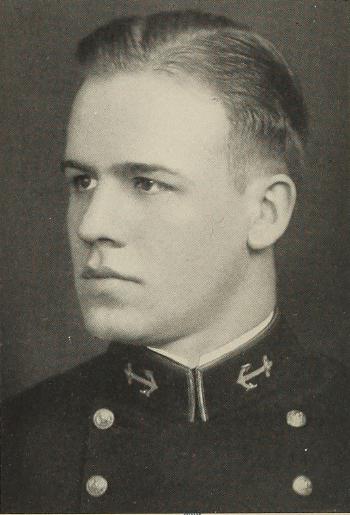
CHARLES JOHN REIMANN
Football 4, 3, 2, 1, N*; Lieutenant (j.g.).
Loss
Charles was lost on March 8, 1942 when the PBY Catalina flying boat he was piloting crashed near Tongue Point, Oregon.
Other Information
From the Greensburg Daily News on Monday, March 16, 1942, via Find A Grave:
MEMORIAL FOR LIEUT. REIMANN
Private Services Held at Shelbyville As Navy Holds “Lost At Sea” ServiceShelbyville, Ind., March 16 – With virtually all hope of recovering his body gone, members of the family of Lieut. Charles J. Reimann Saturday afternoon held brief memorial services here at the home of Mr. and Mrs. H. Wallace Reimann, 40 W. Pennsylvania street. Lieut. Reimann was killed last Sunday in the crash of a huge Catalina flying boat at Tongue Point, Ore.
And as loved ones at home paid final tribute to the widely known Shelbyville athlete, his comrades-at-arms at the Tongue Point naval Air Station took part in a simultaneous funeral ceremony, the simple but impressive “Lost At Sea” service which is traditional with the Navy. Arrangements for the simultaneous services were made by the Reimann family and naval officials Friday afternoon.
SERVICES PRIVATE The services here were for members of the immediate family and Dr. C.A. Bowler, pastor of the First Presbyterian church, officiated. There was no funeral sermon, no eulogy. The brief ceremony was built around a few poems which “Chuck” Reimann, as his hundreds of friends knew him, had liked especially in his high school and naval academy days.
The young naval officer’s widow, the former Miss Barbara Watson, arrived here earlier in the week to be with other members of the family, and her parents, Mr. and Mrs. Ross Watson, of Pensacola, Fla., arrived Saturday to attend the memorial service.
Although the services were of a private nature, a brief memorial ceremony in honor of Lieut. Reimann was held Sunday morning at the First Presbyterian church.
The navigator was the only member of the crew who survived the crash, which occurred during takeoff.
From researcher Kathy Franz:
At Shelbyville High School, Charles played backfield for the football team and guard for the basketball team. He was awarded the Kiwanis football award and Paul Cross basketball award at Shelbyville for his achievement during three years of competition in high school. He attended one year at Purdue University.
He was survived by his father Wallace, a brother William, and a sister. His father was a member of Purdue University’s board of trustees.
Chuck is buried in Indiana.
His high school yearbook:
“Chuck” Reimann, president of the Junior Class, is truly representative of the Junior Boys. Chuck has made name for himself as a leader and is well liked by all. This year the Junior Class under his leadership initiated a new type of entertainment for the reception in putting on Bowery dance which proved enjoyable and novel.
From naval aviation historian Richard Leonard via email on February 9, 2018:
- Date of rank LTJG from 1 Jul 1941 USN Register, 6/2/1941
- VP-41 PatWing4 NAS Tongue Point KIFA, 3/8/1942
Navy Directories & Officer Registers
The "Register of Commissioned and Warrant Officers of the United States Navy and Marine Corps" was published annually from 1815 through at least the 1970s; it provided rank, command or station, and occasionally billet until the beginning of World War II when command/station was no longer included. Scanned copies were reviewed and data entered from the mid-1840s through 1922, when more-frequent Navy Directories were available.
The Navy Directory was a publication that provided information on the command, billet, and rank of every active and retired naval officer. Single editions have been found online from January 1915 and March 1918, and then from three to six editions per year from 1923 through 1940; the final edition is from April 1941.
The entries in both series of documents are sometimes cryptic and confusing. They are often inconsistent, even within an edition, with the name of commands; this is especially true for aviation squadrons in the 1920s and early 1930s.
Alumni listed at the same command may or may not have had significant interactions; they could have shared a stateroom or workspace, stood many hours of watch together, or, especially at the larger commands, they might not have known each other at all. The information provides the opportunity to draw connections that are otherwise invisible, though, and gives a fuller view of the professional experiences of these alumni in Memorial Hall.
July 1938
January 1939
November 1940
April 1941
Charles is one of 72 members of the Class of 1938 on Virtual Memorial Hall.