LT WILLIAM J. SISKO, USN
Lucky Bag Yearbook
From the 1931 Lucky Bag:
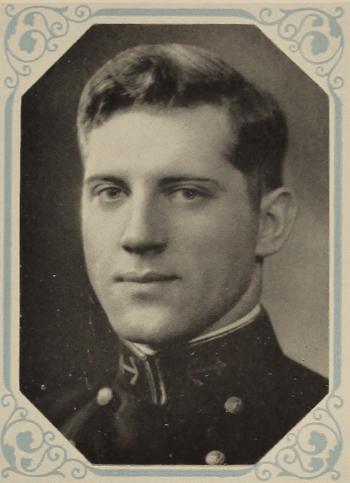
William John Sisko
Football 4, 3, 2, 1; Class Lacrosse 3, 2, 1; M. P. O.
It was a sad blow to Bill when he left the wilds of Pontiac and entered the Academy, to find that he had to row a boat instead of drive one. However, he finally became used to that and other Naval eccentricities, and even learned to enjoy them.
Academics bothered him not at all; although having no starring aspirations, he threw a scare into the ranks of the “Savoirs” by lead—Second Class Steam for two months. Argue? No discussion was complete without his arguments. Either side or any side, right or wrong, just so he could talk. Not a “snake”, but in his spare time he honored a hop or two with his presence, just to give the femmes a treat. Now singing is where Willie really shone; and although his ear for music is rather questionable, no phonograph records exist that he couldn’t duplicate or surpass with a little effort.
With experience in High School and Pontiac Junior College, Michigan lost a good man when Bill decided that the Navy needed his support. A conscientious and willing worker, a real friend and a true Navy man, that’s Bill.
Loss
William was lost when the plane he was piloting crashed into another in mid-air near Pensacola, Florida on August 20, 1941. Four other men were also lost. He was an instructor.
Biography
From researcher Kathy Franz:
William graduated from Pontiac Senior High School in 1926. He played football both junior and senior years, was President of the Upper House, and Vice President of Student Council. He was elected to the National Honor Society, was in Hi-Y, and participated in the Science Club.
As a junior, he played guard and was “aggressive and hard to stop.” As a senior at center, he “was one of the two veterans in the line. Offensively, his passes were accurate, his charge quick, powerful, and lasting. Defensively, he was shifty, covering not only the center position but backing up the whole line as well. Bill was able to diagnose the opposition quickly and was great at breaking up plays. He played between green material and yet, in spite of his smallness, he was a game and stellar mainstay in the line.”
William’s wife was Ina, and they had a daughter Anne born in 1932. In December 1939 they returned from Shanghai to Los Angeles aboard the S. S. President Taft.
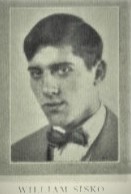
Photographs
Navy Directories & Officer Registers
The "Register of Commissioned and Warrant Officers of the United States Navy and Marine Corps" was published annually from 1815 through at least the 1970s; it provided rank, command or station, and occasionally billet until the beginning of World War II when command/station was no longer included. Scanned copies were reviewed and data entered from the mid-1840s through 1922, when more-frequent Navy Directories were available.
The Navy Directory was a publication that provided information on the command, billet, and rank of every active and retired naval officer. Single editions have been found online from January 1915 and March 1918, and then from three to six editions per year from 1923 through 1940; the final edition is from April 1941.
The entries in both series of documents are sometimes cryptic and confusing. They are often inconsistent, even within an edition, with the name of commands; this is especially true for aviation squadrons in the 1920s and early 1930s.
Alumni listed at the same command may or may not have had significant interactions; they could have shared a stateroom or workspace, stood many hours of watch together, or, especially at the larger commands, they might not have known each other at all. The information provides the opportunity to draw connections that are otherwise invisible, though, and gives a fuller view of the professional experiences of these alumni in Memorial Hall.
July 1931
October 1931
January 1932
April 1932
October 1932
January 1933
April 1933
July 1933
October 1933
July 1934
October 1934
January 1935
April 1935
October 1935
January 1936
April 1936
July 1936
January 1937
April 1937
September 1937
January 1938
July 1938
January 1939
October 1939
June 1940
November 1940
April 1941
William is one of 50 members of the Class of 1931 on Virtual Memorial Hall.