LT EUGENE E. DAVIS, USN
Lucky Bag Yearbook
From the 1927 Lucky Bag:
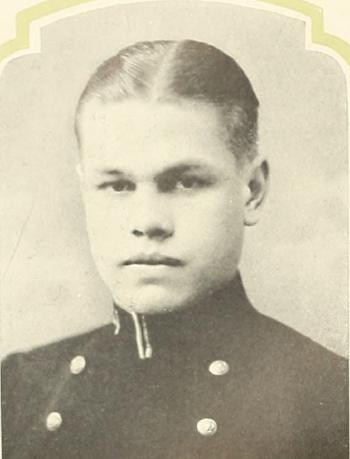
Eugene Edward Davis
Rifle: Squad (2) Block N (2) Expert Rifleman (2) Class (4, 3) Class Numerals (4); Trident: Magazine Staff (2) Business Manager (1); Gymkhana: Cast (4); Orchestra (4); Bugle Corps (2); Class Show (2).
EAST HIGH’S Cadet Battalion stood straight and stiff in their khaki uniforms, under the eyes of the feminine half of—the school. Suddenly, from the rear rank of ———— Company came an adolescent falsetto, “Oh, pick me out, Henrietta!” Under their crust of Salt Lake’s salinity the ears of the cadet captain, Poochie himself, turned a pale pink and glared toward the spot whence a girlish giggle proclaimed that his Henrietta had heard. Thus began his suspicions of a woman’s influence on a military man. But on hop nights, if the average he high enough, his inimitable stepping will cause the femmes to rejoice and the draggers to Curse all stags in general.
Whenever Pooch can be persuaded to knock off playing someone else’s saxophone, banjo, piano or traps better than the owner, or reminiscing over his nights in Paris, he diffidently goes over and out-shoots the rest of the rifle team. When the spirit moves he can track with the best, and also is a mean mermaid, but he claims training table chow doesn’t agree with him. By joining the Hell-cats on the business end of a bugle he gets his big workouts dodging shoes, phonograph records, etc.
Despite his youth and his inability to inhale a skag (which makes him an ideal roommate) Gene has the making of a successful officer, and we all hope to have him cast his lot as a shipmate of ours.
Loss
Eugene was lost on May 23, 1941 when the “long range British bomber” he was aboard went missing while enroute from Gibraltar to England. He was the the assistant Naval attache in London, and “was engaged in an ‘authorized non-operational flight’”.
Other Information
From researcher Kathy Franz:
Eugene was born in Pocatello, Idaho.
His wife, the former Virginia Lee Renfro, sailed in November, 1933, from the Canal Zone to San Francisco. On June, 7, 1935, they both sailed from the Canal Zone to Los Angeles.
In October, 1939, she and their son Eugene, Jr., born May 29, 1936, in Pasadena, sailed from the Canal Zone to San Diego. Their address was in Alhambra, California.
In 1940, Eugene was stationed on the Coco Solo Naval Reservation in the Panama Canal Zone. He was named the air attaché in April, 1941.
Eugene’s father John was a railroad superintendent, mother Sarah, and sisters Lucille and Helen. In 1910, the family lived in Kemmerer, Wyoming. In 1920, they were back in Pocatello.
Eugene’s son died at age 38 in September, 1974, and he desired to be buried at sea.
From the Salt Lake Tribune on July 31, 1931 via researcher Kathy Franz:
Navy Formations Delight Crowds
Then the silver gray navy planes – nine of them, with Lieutenant Thomas Fisher ‘18 in command, went aloft to return to the crowds their appetite for thrills.
The snappy ships bearing the grinning Felix insignia lost no time entering the “V” of “V” formation, with three ships each forming a “V” as they flew over the crowds.
Their close formation and perfect position were a delight to the thousands of eyes. The ships went to the south and then, as they returned to the aiport region, they made up a big “V,” all nine ships participating to compose the design.
Then they executed another perfect move, forming a straight line as they speeded over the field. It was a difficult maneuver, especially in view of the rough atmospheric conditions.
Power Drive Climax Thrills
Then came the echelon of “V’s,” with three ships forming a line, in fact the nine planes comprised three separate lines as they passed over the crowds.
To cap the navy’s aerial exhibition, Lieutenant Fisher and his colleagues engaged in a three-way attack, with nine ships, from a high altitude, rushing toward the earth, with motors roaring. It was a sensational climax to a splendid demonstration.
The navy fliers were Lieutenant Fisher, Lieutenant G. H. Hasselman, Lieutenant Walter F. Boone (’21), and Lieutenants Junior Grade John Broder Moss (’23), Walter D. Leach (’24), John Patrick Fitzsimmons (’26), Leonard James Dow (’26), Eugene E. Davis (’27), and Julian D. Greer (’27).
Eugene is listed at the Cambridge American Cemetery and Memorial.
Navy Directories & Officer Registers
The "Register of Commissioned and Warrant Officers of the United States Navy and Marine Corps" was published annually from 1815 through at least the 1970s; it provided rank, command or station, and occasionally billet until the beginning of World War II when command/station was no longer included. Scanned copies were reviewed and data entered from the mid-1840s through 1922, when more-frequent Navy Directories were available.
The Navy Directory was a publication that provided information on the command, billet, and rank of every active and retired naval officer. Single editions have been found online from January 1915 and March 1918, and then from three to six editions per year from 1923 through 1940; the final edition is from April 1941.
The entries in both series of documents are sometimes cryptic and confusing. They are often inconsistent, even within an edition, with the name of commands; this is especially true for aviation squadrons in the 1920s and early 1930s.
Alumni listed at the same command may or may not have had significant interactions; they could have shared a stateroom or workspace, stood many hours of watch together, or, especially at the larger commands, they might not have known each other at all. The information provides the opportunity to draw connections that are otherwise invisible, though, and gives a fuller view of the professional experiences of these alumni in Memorial Hall.
January 1928
October 1928
January 1929
April 1929
July 1929
October 1929
January 1930
April 1930
October 1930
January 1931
April 1931
July 1931
October 1931
January 1932
April 1932
October 1932
January 1933
April 1933
July 1933
October 1933
April 1934
July 1934
October 1934
January 1935
April 1935
October 1935
January 1936
April 1936
July 1936
January 1937
April 1937
January 1938
July 1938
January 1939
October 1939
June 1940
November 1940
April 1941
Eugene is one of 41 members of the Class of 1927 on Virtual Memorial Hall.