LTJG WILLIAM J. MCCORD, USN
Lucky Bag Yearbook
From the 1923 Lucky Bag:
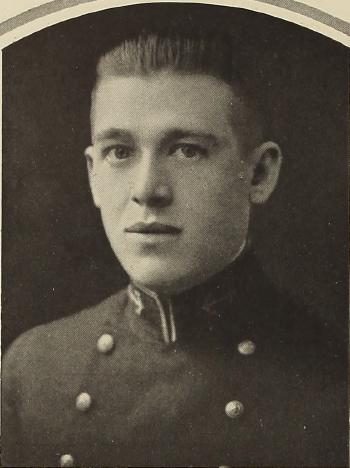
William James McCord
Soccer Squad (2); Class Soccer (3); Class Football (2).
Loss
William was lost on October 28, 1927 when his single-seat Curtiss Hawk plane collided with another near Pensacola, Florida. One crashed through a “negro house” on North Davis street, and the other came to rest in the rear of a home on Sixth avenue. Hundreds of persons witnessed the crash.
Other Information
From researcher Kathy Franz:
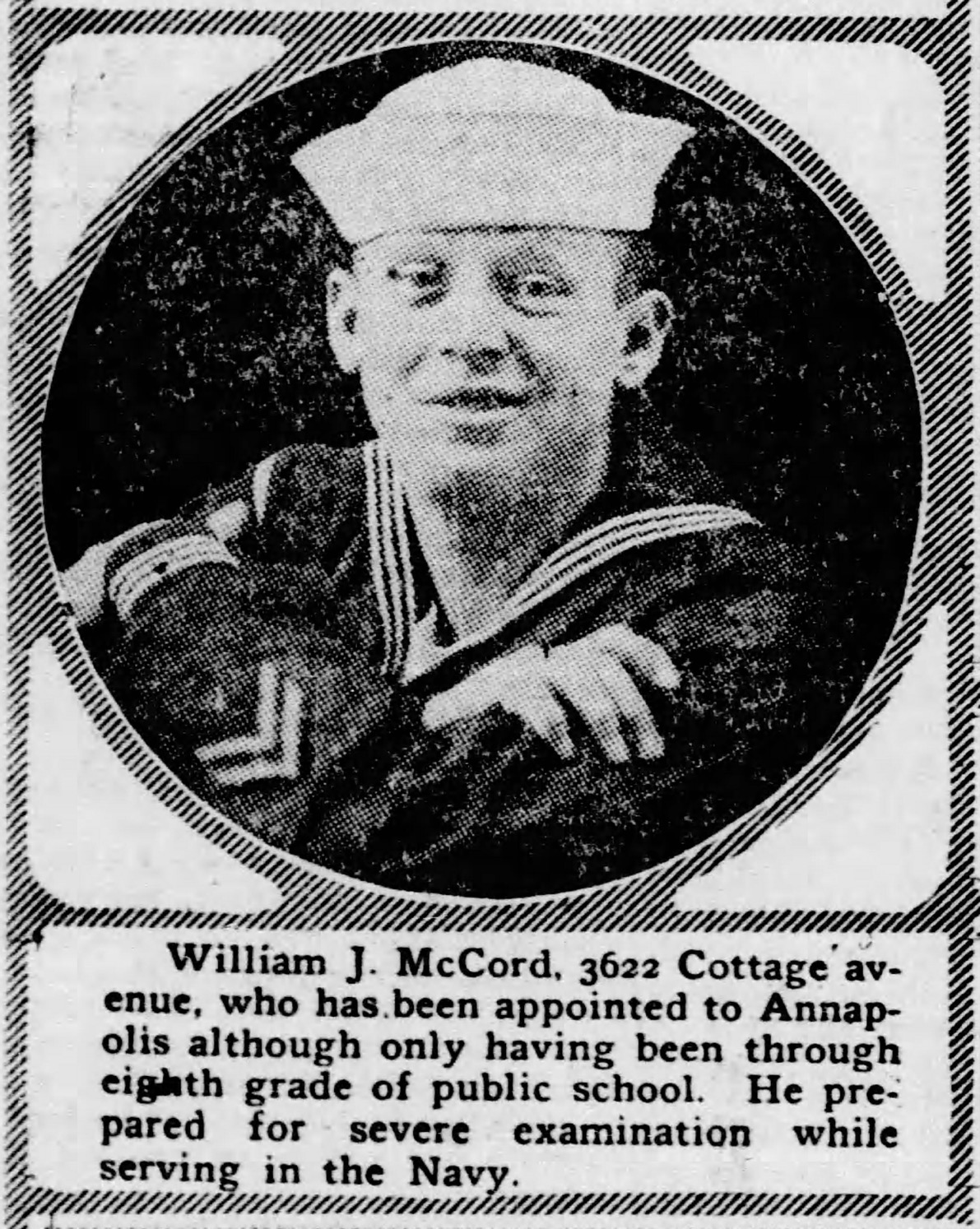
William quit St. Theresa’s School in eight grade to enlist in the Navy on May 5, 1917,
According to the St. Louis Post-Dispatch of June 14, 1923, William was on USS Castine (PG 6) in 1917 and 1918. She was fitted out to aid the British plant mines in the North Sea. His commander, Capt. Randolph Ridgely Jr., wrote St. Louis Congressman William L. Igoe recommending William for the Naval Academy. He had his aide, an Annapolis graduate, coach the boy. William was discharged from the Navy on April 28, 1919, and then he attended Congressman Hall’s Annapolis coaching school at Columbia, Missouri.
William married Elizabeth Dillon. Their daughter was Constance.
William’s father was James, a stationary engineer, mother Annie, and sisters Mary Mamie, Catharine, and Viola. William’s mother was a seamstress in her own home for many years. His father died in June, 1919, in Fairmont, West Virginia. He was working as a stationary engineer at a by-products plant and lived with his daughter Mrs. Ray Griffie in Norwood.
From Find A Grave:
The body of Lieut. William J. McCord, Naval aviator who was killed in an airplane accident Friday at Pensacola, Fla., was brought here Sunday for burial Thursday in Calvary Cemetery. Interment will follow services at 9 a. m. at an undertaking establishment at 3545 Lindell Boulevard and immediately afterwards at the Church of St. Philip Neri, Queens and Thelka Avenues. Lieut. McCord, who was 25 years old, lost his life when his scout plane collided with another plane piloted by Lieut. Edward P. Frawley at an altitude of 5000 feet. Lieut. Frawley also was killed.
A graduate of St. Teresa’s parochial school, Lieut. McCord accomplished the unusual feat of passing the Naval Academy entrance examination in 1919 without having spent a day in high school. He had enlisted in the navy when 16 years old and after he had been detailed to duty with a mine sweeper in the North Sea. He wrote to Congressman Igoe, then representing the Eleventh District, and got an appointment to Annapolis, from which, he was graduated in 1923. His first station was San Diego. CA, where he was engineer officer of the U. S. S. Stoddert. Later he made a cruise in the South Pacific and 11 months ago was transferred to the air service of the Navy at his own request. He got his wings as a Naval Aviator last August. His body was accompanied to St. Louis by his widow and 3-year-old daughter. His mother. Mrs. Anna McCord. lives at 720 Bremen avenue.
Source: St. Louis Post-Dispatch (St. Louis, Missouri), Monday, October 31, 1927, page 4
He is buried in Missouri.
Photographs
Related Articles
Edward Frawley ‘22 was piloting the other aircraft.
Navy Directories & Officer Registers
The "Register of Commissioned and Warrant Officers of the United States Navy and Marine Corps" was published annually from 1815 through at least the 1970s; it provided rank, command or station, and occasionally billet until the beginning of World War II when command/station was no longer included. Scanned copies were reviewed and data entered from the mid-1840s through 1922, when more-frequent Navy Directories were available.
The Navy Directory was a publication that provided information on the command, billet, and rank of every active and retired naval officer. Single editions have been found online from January 1915 and March 1918, and then from three to six editions per year from 1923 through 1940; the final edition is from April 1941.
The entries in both series of documents are sometimes cryptic and confusing. They are often inconsistent, even within an edition, with the name of commands; this is especially true for aviation squadrons in the 1920s and early 1930s.
Alumni listed at the same command may or may not have had significant interactions; they could have shared a stateroom or workspace, stood many hours of watch together, or, especially at the larger commands, they might not have known each other at all. The information provides the opportunity to draw connections that are otherwise invisible, though, and gives a fuller view of the professional experiences of these alumni in Memorial Hall.
July 1923
September 1923
November 1923
January 1924
March 1924
May 1924
July 1924
September 1924
November 1924
January 1925
March 1925
May 1925
July 1925
October 1925
January 1926
October 1926
January 1927
April 1927
October 1927
William is one of 24 members of the Class of 1923 on Virtual Memorial Hall.