LT ANDREW P. STEWART, USN
Lucky Bag Yearbook
From the 1931 Lucky Bag:
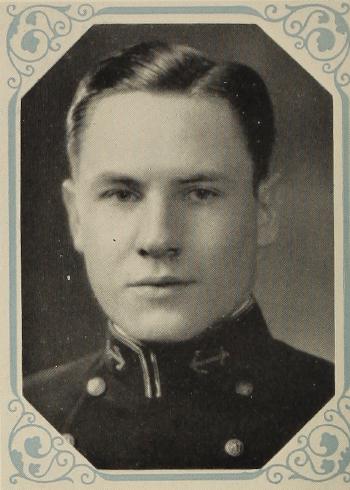
Andrew Patrick Stewart
Track 4, 3, 2, 1; 31 2; N 1; 2 P. O.
Yes, children this is Pat Stewart of Navy. Speaks three languages including Georgian, and is rapidly progressing in Baltimorean. His talents, however, are not restricted to this field alone. List, while we expound on his numerous accomplishments.
October and November find him bemoaning the fact that Sep Leave is over. However, the lure of the track and field soon drive those fond memories back into the remote corners of his head. Winter is the season of hibernation for most of us and especially for Pat. Spring calls him back to the vaulting pit again.
No, he is not a “Red Mike” by any means; but, so far, he has proved to be invulnerable as far as serious affairs are concerned. “I’m dragging in the one hundred and forty-five pound class tonight, but I am coming down to middle weight for the June Ball.”
His frankness is astounding at times. He has been known to utter such untactful things as, “Sir, you are absolutely wrong about that.”
May we be shipmates some day, Pat.
Loss
Andrew was lost when USS Sims (DD 409) was sunk by Japanese dive bombers on May 7, 1942 in the Battle of the Coral Sea.
Other Information
From researcher Kathy Franz:
Andrew was a graduate of Berry Schools.
He was also survived by his mother, Mrs. S. E. Stewart of Miami, and a sister, Mrs. Joe Camp of Smyrna.
His wife was listed as next of kin.
Navy Directories & Officer Registers
The "Register of Commissioned and Warrant Officers of the United States Navy and Marine Corps" was published annually from 1815 through at least the 1970s; it provided rank, command or station, and occasionally billet until the beginning of World War II when command/station was no longer included. Scanned copies were reviewed and data entered from the mid-1840s through 1922, when more-frequent Navy Directories were available.
The Navy Directory was a publication that provided information on the command, billet, and rank of every active and retired naval officer. Single editions have been found online from January 1915 and March 1918, and then from three to six editions per year from 1923 through 1940; the final edition is from April 1941.
The entries in both series of documents are sometimes cryptic and confusing. They are often inconsistent, even within an edition, with the name of commands; this is especially true for aviation squadrons in the 1920s and early 1930s.
Alumni listed at the same command may or may not have had significant interactions; they could have shared a stateroom or workspace, stood many hours of watch together, or, especially at the larger commands, they might not have known each other at all. The information provides the opportunity to draw connections that are otherwise invisible, though, and gives a fuller view of the professional experiences of these alumni in Memorial Hall.
July 1931
October 1931
January 1932
April 1932
October 1932
January 1933
April 1933
July 1933
October 1933
April 1934
July 1934
October 1934
January 1935
April 1935
October 1935
January 1936
April 1936
July 1936
January 1937
April 1937
September 1937
January 1938
July 1938
January 1939
October 1939
June 1940
April 1941
Andrew is one of 50 members of the Class of 1931 on Virtual Memorial Hall.