ENS CLEON H. FELTON, USN
Lucky Bag Yearbook
From the 1931 Lucky Bag:
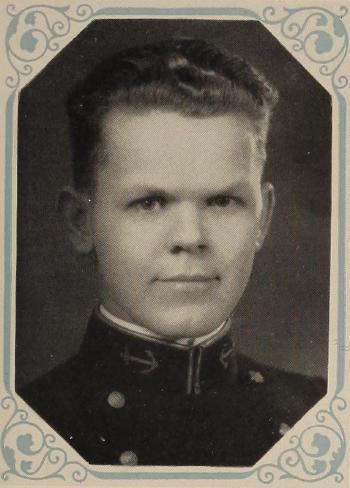
Cleon Henry Felton
Plebe Soccer Squad 4 Class Soccer 3 Wrestling Squad 4, 2, 1 Class Wrestling 3 Class Football 1 Radio Club 2, 1 Secretary-Treasurer 2 President 1 1 P. O.
Here stands a man—his mind is a careless dash of vigor and a restraining dash of sense.
A medley of yet’s, till’s and ten cylinder words with at least two syllables missing can be heard issuing from any room of which he is an habitue. Each season has found Cleon in some sport, soccer, wrestling, or lacrosse. He carried over from Plebe Year the art of changing a man’s ear into a cauliflower. A secret ambition that he has cherished since his first bout is to practice this knowledge on a certain “Piccolo Pete,” who had an annoying habit of tuning in on high Z" whenever Cleon was about to turn in.
Hick is possessed with an unbelievable and insatiable love for Juice and Radio, with which he has spent many recreation hours.
He has an exceptional ability to collect anything in sight—especially his wife’s apparel. More than once has he been mistaken for someone else because of the name on the scivvies that he happened to be sporting at the time.
Loss
Cleon was lost on October 31, 1933 when the SU-1 aircraft he was piloting crashed. He was a member of squadron VS-2B on board USS Saratoga (CV-3); the crash was later attributed to a broken propellor.
Other Information
From Find A Grave:
This memorial is engraved:
CLEON H.
1907-1933
Ensign C. H. Felton, USN, was designated Naval Aviator #3983 on 17 April 1933. Graduated U.S. Naval Academy, Class of 1931.Ensign Felton was fatally injured when his SU-1 aircraft crashed near the San Diego Marine Base on 31 October 1933. He was unmarried.
From researcher Kathy Franz:
Cleon attended Woodland schools and graduated from South Bend Central high school. He attended Marion Institute in Alabama. In 1927, Senator Robinson appointed him to the Naval Academy.
From The South Bend Tribune, Indiana, November 13, 1933: Over 2,000 people attended Cleon’s funeral. Two of the pallbearers were from Central Senior High school’s debate team. As the casket was lowered into its grave, taps were blown by buglers from Mishawaka post No. 161, American legion, and from a nearby hill, other buglers stationed there in advance, sounded a far, sad echo. Three planes dipped in salute overhead, and flowers were dropped.
His father Henry C. was a farmer.
Navy Directories & Officer Registers
The "Register of Commissioned and Warrant Officers of the United States Navy and Marine Corps" was published annually from 1815 through at least the 1970s; it provided rank, command or station, and occasionally billet until the beginning of World War II when command/station was no longer included. Scanned copies were reviewed and data entered from the mid-1840s through 1922, when more-frequent Navy Directories were available.
The Navy Directory was a publication that provided information on the command, billet, and rank of every active and retired naval officer. Single editions have been found online from January 1915 and March 1918, and then from three to six editions per year from 1923 through 1940; the final edition is from April 1941.
The entries in both series of documents are sometimes cryptic and confusing. They are often inconsistent, even within an edition, with the name of commands; this is especially true for aviation squadrons in the 1920s and early 1930s.
Alumni listed at the same command may or may not have had significant interactions; they could have shared a stateroom or workspace, stood many hours of watch together, or, especially at the larger commands, they might not have known each other at all. The information provides the opportunity to draw connections that are otherwise invisible, though, and gives a fuller view of the professional experiences of these alumni in Memorial Hall.
July 1931
October 1931
January 1932
April 1932
October 1932
January 1933
April 1933
July 1933
October 1933
Cleon is one of 50 members of the Class of 1931 on Virtual Memorial Hall.