LT JAMES J. MCROBERTS, USN
Lucky Bag Yearbook
From the 1927 Lucky Bag:
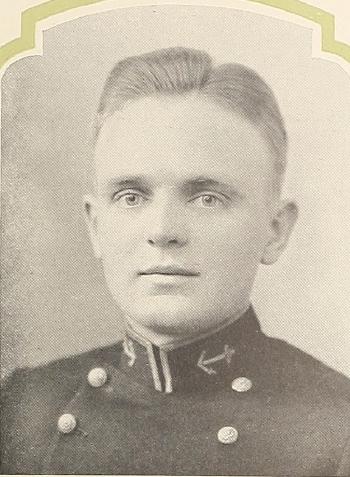
James Johnston McRoberts
Soccer: A Squad (3, 2, 1) Block N (1) Navy Numerals (4, 3, 2); Reception Committee: (2, 1); Gymkhana: Cast (4); Handball: Doubles Championship (2, 1).
The cherubic countenance and spontaneous outbursts of this typical Scotchman who had the true Plebe spirit, “You rate everything you can get away with,” made him a popular Plebe. He soon became inured to demerits, extra duty, workouts and Youngsters, but let it be added to his credit that he has never attempted to suppress the above-mentioned spirit in those following him. Jimmy says what he thinks and is ready to back up his statements.
He is engaged in a constant struggle with the Academics, always coming out topside by acquiring the necessary velvet through a remarkable capacity for ferreting out and absorbing “dope.” Studying, however, is secondary to athletics and social activities, and Mac is seen at every hop, with or without a drag, the which he chooses with a careful eye and treats with the proper indifference that makes them come back again. Add to this his rosy cheeks, baby blue eyes and hair that will not stay down, and his popularity with girls is obvious.
In regard to athletics, soccer is his forte; wrestling during the winter months, and lacrosse in the spring, keep him busy. The handicap of his small stature is overbalanced by hard fighting and good sportsmanship. These same qualities will see him through when he shoulders greater responsibilities after entering the Fleet.
Loss
James was lost on December 23, 1941 when his aircraft crashed off the coast of Cape Henry, Virginia. He was the commanding officer of Fighting Squadron (VF) 41.
Other Information
From researcher Kathy Franz:
In January, 1934, James took part in a squadron flight from Norfolk to Miami. He sent a telegram to his mother expressing his gratification at the success of the nonstop flight to Honolulu that his brother made.
In January, 1937, James and the CCC camp superintendent led 150 workers from Camp Wheeler, Edwardsville, Missouri, to flood duty at Cairo, Illinois.
James’ wife was the former Margaret Carroll of Norfolk. In April, 1940, they lived on the Pearl Harbor Naval Air Station. Their daughters in 1941 were Peggy, age 8, and Carroll, age 3.
His widow married Jerry Curtis South, a Navy captain, in Norfolk in March, 1951.
James’ father was also James, a grocer, who was born In Scotland and died in 1915.
He was also survived by his mother Mrs. Ida McRoberts of St. Louis; three sisters, Mrs. Kenneth McMath of Rye, N. Y.; Mrs. Robert Rowlson of St. Louis, and Mrs. Scott Mitchell, Stamford, Conn.; and a brother, Lieutenant Henry J. McRoberts (’29) of Alexandria.
He has a memorial in New York.
Career
He was commanding officer of USS Thrush (AM 18) from July 1939 to June 1941. He earned his wings as naval aviator #3594 on January 4, 1930 as an Ensign.
Navy Directories & Officer Registers
The "Register of Commissioned and Warrant Officers of the United States Navy and Marine Corps" was published annually from 1815 through at least the 1970s; it provided rank, command or station, and occasionally billet until the beginning of World War II when command/station was no longer included. Scanned copies were reviewed and data entered from the mid-1840s through 1922, when more-frequent Navy Directories were available.
The Navy Directory was a publication that provided information on the command, billet, and rank of every active and retired naval officer. Single editions have been found online from January 1915 and March 1918, and then from three to six editions per year from 1923 through 1940; the final edition is from April 1941.
The entries in both series of documents are sometimes cryptic and confusing. They are often inconsistent, even within an edition, with the name of commands; this is especially true for aviation squadrons in the 1920s and early 1930s.
Alumni listed at the same command may or may not have had significant interactions; they could have shared a stateroom or workspace, stood many hours of watch together, or, especially at the larger commands, they might not have known each other at all. The information provides the opportunity to draw connections that are otherwise invisible, though, and gives a fuller view of the professional experiences of these alumni in Memorial Hall.
January 1928
April 1928
July 1929
October 1929
January 1930
April 1930
October 1930
January 1931
April 1931
July 1931
October 1931
January 1932
April 1932
October 1932
January 1933
April 1933
July 1933
October 1933
April 1934
July 1934
October 1934
January 1935
April 1935
October 1935
January 1936
April 1936
July 1936
January 1937
April 1937
July 1938
January 1939
October 1939
June 1940
November 1940
April 1941
James is one of 41 members of the Class of 1927 on Virtual Memorial Hall.