LT EDWARD H. WORTHINGTON, USN
Lucky Bag Yearbook
From the 1934 Lucky Bag:
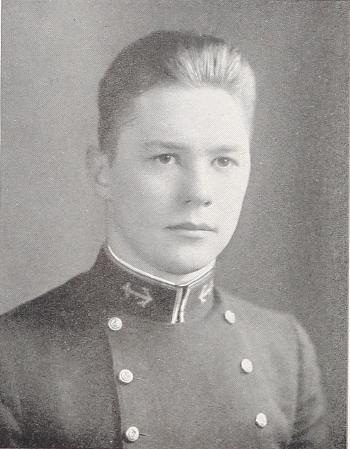
EDWARD HICKS WORTHINGTON
2 P.O.
HAVING come to us from Baltimore the Naval Academy held no terrors for him. At least not until he was firmly planted inside the grey walls. Since then he has been struggling with that ancient foe, the Academic Dept. A terrible foe to have on the opposing side but it seldom had him down to the place where he could be persuaded to give up a good magazine for a dry Juice book, or one of Math.
Ned would probably have had an envious athletic record by now if he had not met with a regrettable accident while boxing his Plebe Year and which has since kept him from participating in sports more strenuous than bridge. Bridge is, by the way, his favorite pastime.
He has endeavored to make us believe that those of the fair sex are farthest from his mind but, in spite of this aversion, one can always find him at every hop with one of the finest on his arm.
All in all, Ned is one of Uncle Sam’s finest and one could want no better as a friend and comrade. Four years with such a man only lead us to wish that we had known him always and to realize that wherever our various paths may lead in the future, he will be with us always.
Loss
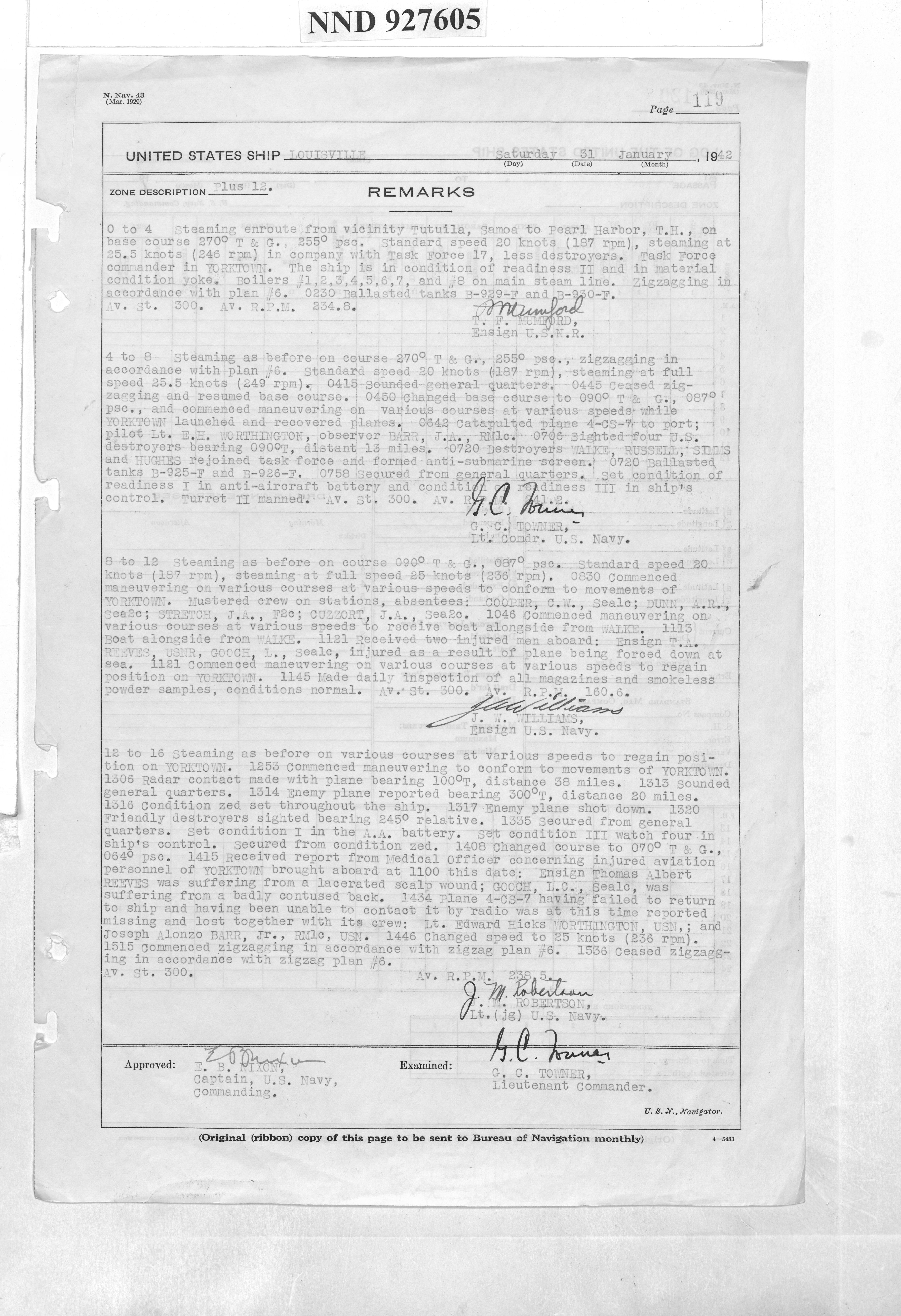
Edward was lost when his scout plane went missing February 1, 1942. He had been catapulted, along with an enlisted spotter, from USS Louisville (CA 28) on antisubmarine patrol around the strike group centered on USS Yorktown (CV 5). There was a Japanese patrol bomber operating in the vicinity that may have shot Edward’s plane down. Louisville’s deck log (from 31 January) reports the loss of his aircraft.
Other Information
His father, H. Linn Worthington, was listed as next of kin. He was also survived by his siblings, Mrs. A.J. Ford, Mrs. B.G. Kilmer, and a younger brother, Henry M. Worthington.
Raid on the Marshall Islands
On February 1, 1942, Task Force 17, led by VADM William Halsey, Jr. (USNA '04) struck Jaluit, Mili, and Makin (Butaritari) islands. The Task Force was centered on USS Yorktown (CV 5), with USS Louisville (CA 28) among her escorts.
George Bellinger '32, Francis Maher, Jr. '35, and Jack Moore '36 were all flying from Yorktown and were all lost that day. George Bellinger's plane simply "failed to return;" he had last been seen in the vicinity of Jaluit as the leader of a bombing section. Jack Moore's plane also "failed to return;" no other information was given in the after-action report. Francis Maher may have been the pilot of the plane observed in the water approximately 20 miles astern of the carrier, presumably having crashed due to a lack of fuel. The crew were seen getting into rubber rafts, and "a destroyer was immediately sent back but failed to make contact."
A fourth graduate, Edward Worthington '34, was lost when his float plane, launched from Louisville, went missing and was possibly shot down by a Japanese patrol bomber.
Separately, Task Force 8 was raiding other islands in the group. Hallsted Hopping '24, commanding officer of Scouting Squadron (VS) 6, was flying from USS Enterprise (CV 6). His aircraft was shot down by a Japanese fighter and he and his gunner were both killed.
Career
Edward began his career aboard USS Lexington (CV 2); he is listed in the 1935 Navy Directory as a member of that ship’s wardroom. In the 1936 Navy Directory he is aboard USS Fox (DD 234); in the 1937 Navy Directory he is aboard USS Wyoming (BB 32).
On May 13, 1938 he became naval aviator #5622 as a LTjg; later that year he was listed in the 1938 Navy Directory as a member of Fighting Squadron (VF) 5 aboard USS Yorktown (CV 5). In the 1939 Navy Directory he is still aboard Yorktown but has moved to Scouting Squadron (VS) 5.
In the 1940 Navy Directory he is listed with Cruiser Scouting Squadron (VCS) 5 aboard USS Louisville (CA 28).
In 1941 he was promoted to LT; the Navy Directory for that year lists him as still aboard Louisville but that the squadron designation has changed to Cruiser Scouting Squadron (VCS) 4.
Navy Directories & Officer Registers
The "Register of Commissioned and Warrant Officers of the United States Navy and Marine Corps" was published annually from 1815 through at least the 1970s; it provided rank, command or station, and occasionally billet until the beginning of World War II when command/station was no longer included. Scanned copies were reviewed and data entered from the mid-1840s through 1922, when more-frequent Navy Directories were available.
The Navy Directory was a publication that provided information on the command, billet, and rank of every active and retired naval officer. Single editions have been found online from January 1915 and March 1918, and then from three to six editions per year from 1923 through 1940; the final edition is from April 1941.
The entries in both series of documents are sometimes cryptic and confusing. They are often inconsistent, even within an edition, with the name of commands; this is especially true for aviation squadrons in the 1920s and early 1930s.
Alumni listed at the same command may or may not have had significant interactions; they could have shared a stateroom or workspace, stood many hours of watch together, or, especially at the larger commands, they might not have known each other at all. The information provides the opportunity to draw connections that are otherwise invisible, though, and gives a fuller view of the professional experiences of these alumni in Memorial Hall.
July 1934
October 1934
January 1935
April 1935
October 1935
January 1936
April 1936
January 1937
April 1937
September 1937
January 1938
July 1938
January 1939
October 1939
June 1940
November 1940
April 1941
Edward is one of 40 members of the Class of 1934 on Virtual Memorial Hall.