LT EDWIN F. CONWAY, USN
Lucky Bag Yearbook
From the 1920 Lucky Bag:
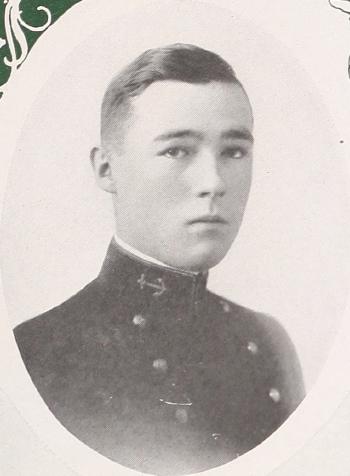
Edwin Francis Conway
Honors: Buzzard.
“OIRISH” is a noisy, happy-go-lucky man, famous for his heavy line and vivid imagination. If the facts don’t suit, that same imagination supplies him with some humorous fabrication which turns the tables on the individual who is chesty enough to match wits with him. He’s always on hand for a roughhouse and usually on top of the pile.
Even in his candidate days “Mickie” showed signs of the greatness that has put the Academic Department to defeat consistently since first Plebe section days. As to fussing, he lays claim to the perforated radiator for being the most famous Red Mike, but his chances went glooming when we hepped up to his correspondence and knitted socks and helmet. His tales of Sep leave are always varied and interesting—even to the one in which he claims to have started a riot by wearing a suit of whites down his Podunk’s main drag.
“Irish’s” one great hobby is base ball. He has a star team all his own that can outplay and out-argue all comers.
The Executive Department passed up one more good man when they assigned a plucked crow to the “Totem Pole’s” lot, but gold braid around the cuff don’t make the man, and “Ed” proves it.
But when all’s said and done, Conway’s academic achievements sum themselves up in the phrase: “He’s the kind of a friend the Irish know how to be.”
Loss
From Find A Grave:
Lt. Edwin Francis Conway died of “fractures, multiple, extreme” sustained in airplane crash at Lido Beach, Hempstead, New York. 17 January 1933.
Other Information
From researcher Kathy Franz:
Edwin’s plane went into a spin, and he dived at full speed from an altitude of only 400 feet trying to right the plane. A split second before the crash, he shut off the ignition switch, thereby averting a fire. His mechanic survived the crash.
Edwin was born to Rose Mary (Sheeham) and Joseph Francis Conway, a lumberman and superintendent of a mill. His father drowned in the sinking of the Dix in the Seattle harbor in November, 1906. In 1910, Edwin’s stepfather was Leroy W. Stetson, also a lumberman.
Edwin graduated from Queen Anne high school. He was appointed to the Naval Academy by Senator Miles Poindexter.
In 1921, Edwin applied for a stipend from the World War I Veteran’s Adjusted Compensation Fund. However, his application was rejected because he enlisted before the war began.
At San Francisco’s St. Mary’s Cathedral on June 24, 1922, Edwin married Frances Ruth Shebley. Their son Shebley Stetson Conway was born on October 14, 1923, in San Francisco. In April, 1926, they sailed from Cristobal Canal Zone to New York City. In June, 1932, she sailed from Los Angeles to New York City. After Edwin’s death, she married Walter Frederick Vogel in Los Angeles on December 21, 1952.
From The Seattle Star, September 4, 1929:
Federal officers in Seattle Wednesday were preparing to file charges of impersonating a naval officer against John Rice, who was arrested in San Francisco Tuesday following a search conducted by department of justice agents and postal inspectors.
According to federal agents, Rice posed as “Lieut.-Commander Edwin F. Conway, U. S. N.” here during Fleet week. While wearing the uniform he was said to have paid off a small loan to a local bank with a check for $200 stolen from a post office box at Beaverton, Ore. With the difference he opened a checking account in the bank.
From the Time Union, January 22, 1933:
… Perhaps the most complete eulogy at his passing was penned by the personnel of the Navy hangar an “In Memoriam” which appeared in this week’s News Bulletin of the U. S. Navy Reserve Aviation Base.
“Our commanding officer and friend, Lieut. Edwin F. Conway, U. S. Navy, was killed in a crash of the OL-9 on Jan. 17, 1933.
“We of the base have not only lost our commanding officer, but we have also lost our best friend to both officers and enlisted men. While he had only been here six months he endeared himself to the hearts of all, and by his striking and charming personality made more friends in that short period than most men make in a lifetime.
“We, his shipmates, will miss him sorely. His smiling face will never more be seen around the base, and his ready wit and humor will be absent.
“But wherever good aviators and gentlemen go when they depart from this world, we know there will be “Irish” Conway, and lets hope that from his vantage point with the Great Spirit he’ll watch over us and, if he can, help us guide the base to better things. Just to have known him is an inspiration. Carry on.”
From the Times Union, October 30, 1933:
A bronze plaque telling the story of Edwin’s career and sudden death was dedicated outside of Hangar 5 at Bennett field. It says: “1898 to 1933 in memoriam to Edwin Francis Conway, lieutenant, U. S. Navy, commanding the Naval Reserve Aviation Base, Floyd Bennett Field; killed in line of duty crash of amphibian plane Jan. 17, 1933. He loved progress more than he feared death. Erected by his friends and those who were proud to serve under him.”
. . . Mayor O’Brien said: “It is said he loved progress more than he feared death. That may be attributed to the fact that early in his studies he began preparations to be a Jesuit priest.”
. . . Commissioner of Docks John McKenzie said: “’Irish’ Conway was a man possessed of good humor, fearlessness and a fine disposition. He was a man of courage typical of the U. S. Navy.”
[Hangars 5-8 were later converted into an indoor sports facility called Aviator Sports.]
Edwin was became naval aviator #3516 in 1929. He was the commanding officer of the Naval Reserve Aviation Base at Floyd Bennett Field, Brooklyn, New York from June 1932 until his death.
He is buried in Arlington National Cemetery.
Photographs
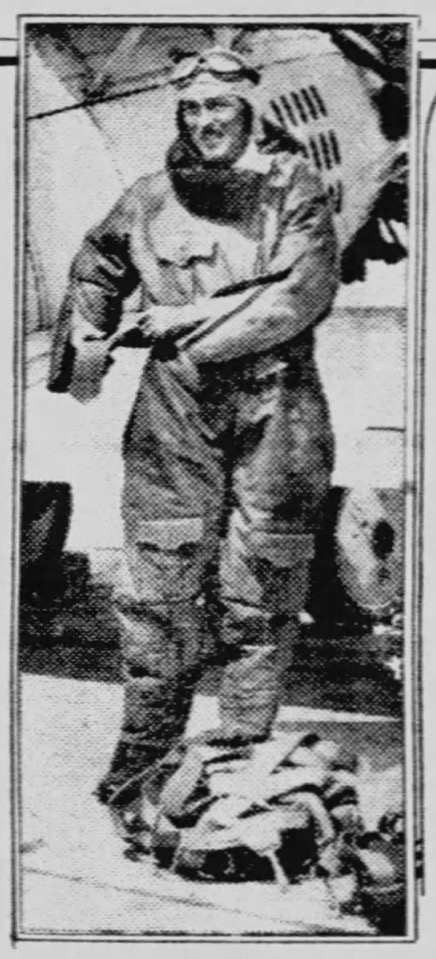
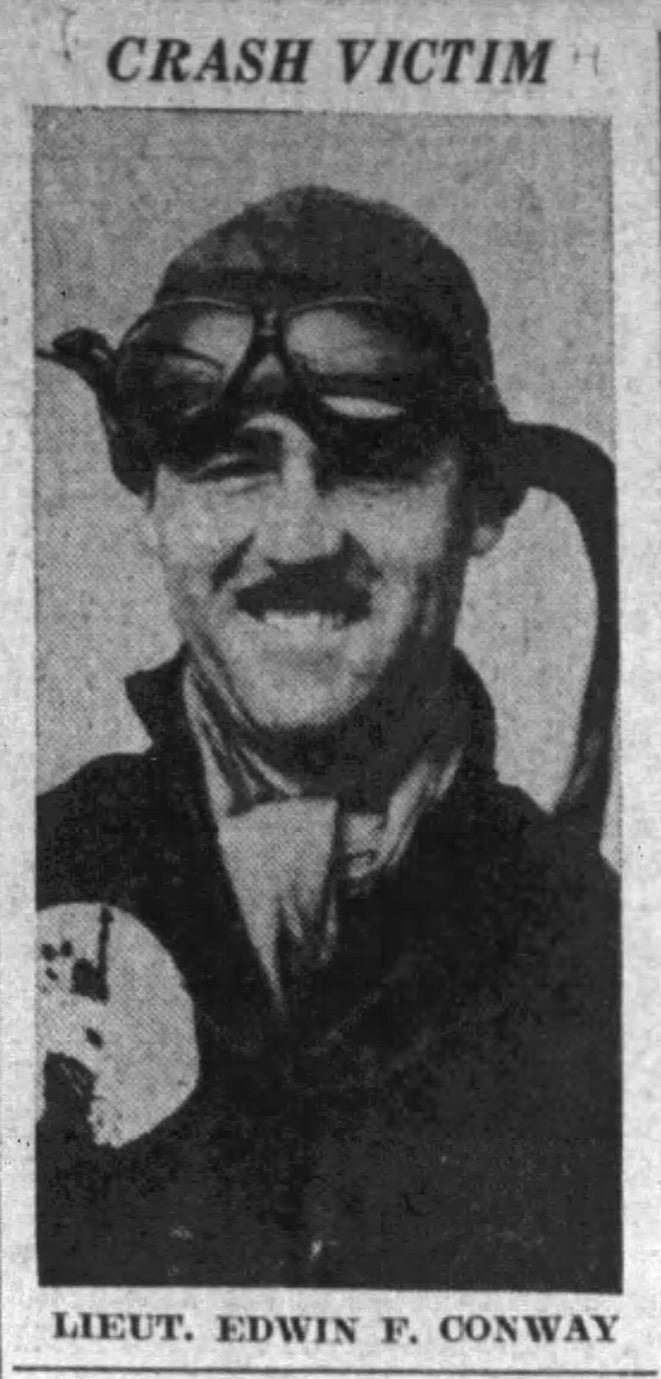
Conway Trophy
From “U.S. Naval and Marine Corps Reserve Aviation”: “The Lieutenant Edwin Francis Conway, U.S. Navy Memorial Trophy was presented by personal friends of LT Conway… to the Naval Reserve Aviation Base given the highest final merit by the Naval Reserve Inspection Board.”
Navy Directories & Officer Registers
The "Register of Commissioned and Warrant Officers of the United States Navy and Marine Corps" was published annually from 1815 through at least the 1970s; it provided rank, command or station, and occasionally billet until the beginning of World War II when command/station was no longer included. Scanned copies were reviewed and data entered from the mid-1840s through 1922, when more-frequent Navy Directories were available.
The Navy Directory was a publication that provided information on the command, billet, and rank of every active and retired naval officer. Single editions have been found online from January 1915 and March 1918, and then from three to six editions per year from 1923 through 1940; the final edition is from April 1941.
The entries in both series of documents are sometimes cryptic and confusing. They are often inconsistent, even within an edition, with the name of commands; this is especially true for aviation squadrons in the 1920s and early 1930s.
Alumni listed at the same command may or may not have had significant interactions; they could have shared a stateroom or workspace, stood many hours of watch together, or, especially at the larger commands, they might not have known each other at all. The information provides the opportunity to draw connections that are otherwise invisible, though, and gives a fuller view of the professional experiences of these alumni in Memorial Hall.
January 1922
May 1923
July 1923
November 1923
January 1924
September 1924
November 1924
January 1925
March 1925
May 1925
July 1925
October 1925
January 1926
October 1927
January 1928
April 1928
July 1928
October 1928
January 1929
April 1929
July 1929
October 1929
January 1930
April 1930
October 1930
January 1931
April 1931
July 1931
October 1931
January 1932
April 1932
October 1932
January 1933
Edwin is one of 26 members of the Class of 1920 on Virtual Memorial Hall.