LTJG THOMAS D. CUMMINS, USN
Lucky Bag Yearbook
From the 1935 Lucky Bag:
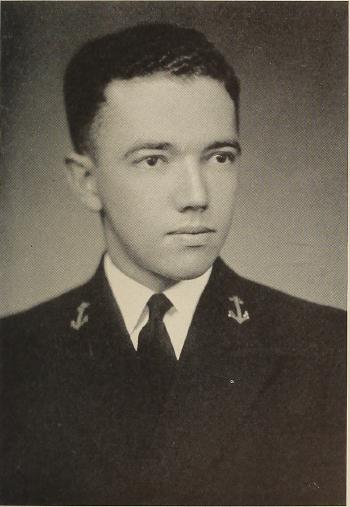
THOMAS DAVIS CUMMINS
Track 4, 3, 2, 1. Soccer 4, 3. Boxing 4. G.P.O.
Loss
Thomas was lost when his plane crashed near Oahu, Hawaii, on November 14, 1940. He was designated a naval aviator (#5964) in 1939. He was attached to the USS Yorktown (CV-5) at the time of his death.
Other Information
Thomas is identified as the pilot of a BT-1 bomber from Bombing Squadron (VB) 5, pictured in the Pacific in July 1940 after having gone over the side of USS Yorktown (CV 5) during flight operations. He apparently was not seriously injured.
From researcher Kathy Franz:
Thomas died two days before his engagement was announced to Helen Clopton Franklin of St. Louis. Catholic funeral services were held on November 19 at the Borthwick Mortuary with Chaplain John R. Boslet of the USS Altair officiating. His body was then sent to the mainland.
Thomas was survived by his parents, Major-General and Mrs. Joseph M. Cummins, two sisters, Mrs. R.J.B. Page and Kathleen Cummins, and his brother, Captain Joseph M. Cummins Jr. He is buried in Arlington National Cemetery.
His oldest brother, Joseph, graduated West Point in 1934. Joseph earned the Silver Star and Bronze Star before he was killed in action in Germany in 1945. Their father was a Major General in the Army; their grandfather was also an infantryman.
Navy Directories & Officer Registers
The "Register of Commissioned and Warrant Officers of the United States Navy and Marine Corps" was published annually from 1815 through at least the 1970s; it provided rank, command or station, and occasionally billet until the beginning of World War II when command/station was no longer included. Scanned copies were reviewed and data entered from the mid-1840s through 1922, when more-frequent Navy Directories were available.
The Navy Directory was a publication that provided information on the command, billet, and rank of every active and retired naval officer. Single editions have been found online from January 1915 and March 1918, and then from three to six editions per year from 1923 through 1940; the final edition is from April 1941.
The entries in both series of documents are sometimes cryptic and confusing. They are often inconsistent, even within an edition, with the name of commands; this is especially true for aviation squadrons in the 1920s and early 1930s.
Alumni listed at the same command may or may not have had significant interactions; they could have shared a stateroom or workspace, stood many hours of watch together, or, especially at the larger commands, they might not have known each other at all. The information provides the opportunity to draw connections that are otherwise invisible, though, and gives a fuller view of the professional experiences of these alumni in Memorial Hall.
October 1935
January 1936
July 1936
January 1937
April 1937
September 1937
January 1938
July 1938
January 1939
October 1939
June 1940
November 1940
Thomas is one of 56 members of the Class of 1935 on Virtual Memorial Hall.