LCDR WILLIAM W. GRAHAM, JR., USN
Lucky Bag Yearbook
From the 1925 Lucky Bag:
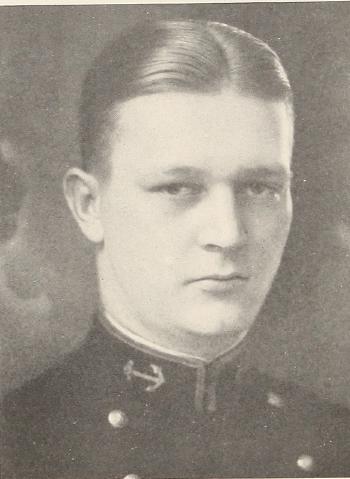
William Walter Graham
Class Baseball (4, 3, 2); Class Numerals (3, 2); Class Football (2, 1); Class Boxing (4); Black N * * *.
FIRST of all we must tell you that “Bill” is a good sport. If you ask me, that is his weakness and his strength, too. “Bill” hasn’t limited himself to the layman’s idea of sports in which he has tried his hand in Football, Boxing, and Baseball, but has branched out into other lines. As organizer and charter member of the Lion Tamers’ Club, he became notorious during Second Class Cruise. This Club was well known for the antipathy of its members for work and for its strict entrance requirements. To become a member it was necessary to perform 36 hours of continuous and progressive caulking.
“Do you know that —-?” and he is off to the sport of the hour whether it be bridge, bull, or baseball. We now take a very unsportsmanlike advantage of the picture above and quote a few lines from his latest book on how to play pinochle:
“Oh, he’s a downy bird.”
“Yeah, sharp as shaving cream!”
Loss
William was lost on August 9, 1942, when USS Jarvis (DD 393) was sunk by Japanese aircraft near Guadalcanal. He was the ship’s commanding officer.
Other Information
From researcher Kathy Franz:
William graduated from Palmyra high school in 1921.
His wife was the former Dorothy Glassford, daughter of Brigadier General Pelham Glassford.
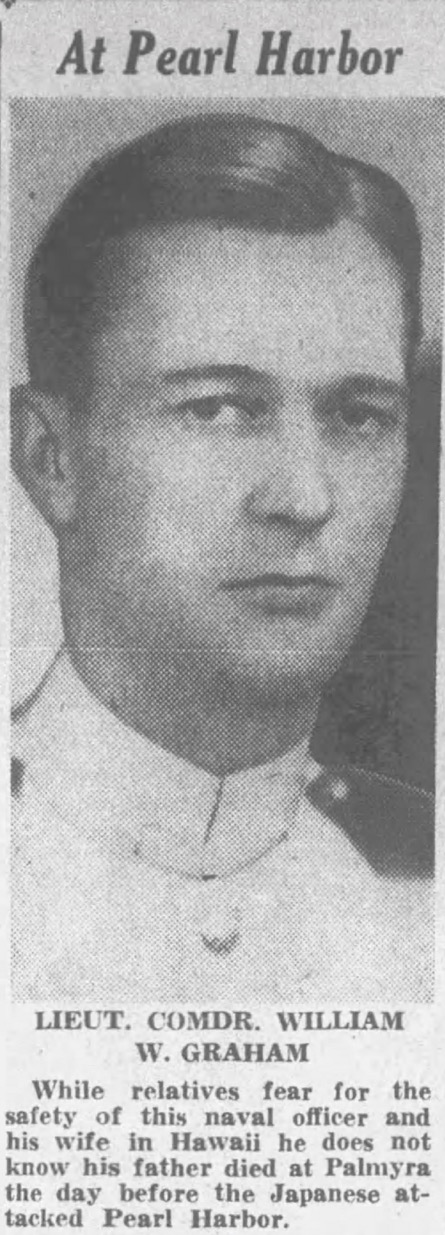
William’s father was a tea and coffee merchant. He died the day before the Pearl Harbor attack. Hs mother was Emily, and his brothers were George and Dr. Richard Graham of Point Pleasant.
His wife was listed as next of kin; he is listed at the Manila American Cemetery and Memorial.
Photographs
Remembrances
From the February 1950 issue of U.S. Naval Institute Proceedings:
To Lieutenant Commander William W. Graham, 39-year-old skipper of the Jarvis, fell the heaviest burden in meeting the crisis [of being torpedoed on August 8, 1942, during an aerial attack during the invasion of Guadalcanal]. Graham was a quiet, competent, and personable officer who kept a huge store of nervous energy visible, but under control until it was needed. He had taken command only two months previously when his predecessor suffered appendicitis. Yet during that time he had won the loyalty and confidence of the veteran crew. When the Jarvis was hit while maneuvering during the air attack, many of the men believed their skipper had unselfishly interposed his ship in the way of the torpedo so as to save the more valuable Vincennes.
A torpedo hit followed by extensive flooding and fierce fire puts a 1500-ton ship in serious peril, and during the few seconds of terror and confusion after the disaster, somebody passed the word, “Abandon Ship.” Accustomed to obedience, many did not question the authenticity of the order and lowered boats, life rafts, and preservers into the water. But the captain, despite his station almost over the explosion, never considered leaving his lady in distress. Aided by subordinates, he led his men in gallant and effective efforts. They put out the fire which raged forward, patched up the engineering plant, and jettisoned torpedoes which threatened to overturn the ship. The destroyer Dewey came alongside and towed the Jarvis to a shallow-water anchorage near the Guadalcanal landing beaches. Nobody took time to retrieve the boats and life rafts. Admiral Turner’s flagship MacCawley loaned the stricken ship thirty men to help make temporary repairs. Graham didn’t need them. Urged on by the captain’s example, Chief Pharmacist’s Mate George W. Head ignored his own painful burns to help other wounded sailors. Fourteen men were missing; seven others wounded; the seven were transferred to the MacCawley.
Navy Directories & Officer Registers
The "Register of Commissioned and Warrant Officers of the United States Navy and Marine Corps" was published annually from 1815 through at least the 1970s; it provided rank, command or station, and occasionally billet until the beginning of World War II when command/station was no longer included. Scanned copies were reviewed and data entered from the mid-1840s through 1922, when more-frequent Navy Directories were available.
The Navy Directory was a publication that provided information on the command, billet, and rank of every active and retired naval officer. Single editions have been found online from January 1915 and March 1918, and then from three to six editions per year from 1923 through 1940; the final edition is from April 1941.
The entries in both series of documents are sometimes cryptic and confusing. They are often inconsistent, even within an edition, with the name of commands; this is especially true for aviation squadrons in the 1920s and early 1930s.
Alumni listed at the same command may or may not have had significant interactions; they could have shared a stateroom or workspace, stood many hours of watch together, or, especially at the larger commands, they might not have known each other at all. The information provides the opportunity to draw connections that are otherwise invisible, though, and gives a fuller view of the professional experiences of these alumni in Memorial Hall.
July 1925
October 1925
October 1926
January 1927
April 1927
October 1927
January 1928
April 1928
July 1928
October 1928
January 1929
April 1929
July 1929
October 1929
January 1930
April 1930
October 1930
January 1931
April 1931
July 1931
October 1931
January 1932
April 1932
October 1932
January 1933
April 1933
July 1933
October 1933
April 1934
July 1934
October 1934
January 1935
April 1935
October 1935
January 1936
April 1936
July 1936
January 1937
April 1937
September 1937
January 1938
July 1938
January 1939
October 1939
June 1940
November 1940
April 1941
William is one of 26 members of the Class of 1925 on Virtual Memorial Hall.