LCDR GEORGE R. STONE, USN
Lucky Bag Yearbook
From the 1931 Lucky Bag:
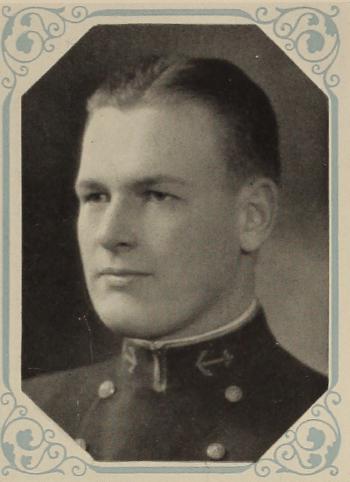
George Roben Stone
Gymkhana 4; Plebe Crew; Radio Club 3, 2, 1; 1 P. O.
In following the example of his grandfather, Chub came to the Academy as one “to the manner born.”
The carefree days spent in preparation at Ferris Institute proved their worth by the ease with which Chubby stayed around the first section. His aptitude for clear and ready reasoning helped to clear the way for more than one struggling friend.
No one ever found this big boy from Grand Rapids anything but good natured. Although seemingly irresponsible those who really know him appreciate the depth of character that lies beneath his carefree air.
Chub’s unfailing loyalty, his full generosity, and true friendship will cause him to be well remembered for many days by those who are proud to know him as a friend. His keen ability and ready adaptability should assure the success in the Service, that is the sincere wish of his many friends at the Naval Academy.
Loss
George was lost on January 21, 1943, when the aircraft he was aboard crashed near Ukiah, California while enroute from Pearl Harbor to San Francisco. The flying boat, a Pan Am Clipper, was being operated by Pan Am employees but was a contracted Navy flight, and all ten passengers were Navy officers.
Other Information
From researcher Kathy Franz:
From the Lansing State Journal, Michigan, January 25, 1943:
The example of Capt. Eddie Rickenbacker’s amazing rescue from the South Pacific after more than three weeks on a life raft today encouraged Mr. and Mrs. George Stone as they await word from the navy department on results of the search for their son, Lieut. Comdr. George R. Stone, Big Rapids.
Stone is among a group of 10 high-ranking naval officers missing on a fight from Pearl Harbor to San Francisco.
One of the navy’s leading aerologists, Stone was stationed at Pearl Harbor in command of navy weather forecasting for the South Pacific area [as of May, 1942.] Before going to Pearl Harbor, he had been stationed at Dutch Harbor, Alaska [where he was the officer in charge of the Alaskan Aerological Expedition.]
Following a tour of sea duty after graduation from Annapolis, Stone studied aerology at the Massachusetts Institute of Technology for two years.
Stone comes from a naval family. His father was a senior lieutenant in the first World war and his grandfather Lieut. Comdr. Douglas Roben, served the navy in the Civil war and he was the first navy man to raise the American flag in Alaska.
Stone’s grandmother, Mrs. Stella Roben, prominent Michigan prohibitionist and Republican party leader, was buried Saturday at Big Rapids, Mich.
The plane had circled San Francisco but was unable to land due to fog and heavy rain. It was headed to Clear Lake when it hit a vertical cliff 150 feet below the ridge of a 2,000 foot mountain. The burned wreckage was found in a deep canyon, ten miles southwest of Ukiah.
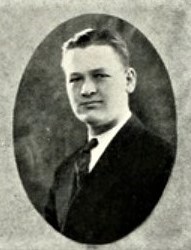
George, who went by Roben — his mother’s maiden name — graduated from Central high school in Grand Rapids in 1926. He played a pirate in the senior play. Class Prophecy: Roben Stone as comedian brings many a scream.
His wife was the former Jean Margaret Richardson of Oak Park, Illinois. Their son Donald was born there on November 19, 1934. Jean and Donald traveled to Honolulu in July, 1936. In January, 1943, Jean knew George would be arriving in San Francisco and made a hectic journey to meet him . . . only to learn of his death.
In 1910, George’s father was George, a foreman in a furniture shop, mother Blanch, and sister Hellen.
George was a meteorologist.
His wife was listed as next of kin. He is buried in Arlington National Cemetery.
Photographs
Related Articles
Robert English ‘11, Donald Godwin ‘11, Robert Smith ‘20, John Crane ‘26, Francis Black ‘26, William Myers ‘26, and John Coll ‘27 were also lost in the crash of Pan Am Flight 1104. Eight of the ten passengers were Naval Academy graduates.
Navy Directories & Officer Registers
The "Register of Commissioned and Warrant Officers of the United States Navy and Marine Corps" was published annually from 1815 through at least the 1970s; it provided rank, command or station, and occasionally billet until the beginning of World War II when command/station was no longer included. Scanned copies were reviewed and data entered from the mid-1840s through 1922, when more-frequent Navy Directories were available.
The Navy Directory was a publication that provided information on the command, billet, and rank of every active and retired naval officer. Single editions have been found online from January 1915 and March 1918, and then from three to six editions per year from 1923 through 1940; the final edition is from April 1941.
The entries in both series of documents are sometimes cryptic and confusing. They are often inconsistent, even within an edition, with the name of commands; this is especially true for aviation squadrons in the 1920s and early 1930s.
Alumni listed at the same command may or may not have had significant interactions; they could have shared a stateroom or workspace, stood many hours of watch together, or, especially at the larger commands, they might not have known each other at all. The information provides the opportunity to draw connections that are otherwise invisible, though, and gives a fuller view of the professional experiences of these alumni in Memorial Hall.
July 1931
October 1931
January 1932
April 1932
October 1932
January 1933
April 1933
July 1933
October 1933
April 1934
July 1934
October 1934
January 1935
April 1935
October 1935
January 1936
July 1936
January 1937
April 1937
September 1937
January 1938
July 1938
January 1939
October 1939
June 1940
November 1940
April 1941
George is one of 50 members of the Class of 1931 on Virtual Memorial Hall.