CDR JAMES E. KYES, USN
Lucky Bag Yearbook
From the 1930 Lucky Bag:
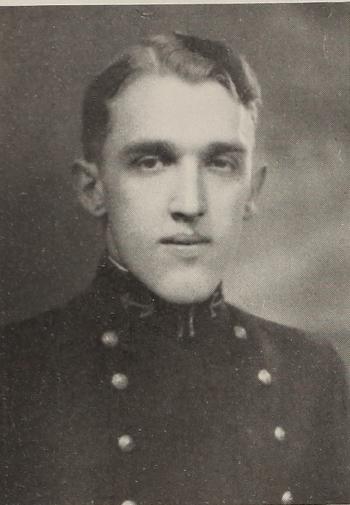
JAMES ELSWORTH KYES
Track 4, 3, 2, 1, Varsity Numerals; Log Staff 4, 3, 2, 1, Associate Editor 1; Lucky Bag Staff 2, 1; Trident Society 2, 1; Class Cross Country 2, Class Numerals; M.P.O.
SINCE the early days of Plebe summer, Jimmy’s activities have been numerous. Lucky Bag and Log interest him because of his love of writing. Track takes up much of his time during the spring and winter months, while in the fall cross country demands his attention. In 1928 he ran on the class championship team in the latter sport. With all these he still finds, of course, the necessary time for boning.
Jimmy, a favorite son of Everett, Washington, came East in the summer of 1926 resolved to become a mariner. Little did he dream that after leaving behind those forest fires he was to run into a Math course which would prove many times hotter. That one subject has been the bane of his existence at the Naval Academy but in spite of it he has stood well up in the class each year.
Among his many virtues there are two which outshine the rest. First is his helpful spirit. He is always willing to aid in a worthy cause, and is as enthusiastic in his execution as in his conception. The second is that energy and thoroughness and precision which are so necessary to success in any field.
Loss
James was lost on December 24, 1943 when USS Leary (DD 158) was torpedoed and sunk in the North Atlantic.
Other Information
From The News Tribune, Tacoma, Washington, August 31, 1943, via Kathy Franz:
Rescue of a young Tacoma army flier “whose name was Johnson,” was described in a letter from the commander of the destroyer, U. S. S. Leary, that picked up the pilot who in a rubber lifeboat on the high seas after bailing out of his disabled plane.
No further identification of the Tacoman was given in the letter, from Lieut. Cmdr. James E. Kyes to his mother, Mrs. James Kyes of Seattle. “The plane circled over the ship three times and then went in a straight line ahead,” said the letter. The destroyer followed and picked up the flier who said his motor had failed, forcing him to make a parachute jump.
There was no indication where or how recently the accident occurred, the location of the destroyer at any specific time being a military secret.
From The World, published December 24, 2010:
The sight arrests the eye as surely as the story moves the heart.
Deep in Washington’s central Cascade Mountains lie the remnants of Monte Cristo, a flash-in-the-pan gold-mining town that flourished in the 1890s.
Only a few foundations, rusted mine machines and tumble-down shacks are left amid the berry brambles, except this:
A perfect cone of an alpine fir inside a freshly painted white picket fence.
Stumble closer through the brush and you notice a plaque in memory of the young man who grew up in ‘Monty," climbed a nearby mountain, and brought home the sapling that grew into the lovely tree.
As the tree did, James E. Kyes grew up straight and tall.
The mines had played out years before, but the town survived as a summer tourist retreat surrounded by snow-cloaked peaks. Jimmy led visitors on mountain hikes from the hotel his father managed.
The lad was smart, with grades high enough for a U.S. Naval Academy appointment. His career led him around the globe and eventually to the U-boat-infested North Atlantic. Now a commander, he stood on the bridge of the destroyer USS Leary – a refitted relic of the First World War – on Christmas Eve 1943.
In a matter of months, he had been told, he would be promoted to captain and be given command of a newly commissioned heavy cruiser.
For now, the Leary, two more destroyers and an escort aircraft carrier made up a hunter/killer task group pursuing German submarines. That night, the hunters became the quarry when they steamed into a wolf pack on the surface.
While the other destroyers escorted the carrier out of torpedo range, the Leary attacked, only to be hit by one … two … three torpedoes. It broke two.
Kyes ordered his crew to abandon ship, then looked around him. A Filipino mess boy’s life jacket had been blown off his body. Kyes doffed his life preserver, handed it to the mess boy and calmly stepped over the side into the frigid Atlantic.
And into immortality.
Eleven days before the war ended, a new Gearing-class destroyer was named the James E. Kyes. His widow christened the ship Aug. 4, 1945. A mountain in the Cascades that Jimmy had been among the first to climb was named Kyes Peak.
Still, in its eerie isolation, inside its white fence, the tree is the most enduring memorial to the young man – Kyes was 37 when he died – who had climbed many nights to the Leary’s bridge and told shipmates about his adventures in Monty.
It was one of those shipmates who wrote to ’the old-timers" at Monte Cristo a brief account of Kyes’ heroism. Signed only ‘A mate," it bears the redactions of a Navy censor. Framed and fastened to the fence, it speaks simply and more eloquently than the bronze plaque placed nearby by the U.S. Naval Academy Alumni Association.
I stumbled onto it in the 1980s on a day trip to Monty. Intrigued, I sought out and talked to men with whom he had roamed the mountains, to his childhood sweetheart, even to a sailor who had served aboard the Leary. I wrote a series of columns about Kyes for the Everett Herald.
Searching for him on the Internet a few days ago, I discovered that the tree, the plaque and the letter all endure in Monte Cristo. They await other visitors who will stop, stare, read and wonder at the selfless actions of James E. Kyes.
And maybe, like I, they’ll cast a thankful thought toward the heavens every Christmas Eve.
From researcher Kathy Franz:
James graduated from Everett high school in 1924. “A growing knowledge of material things.” Entered, 1920; Scientific. Commencement Speaker “Economics of America”; Olympic Club; Service League; Honor Roll; Junior Farce; Assistant Business Manager Nesika yearbook. Prophecy: Mr. James Kyes and his wife, formerly Lucie Wilson, gave a reception in honor of the First Lady of the Land and her husband. Nickname: Jimmy. Pal: Three Royal Bums. Prominent Feature: My ears. Inspiration: Miss Taylor. Aspiration: To play football like Gordon Ferguson.
James attended the University of Washington for two years.
He and his wife Frances M. had two sons: James born in 1932 and David born in 1935. David served aboard the USS James Kyes, named after his father, and died in May, 2007.
In November, 1936, James’ wife and two sons sailed from Honolulu to San Francisco. In 1940, the family lived in Medford, Massachusetts.
James’ mother was Anna, sister Velma and brothers Leo and Montana. In 1910, his father James was a fireman for the railroad in Snohomish. John Johnson, a saloonkeeper, was a boarder at their house. In 1920, his father James was a gold miner in Everett. James’ grandfather Uriah Cook, a carpenter, lived with them from at least 1910.
His wife was listed as next of kin. He has a memory marker in Arlington National Cemetery and is listed at the Cambridge American Cemetery and Memorial.
James is listed on the Class of 1930 panel as if he was lost in December 1944; as he was listed as missing, this was the standard official date of death (year + 1 day).
Photographs
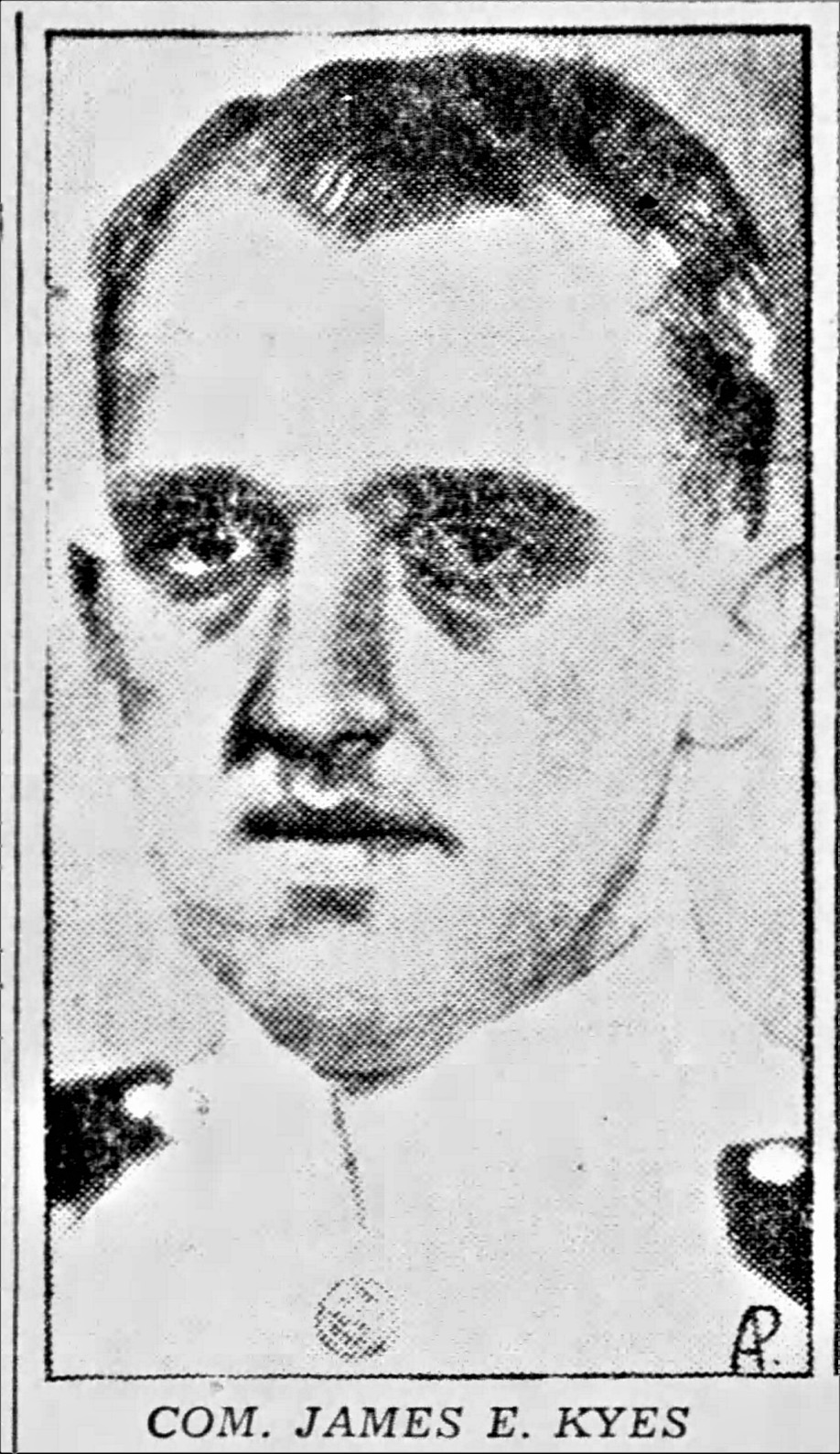
Navy Cross
From Hall of Valor:
The President of the United States of America takes pride in presenting the Navy Cross (Posthumously) to Commander James Elsworth Kyes, United States Navy, for extraordinary heroism and distinguished service in the line of his profession as Commanding Officer of the Destroyer U.S.S. LEARY (DD-158), during action against a concentrated force of hostile submarines in the North Atlantic on the night of 23 December 1943. As Commander Kyes boldly maneuvered to close the range on four of the hostile pack, the enemy struck, mortally damaging the Leary with three torpedo hits and causing her to start sinking rapidly. After giving the order to abandon ship, Commander Kyes coolly and courageously made a personal inspection in order to assure himself that none of his men remained aboard. Preparing to abandon the stricken vessel and observing one of his crew whose lifejacket was torn and useless, Commander Kyes gallantly removed his own, gave it to the man and then calmly went over the side. Commander Kyes’ inspiring leadership and the valiant devotion to duty of his command contributed in large measure to the outstanding success of these vital missions and reflect great credit upon the United States Naval Service.
General Orders: Bureau of Naval Personnel Information Bulletin No. 325 (April 1944)
Service: Navy
Rank: Commander
Namesake
USS James E. Kyes (DD 787) was named for James; the ship was sponsored by his widow.
Kyes Peak
Kyes Peak, in the Cascade Range in Washington, is named for James. He was one of two people who first climbed it, in 1920. He was 14 at the time of the ascent and a member of the Everett Boy Scouts.
Navy Directories & Officer Registers
The "Register of Commissioned and Warrant Officers of the United States Navy and Marine Corps" was published annually from 1815 through at least the 1970s; it provided rank, command or station, and occasionally billet until the beginning of World War II when command/station was no longer included. Scanned copies were reviewed and data entered from the mid-1840s through 1922, when more-frequent Navy Directories were available.
The Navy Directory was a publication that provided information on the command, billet, and rank of every active and retired naval officer. Single editions have been found online from January 1915 and March 1918, and then from three to six editions per year from 1923 through 1940; the final edition is from April 1941.
The entries in both series of documents are sometimes cryptic and confusing. They are often inconsistent, even within an edition, with the name of commands; this is especially true for aviation squadrons in the 1920s and early 1930s.
Alumni listed at the same command may or may not have had significant interactions; they could have shared a stateroom or workspace, stood many hours of watch together, or, especially at the larger commands, they might not have known each other at all. The information provides the opportunity to draw connections that are otherwise invisible, though, and gives a fuller view of the professional experiences of these alumni in Memorial Hall.
October 1930
January 1931
April 1931
July 1931
October 1931
January 1932
April 1932
October 1932
January 1933
April 1933
July 1933
October 1933
July 1934
October 1934
January 1935
April 1935
October 1935
January 1936
April 1936
July 1936
January 1937
April 1937
September 1937
January 1938
July 1938
January 1939
October 1939
June 1940
November 1940
April 1941
James is one of 40 members of the Class of 1930 on Virtual Memorial Hall.