CDR GEORGE M. BROOKE, USN
Lucky Bag Yearbook
From the 1921 Lucky Bag:
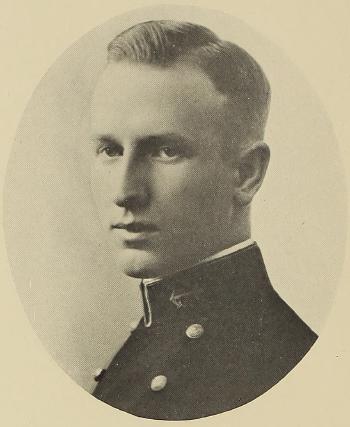
George Magruder Brooke
Buzzard (2, 1).
OLLIE entered this fair institution of learning with the first day’s installment. Under the tender care of ‘18 he soon learned most of a Plebe’s functions—of course, in those days hazing was of such a mild form that Mothers didn’t fear for the lives of their darling sons and Upper Classmen weren’t rated on a par with the Kaiser.
Youngster year Smiling Shinton and some more of the clean-cut boys started in helping Scupper out by way of Maryland Avenue, but Scupper came back with a 4.0 on the exam and since he has been rated as a back corridor math shark. Since ‘21’s best have resumed the old course Ollie has had easy sailing and velvet to burn.
Brooke’s three main worries in life are: his hair, sleep and love. In regard to his hair, two more years of Herpicide and he will have nothing more to worry about; when it comes to sleep, Ollie can caulk twenty hours and then go to sleep on his feet; and speaking of love, that far-away look in his eyes tells that his thoughts are always dwelling on her and a prospective California bungalow.
Scupper is conscientious and dependable in all his work. He is rather quiet and reserved but as the old sage so well said, “It is the full bottle that rattleth not.”
Loss
George was lost on February 28, 1945, while in a Japanese POW camp.
Other Information
From researcher Kathy Franz:
George graduated from Lewis and Clark high school in 1916. He marched with the high school in the patriotic parade held on May 25, 1917.
He attended the preparatory school at Annapolis. His friend Joe Drumheller held a theater party and supper in honor of George who would leave shortly for the Naval Academy.
George married Lucile Richards of San Diego on May 16, 1929, in Chicago. For the next six months, they lived in New York where he was studying at Columbia. He then returned to San Diego where he was in the submarine division. Their sons were Robert, born in 1931, and George, born in 1934.
George was promoted to Commander with 280 other naval officers in October, 1941.
The gunboat Luzon was reported damaged by the Japanese fire on Corregidor and was sunk by the Americans to prevent its fall into the hands of the Japanese. George’s brother Philip was notified in May 1942 that George was missing.
In June, 1945, his sister Bonnie received word that he was in the Sukuaka camp on Kyushu Island. In September, his brother Philip received word that George was liberated by occupying American troops from a Japanese prison camp at Fukui on Honshu Island. However, it was reported in October that George had died in February, and Lt. Robert Brandston of Seattle was with him when he died.
George’ father died unexpectedly in December 1921, of apoplexy. He and H. W. Fairweather founded a bank which later became the First National bank of Sprague. When it burned down, it opened in Spokane under the name Fidelity National bank. He belonged to the sons of the American Revolution. George’s mother was Julia, his brother was Philip, a lawyer, and his sisters were Rebecca, Mary, and Julia Eitinge. Another brother Robert died of influenza in 1918.
He had survived three Hell Ships:
In December 1944, he was boarded onto the Oryoku Maru for transport to Japan. The ship was sunk by American planes at Subic Bay, Philippine Islands, on December 15, 1944. The surviving POWs were boarded onto the Enoura Maru which reached Takao, Formosa. While docked it was bombed by American planes on January 9, 1945, killing many of the POWs. The surviving POWs were boarded onto the Brazil Maru and reached Japan on January 29, 1945.
His wife, Lucile, was listed as next of kin. He is buried in Missouri.
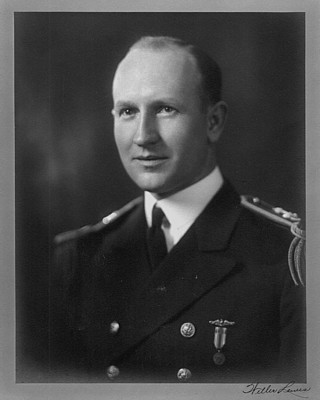
Photographs
Career
George’s command, USS Luzon (PR 7), made a treacherous voyage from China to the Philippines in late November 1941 with Rear Admiral Glassgow, commander of the Yangtze River Patrol, aboard. George had taken command sometime in 1940.
Navy Cross
From Hall of Valor:
The President of the United States of America takes pride in presenting the Navy Cross (Posthumously) to Commander George Magruder Brooke (NSN: 0-34000), United States Navy, for extraordinary heroism and distinguished service in the line of his profession as Commanding Officer of the River Gunboat U.S.S. LUZON (PR-7), during the periods 7 to 22 December 1941, and from 30 December 1941 to 28 April 1942, in the Philippine Islands. While exposed to frequent horizontal and dive bombing attacks by enemy Japanese air forces, Commander Brooke directed the anti-aircraft batteries of his ship and conducted operations of strategic important involving hazardous missions such as to bring great credit to his command and the United States Naval Service. He gallantly gave his life for his country.
General Orders: Commandant, 16th Naval District, Dispatch 281200-NCR-7859 (April 29, 1942)
Service: Navy
Navy Directories & Officer Registers
The "Register of Commissioned and Warrant Officers of the United States Navy and Marine Corps" was published annually from 1815 through at least the 1970s; it provided rank, command or station, and occasionally billet until the beginning of World War II when command/station was no longer included. Scanned copies were reviewed and data entered from the mid-1840s through 1922, when more-frequent Navy Directories were available.
The Navy Directory was a publication that provided information on the command, billet, and rank of every active and retired naval officer. Single editions have been found online from January 1915 and March 1918, and then from three to six editions per year from 1923 through 1940; the final edition is from April 1941.
The entries in both series of documents are sometimes cryptic and confusing. They are often inconsistent, even within an edition, with the name of commands; this is especially true for aviation squadrons in the 1920s and early 1930s.
Alumni listed at the same command may or may not have had significant interactions; they could have shared a stateroom or workspace, stood many hours of watch together, or, especially at the larger commands, they might not have known each other at all. The information provides the opportunity to draw connections that are otherwise invisible, though, and gives a fuller view of the professional experiences of these alumni in Memorial Hall.
January 1922
May 1923
July 1923
September 1923
November 1923
January 1924
March 1924
May 1924
July 1924
September 1924
November 1924
January 1925
March 1925
May 1925
July 1925
October 1925
January 1926
October 1926
January 1927
April 1927
October 1927
January 1928
April 1928
July 1928
October 1928
January 1929
April 1929
July 1929
October 1929
January 1930
April 1930
October 1930
January 1931
April 1931
July 1931
October 1931
January 1932
April 1932
October 1932
January 1933
April 1933
July 1933
October 1933
April 1934
July 1934
October 1934
January 1935
April 1935
October 1935
January 1936
April 1936
July 1936
January 1937
April 1937
September 1937
January 1938
July 1938
January 1939
October 1939
June 1940
November 1940
April 1941
George is one of 28 members of the Class of 1921 on Virtual Memorial Hall.