LT ARTHUR H. VORPAHL, USN
Lucky Bag Yearbook
From the 1932 Lucky Bag:
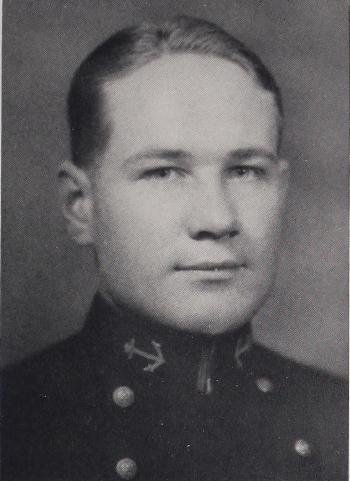
ARTHUR HENRY VORPAHL
M.P.O.
A true son of Wyoming, Pop came to us from the land of the high wooded mountains and crystal streams. His first year at the Academy was spent amidst varying degrees of fortune and misfortune until the latter finally won, by a mean trick of fate. It was with great sorrow that ‘31 was forced to give him up and with open arms that ‘32 received him.
An athlete of no mean ability—if it so pleases him to be such. Swimming first claimed his attention, but his interest soon turned to Lacrosse, in which his success would have been unlimited, but for a knee injury sustained early in Youngster year. Pop has been like a father to us for four years, and more than once his fatherly advice has turned us from the path of wrong-doing to that of righteousness.
With his foot on a table and a skag in his lips, with a fluent line of conversation that never tires, and a listener who will allow himself to be browbeaten by remaining passive, we have a perfect picture of Pop that we will never forget.
Loss
Arthur was lost when USS Pillsbury (DD 227) was sunk by a Japanese navy surface force in a night action on March 2, 1942, 200 miles east of Christmas Island in the Indian Ocean.
Other Information
From researcher Kathy Franz:
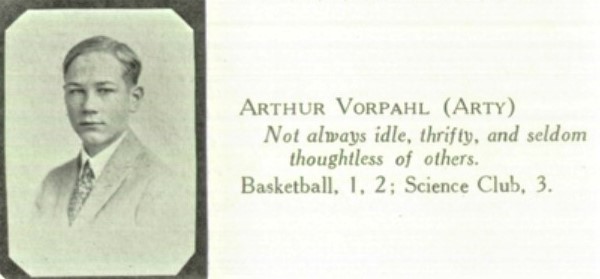
Anthony graduated from Laramie high school in 1925. His sister Emma was also a senior that year. Class Prophecy (year 1965): Arthur took Mr. Conrey’s place, although he knew nothing about Chemistry. His sister Emma was a bathing beauty with the Mack Sennett Comedies.
Arthur and wife Anna visited A. E. Vorpahl in Scottsbluff and would sail for China about July 1, 1941. In 1940, Arthur and Anna lived in Annapolis with their daughter Linda, age 1.
His father was Gustav, mother Ada, sister Adelaide, and brother John.
His wife was listed as next of kin. He has a memory marker in Arlington National Cemetery.
Photographs
Navy Directories & Officer Registers
The "Register of Commissioned and Warrant Officers of the United States Navy and Marine Corps" was published annually from 1815 through at least the 1970s; it provided rank, command or station, and occasionally billet until the beginning of World War II when command/station was no longer included. Scanned copies were reviewed and data entered from the mid-1840s through 1922, when more-frequent Navy Directories were available.
The Navy Directory was a publication that provided information on the command, billet, and rank of every active and retired naval officer. Single editions have been found online from January 1915 and March 1918, and then from three to six editions per year from 1923 through 1940; the final edition is from April 1941.
The entries in both series of documents are sometimes cryptic and confusing. They are often inconsistent, even within an edition, with the name of commands; this is especially true for aviation squadrons in the 1920s and early 1930s.
Alumni listed at the same command may or may not have had significant interactions; they could have shared a stateroom or workspace, stood many hours of watch together, or, especially at the larger commands, they might not have known each other at all. The information provides the opportunity to draw connections that are otherwise invisible, though, and gives a fuller view of the professional experiences of these alumni in Memorial Hall.
October 1932
January 1933
April 1933
July 1933
October 1933
April 1934
July 1934
October 1934
January 1935
April 1935
October 1935
July 1936
January 1937
April 1937
September 1937
January 1938
July 1938
January 1939
October 1939
June 1940
November 1940
April 1941
Arthur is one of 52 members of the Class of 1932 on Virtual Memorial Hall.