LT RUSSELL R. ROSS, USN
Lucky Bag Yearbook
From the 1930 Lucky Bag:
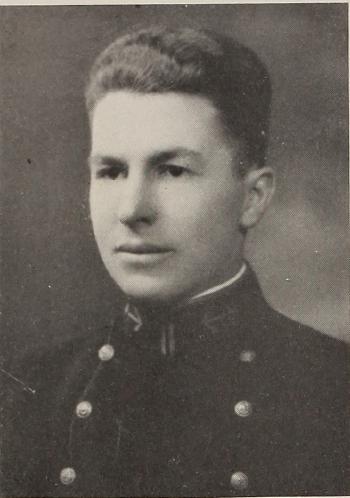
RUSSELL ROOSEVELT ROSS
Class Baseball 4, 3, 2, 1; Class Football 3, 2; Two Stripes.
We don’t know whether or not his seagoing life gave him his “head for riggers,” but we do know that one of our most formidable departments gave him little to worry about with its two and a half years of attack. Observantly, but not apologetically, quiet, still he is apt to get “riled” upon provocation but you’ll seldom find he is in the wrong.
Rosy’s not the sort of chap that will tell you how good he is; but whether he is helping his classmates in the solution of a difficult Math prob, or the winning of the Harvard shield, you’ll learn that there is no one more thoroughly capable of producing results than he.
He takes a real live interest in his profession and if it’s information you’re looking for, he is sure to have it. We won’t predict his future as a “howling success”; he’s too quiet to be associated with any howling, but he will do well in anything he does.
Loss
Russell was captured following the sinking of USS Houston (CA 30) at the Battle of Sunda Strait on March 1, 1942. He was an assistant to the gunnery officer.
He died of dysentery on May 5, 1942 at a Japanese prisoner of war camp near Batavia (now Jakarta).
Other Information
From “Ship of Ghosts: The Story of the USS Houston”:
The worst case [of sickness in the prison camp] belong to the senior surviving line officer [present in this camp] from the Houston, Lt. Russell R. Ross. They called him “Rosie.” He had contracted a case of bacillary dysentery that defied the best work of the men at Bicycle Camp’s hospital. [Lieutenant] Hamlin repeatedly asked the camp commander, a lieutenant named Suzuki, to allow him to go to Batavia to buy medicine, where there was known to be an ample supply. The Japanese refused. According to Hamlin, “Finally a British colonel interceded and told the Japs it would be plain murder if they did not permit the purchase of medicine for Lt. Ross and an Australian soldier who was also critically ill.” The medicine was delivered, but it arrived too late. Ross died on May 5 [1942], the Australian a day or two later.
According to John Wisecup, Ross could not seem to summon the will to live in captivity. “He gave up a long time ago,” Wisecup said. “This guy was an overaged lieutenant. He was in his thirties and was a very moody type of guy.” Senior officers, who usually had the best access to information and were well suited to evaluate it, could be the most despondent prisoners in the camp. …
From researcher Kathy Franz:
Russell was born in Gualala, California.
On August 4, 1937, he sailed on the President Jackson from Shanghai, China, to Seattle, Washington.
His father Johnston was the “popular woods boss” as reported by a Gualala News article published in the Ukiah Dispatch Democrat, November 29, 1901. In Gualala, Zemri Heywood and Samuel Harmon owned the lumber mills. Note: Russell’s brother William had Heywood as his middle name.
Johnston was the logging camp foreman at Hydesville in 1910. He died in 1916 while working for the Little River Redwood Company in Bulwinkle. His funeral was held at the family home at 1303 Harris Street, Eureka. His mother was Catherine/Kathryn (Tock/Turk). His brothers were William Heywood (1905-1990), Henry (1906-1991) Tock, and Benjamin Marshall, an accountant (1912-1995.) Henry was in the Navy and served in WWII and Korea.
Russell is buried in Hawaii.
Prisoner of War
From Hall of Valor:
Lieutenant Russell Roosevelt Ross (NSN: 0-63232), United States Navy, was captured by the Japanese after the sinking of his ship the U.S.S. HOUSTON (CA-30), on 28 February 1942, and was interned as a Prisoner of War until his death while in captivity.
General Orders: NARA Database: Records of World War II Prisoners of War, created, 1942 - 1947
Service: Navy
Rank: Lieutenant
Navy Directories & Officer Registers
The "Register of Commissioned and Warrant Officers of the United States Navy and Marine Corps" was published annually from 1815 through at least the 1970s; it provided rank, command or station, and occasionally billet until the beginning of World War II when command/station was no longer included. Scanned copies were reviewed and data entered from the mid-1840s through 1922, when more-frequent Navy Directories were available.
The Navy Directory was a publication that provided information on the command, billet, and rank of every active and retired naval officer. Single editions have been found online from January 1915 and March 1918, and then from three to six editions per year from 1923 through 1940; the final edition is from April 1941.
The entries in both series of documents are sometimes cryptic and confusing. They are often inconsistent, even within an edition, with the name of commands; this is especially true for aviation squadrons in the 1920s and early 1930s.
Alumni listed at the same command may or may not have had significant interactions; they could have shared a stateroom or workspace, stood many hours of watch together, or, especially at the larger commands, they might not have known each other at all. The information provides the opportunity to draw connections that are otherwise invisible, though, and gives a fuller view of the professional experiences of these alumni in Memorial Hall.
October 1930
January 1931
April 1931
July 1931
October 1931
January 1932
April 1932
October 1932
January 1933
April 1933
July 1933
October 1933
April 1934
July 1934
October 1934
January 1935
April 1935
October 1935
January 1936
April 1936
July 1936
January 1937
April 1937
September 1937
January 1938
July 1938
January 1939
October 1939
November 1940
April 1941
Russell is one of 40 members of the Class of 1930 on Virtual Memorial Hall.