CDR WILLIAM M. HAYNSWORTH, JR., USN
Lucky Bag Yearbook
From the 1923 Lucky Bag:
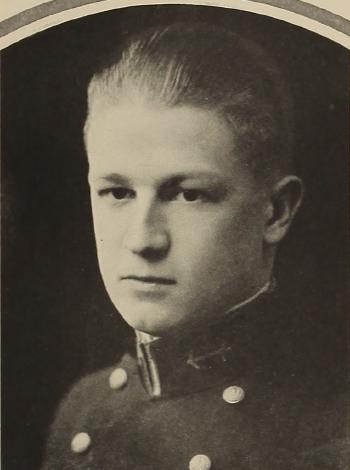
William McCall Haynsworth, Jr.
Class Track (2); Class Swimming (1).
“M’SIEU Ainsworth,” and poor Max would begin his regular skirmish with the Dago Department amid much anguish and gnashing of teeth. Truly, Dago was the bane of Willyums existence. The rest of the Academics were fruit, however, and Bill enjoyed the peaceful immunity of the “3.0’s and better” for the remainder of his midshipman days.
To know him is to like him—and the girls—they merely saw and were conquered. It is strange to believe that Max was a Red Mike for over two years; but once he began to step out it was useless to offer competition.
One night Bill dreamed that his hair was falling out. Ye gods. How the Herpicide and Glover’s invaded the camp. He just wouldn’t be convinced that it was all there.
We wish you the best of luck. Max. By the way; green paint and full dress is a queer combination.
“Say, Max, got any chow?”
Loss
William was lost on August 22, 1942 when USS Ingraham (DD 444) sank following a collision in a dense fog off the coast of Nova Scotia.
He had been commanding officer of the ship since her commissioning on July 19, 1941.
Other Information
From Wikipedia:
Born in Darlington, South Carolina, Haynsworth appointed Midshipman from the Sixth Congressional District of South Carolina 19 June 1919. After graduation from the Naval Academy he reported for duty on board destroyer USS Mahan (DD-364), 16 June 1924, and was detached in April 1928 for postgraduate instruction in mechanical engineering at the Naval Academy, followed by postgraduate work at various colleges and industrial plants. He was assigned to cruiser USS Houston (CA-30), 10 November 1930 and detached in February 1934 to serve at the Naval Research Laboratory, Bellevue, District of Columbia until June 1936 when he was ordered to Houston as Assistant Fire Control Officer.
In April 1939 he reported to Charleston Navy Yard in connection with fitting out of USS Ingraham (DD-444). He assumed command of Ingraham 19 July 1941 and with the outbreak of World War II commenced escort duty for convoys sailing from New York and Halifax to the British Isles.
Ingraham, while investigating the collision of destroyer USS Buck (DD-420) with a merchant vessel, was rammed by fleet oiler USS Chemung (AO-30) in dense fog off Nova Scotia, 22 August 1942. The force of the collision exploded Ingraham, killing Commander Haynsworth and all but ten men and one officer.
From researcher Kathy Franz:
William graduated with honors from St. John’s high school in 1918. In football, he played guard and end. Senior Vote: “The cutest in the class? Why William Haynsworth, of course. What are brown eyes and a beaming smile for?”
He was appointed to the Naval Academy by Congressman J. Willard Ragsdale. William first attended the Annapolis Fitting school 1918-1919.
William married Mrs. Ruth Winfield Larned, a magazine editor, on December 23, 1938, at Commander W. W. Thompson’s home in Los Angeles.
In July, 1941, William’s ship, the Ingraham, was launched. She was on constant convoy duty in the North Atlantic. In November, William issued special commendations to J. H. Darby, a plumber, and other workmen at the Charleston Navy yards for work on the destroyer Ingraham.
A special tribute was paid to Williams’ memory at Darlington’s Trinity Methodist church on October 18, 1942. The service also honored others from the church in the armed forces.
William’s parents were William and Amarintha, and in 1910, his brothers were Harllee, Monie, Julius and James. His stepmother was Marie K. Haynsworth of Darlington.
William’s brother Monie, a draftsman, died in September 1973, at the V. A. Hospital in Oteen, North Carolina. His brother James became a salesman for an engineering company, married and lived in Baton Rouge, Louisiana.
His wife was listed as next of kin; he was also survived by a son, William III.
He has a memory marker in South Carolina.
Photographs
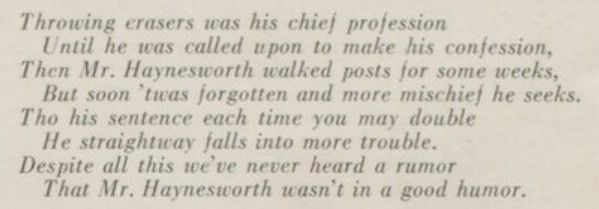
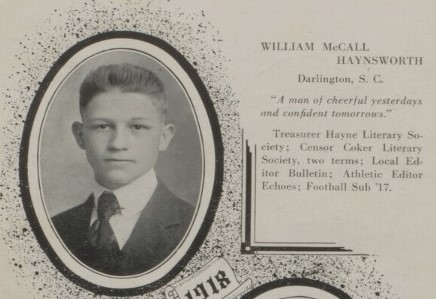
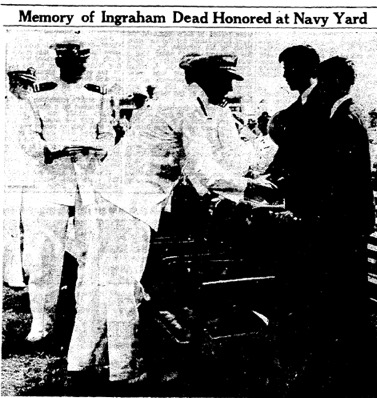
Namesake
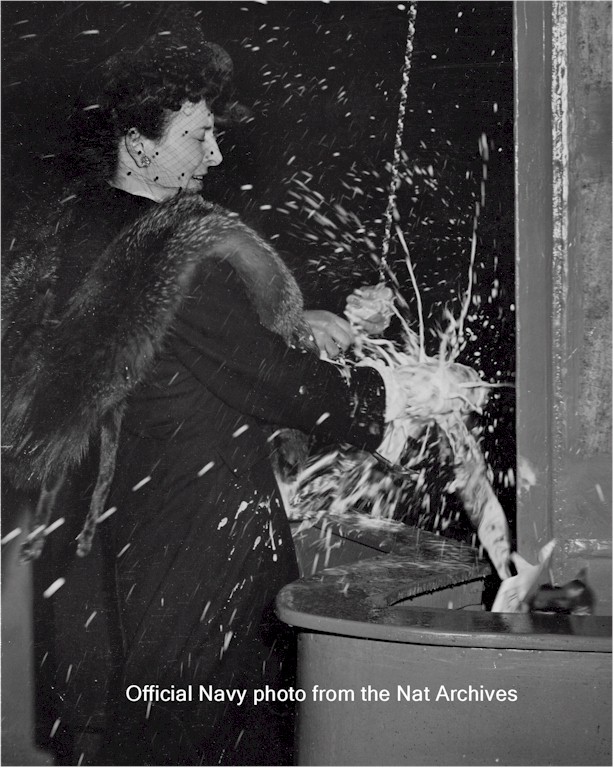
USS Haynsworth (DD 700) was named for William; the ship was sponsored by his widow.
Navy Directories & Officer Registers
The "Register of Commissioned and Warrant Officers of the United States Navy and Marine Corps" was published annually from 1815 through at least the 1970s; it provided rank, command or station, and occasionally billet until the beginning of World War II when command/station was no longer included. Scanned copies were reviewed and data entered from the mid-1840s through 1922, when more-frequent Navy Directories were available.
The Navy Directory was a publication that provided information on the command, billet, and rank of every active and retired naval officer. Single editions have been found online from January 1915 and March 1918, and then from three to six editions per year from 1923 through 1940; the final edition is from April 1941.
The entries in both series of documents are sometimes cryptic and confusing. They are often inconsistent, even within an edition, with the name of commands; this is especially true for aviation squadrons in the 1920s and early 1930s.
Alumni listed at the same command may or may not have had significant interactions; they could have shared a stateroom or workspace, stood many hours of watch together, or, especially at the larger commands, they might not have known each other at all. The information provides the opportunity to draw connections that are otherwise invisible, though, and gives a fuller view of the professional experiences of these alumni in Memorial Hall.
January 1924
March 1924
May 1924
July 1924
September 1924
November 1924
January 1925
March 1925
May 1925
July 1925
October 1925
January 1926
October 1926
January 1927
April 1927
October 1927
January 1928
April 1928
July 1928
October 1928
January 1929
April 1929
July 1929
October 1929
January 1930
April 1930
October 1930
January 1931
April 1931
July 1931
October 1931
January 1932
April 1932
January 1933
April 1933
October 1933
April 1934
July 1934
October 1934
January 1935
April 1935
October 1935
January 1936
April 1936
July 1936
January 1937
April 1937
September 1937
January 1938
January 1939
October 1939
June 1940
November 1940
April 1941
William is one of 24 members of the Class of 1923 on Virtual Memorial Hall.