LCDR JOHN E. BURKE, USN
Lucky Bag Yearbook
From the 1928 Lucky Bag:
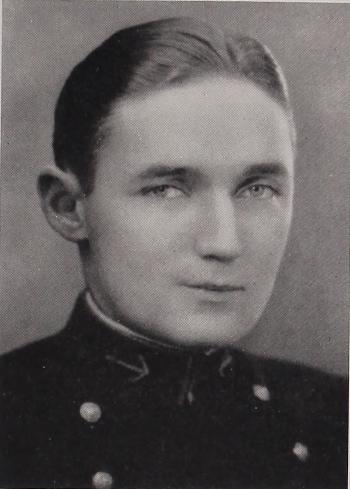
JOHN EDWARD BURKE
Football (4); Basketball (4), Navy Numerals (4); Class Basketball (3), Class Numerals (3).
ALL the essential qualities of real manhood are embodied in “Soc.” Combined with an irresistible spirit of good cheer, is a soul of deep understanding and a heart as big as a barrel. The hand of Destiny writes success for “Soc,” for no obstacles are too big for him to surmount. A fighting spirit is unconquerable.
His weakness is twofold; namely, women and exaggeration. His famous story dwells on the climatic changes in North Dakota. “Say Smitty, in the year 1873, a terrible blizzard struck Bismarck on the Fourth of July, and all the farmers who were in town to celebrate the occasion were buried in forty feet of snow!”
“Soc” is an experienced judge of females, and quite a connoisseur on the subject, but I do believe he would be hurt if he ever made a favorable remark when judging the other’s girl.
Like most of us he has met many obstacles in his Academic path but “that old time fight” has pulled him through so far in Life and will probably continue to do so.
An athlete of no mean ability, he prefers to succumb to the radiator and its warming charms. “Sic” ’em “Soc.”
Loss
John was lost on November 15, 1942 when USS South Dakota (BB 57) was damaged by Japanese surface forces at the Naval Battle of Guadalcanal.
Other Information
From researcher Kathy Franz:
After graduating from the Naval Academy, John took the six-week summer aviation course consisting of observation, groundwork and actual flying.
He married Miriam Katherine Beach on July 5, 1929, in King County, Washington.
John’s father Edward T. was a judge of the district court, mother Florence and brothers Charles and Robert.
From NavSource:
John Edward Burke was born on 24 January 1905 in Bismarck, N.D. He was commissioned ensign upon graduation from the Naval Academy in 1928. Burke saw service afloat before serving as aircraft gunnery observer with the Battle Force Torpedo School. Service in USS Wasp (CV 7) was followed by periods of training duty. On 02 February 1942 Lt. Comdr. Burke reported to USS South Dakota (BB 57) at the New York Shipbuilding Corp. in Camden, N.J., for duty as air defense officer. The battleship was commissioned on 20 March and, following shakedown training, headed for the Pacific. Just after midnight on 15 November 1942, South Dakota engaged a Japanese bombardment group under Admiral Kondo off Guadalcanal. South Dakota took 42 hits which killed 30 crewmen and caused considerable damage. Lt. Comdr. Burke was one of those killed. Lt. Comdr. Burke was posthumously awarded the Purple Heart.
His wife was listed as next of kin.
He is buried at sea and his memorial is in the Manila American Cemetery and Memorial, Philippines.
Namesake
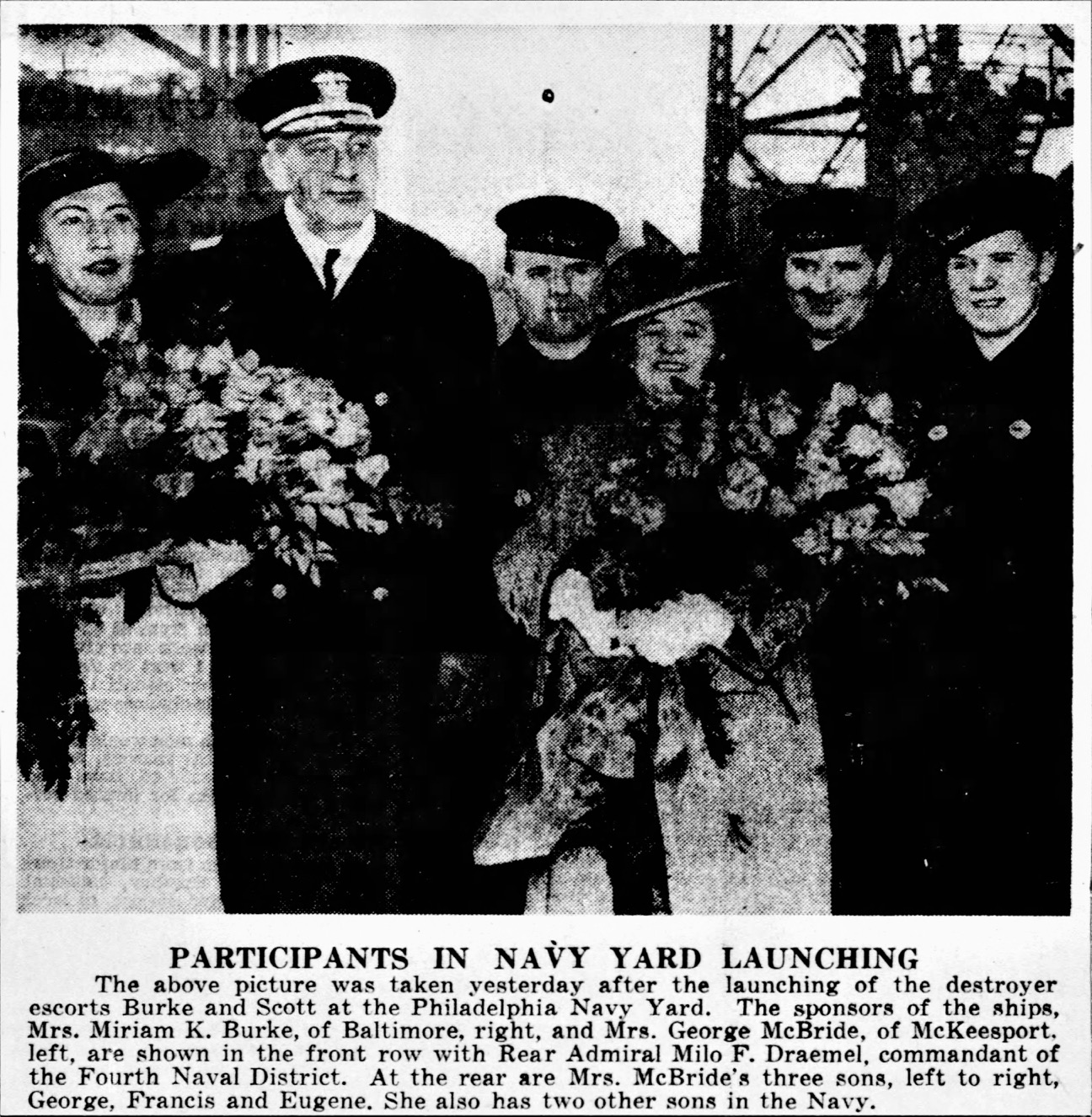
USS Burke (DE 215) was named for John; the ship was sponsored by his widow, Miriam.
Photographs
Related Articles
Milton F. Pavlic ‘32, David M. Currer ‘42, Raymond M. Krepps, Jr. ‘42
Navy Directories & Officer Registers
The "Register of Commissioned and Warrant Officers of the United States Navy and Marine Corps" was published annually from 1815 through at least the 1970s; it provided rank, command or station, and occasionally billet until the beginning of World War II when command/station was no longer included. Scanned copies were reviewed and data entered from the mid-1840s through 1922, when more-frequent Navy Directories were available.
The Navy Directory was a publication that provided information on the command, billet, and rank of every active and retired naval officer. Single editions have been found online from January 1915 and March 1918, and then from three to six editions per year from 1923 through 1940; the final edition is from April 1941.
The entries in both series of documents are sometimes cryptic and confusing. They are often inconsistent, even within an edition, with the name of commands; this is especially true for aviation squadrons in the 1920s and early 1930s.
Alumni listed at the same command may or may not have had significant interactions; they could have shared a stateroom or workspace, stood many hours of watch together, or, especially at the larger commands, they might not have known each other at all. The information provides the opportunity to draw connections that are otherwise invisible, though, and gives a fuller view of the professional experiences of these alumni in Memorial Hall.
July 1928
October 1928
July 1929
October 1930
January 1931
April 1931
July 1931
October 1931
January 1932
April 1932
April 1934
July 1934
October 1934
January 1935
April 1935
October 1935
January 1936
April 1936
July 1936
January 1937
April 1937
September 1937
January 1938
July 1938
June 1940
November 1940
April 1941
John is one of 15 members of the Class of 1928 on Virtual Memorial Hall.